The Strange Objects Found Inside Walls During Ordinary Renovations
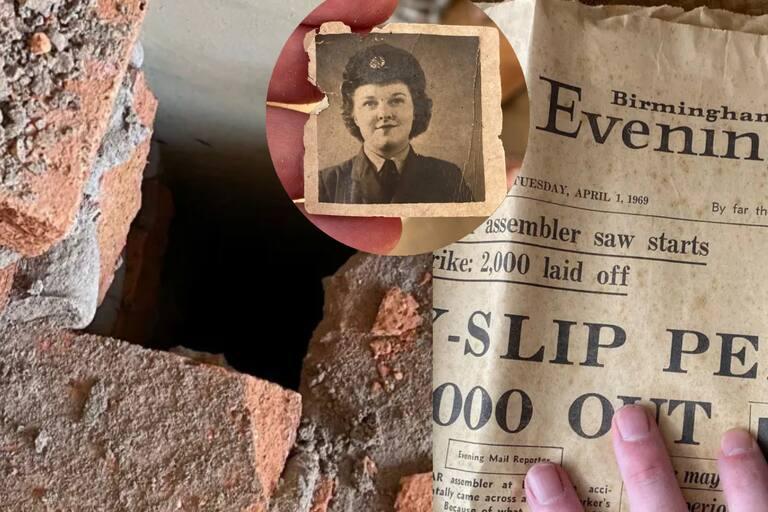
Somewhere behind the plaster, beneath the floorboards, or between two layers of brick, a house may be keeping a secret. And sometimes, all it takes to uncover a piece of history is a hammer, a renovation project, and one very surprised homeowner.
There is something fascinating about old buildings. They appear ordinary from the outside, yet their walls can conceal entire chapters of human history. A room may have been repainted a dozen times, a doorway sealed for generations, and a fireplace replaced by a modern television. Beneath these familiar surfaces, however, objects from another era can remain almost perfectly undisturbed.
Then somebody decides to renovate.
A worker removes a section of plaster and discovers a collection of handwritten letters. Another homeowner pulls up a floorboard and finds an old newspaper. Somewhere else, a contractor opens a chimney and uncovers a shoe that has apparently been hiding there for centuries.
Suddenly, a routine construction project becomes an archaeological investigation.
These discoveries are not always valuable in the financial sense. Many are ordinary household objects, inexpensive personal belongings, or items that their original owners probably never expected anyone to see again. Yet their historical and emotional significance can be extraordinary.
Why would someone hide a shoe inside a wall? What makes a forgotten newspaper interesting? How can a small object buried beneath layers of brick tell us something about the people who built a house hundreds of years ago?
The answers reveal an intriguing side of everyday architecture: buildings are not merely structures that protect us from the weather. They are also accidental archives of the people who lived, worked, and sometimes disappeared into the past.
1. The Mysterious Shoes Hidden Inside Walls
Imagine renovating an old house and discovering a shoe inside a wall.
Not a shoe displayed on a shelf. Not one accidentally dropped behind a cabinet. A shoe deliberately concealed inside the building’s structure, sometimes beneath plaster or inside a chimney breast.
This is a genuine historical phenomenon known as concealed footwear.
For centuries, shoes and other items of clothing were deliberately hidden in buildings throughout Britain and parts of Europe. Discoveries have been documented in chimneys, beneath floorboards, inside roof spaces, and within walls. Some of the objects date back several hundred years.
The most intriguing question is why anyone would do this.
One explanation involves traditional protective beliefs. Some people believed that concealed shoes could protect a household against misfortune or unwanted supernatural visitors. A worn shoe, having been in close contact with its owner, was thought in certain traditions to possess a personal connection that made it useful for protection.
Another theory is that shoes were hidden to discourage pests. A shoe placed in a chimney or wall cavity might have been intended to attract or trap small animals, although this explanation does not account for every discovery.
The exact motivation behind individual examples is often impossible to establish. Not every hidden shoe has a documented explanation, and researchers must distinguish historical evidence from later folklore.
Nevertheless, the discoveries are remarkable.
Many concealed shoes show signs of wear. Their leather is cracked, their soles are thin, and their shapes reveal the pressure of years of walking. They were not necessarily manufactured as decorative objects. They belonged to real people who walked streets, worked long hours, visited neighbours, and returned home at the end of the day.
Then, for reasons that may never be known, somebody placed one inside a building and covered it up.
A modern renovation can bring that decision back into view.
2. The Newspapers That Turn a Wall Into a Time Capsule
Few objects communicate a historical moment as effectively as a newspaper.
A newspaper captures the world as it appeared on a particular day. Its headlines describe the events people were discussing, its advertisements reveal the products they purchased, and its small announcements record weddings, funerals, public meetings, and local business activities.
Now imagine finding one inside a wall that has not been opened for eighty years.
For the homeowner, the discovery may begin with a strange patch of paper protruding from a gap in the plaster. After carefully removing the surrounding material, a worker might uncover several folded pages or a bundle wrapped around another object.
Suddenly, the renovation has produced a snapshot of another generation.
Newspapers are sometimes left behind during construction because workers use them as temporary packing material, insulation, or protective wrapping. Builders may also place dated newspapers beneath floors or inside wall cavities, intentionally or accidentally preserving them for decades.
The publication date can provide a useful clue about when a particular repair or construction phase occurred. If a newspaper from 1948 is found beneath an old floor, for example, it establishes that the paper was placed there no earlier than its publication date. It does not necessarily prove that the entire building was constructed in 1948.
That distinction matters because buildings evolve.
A house that appears to belong to one historical period may contain several different layers of renovation. One generation builds a room, another installs electricity, and a third changes the windows. Materials from these separate periods can become trapped together.
A newspaper can help reconstruct that sequence.
Even the advertisements become fascinating. The prices, telephone numbers, product names, and shop addresses can reveal how daily life differed from the present.
A simple sheet of newsprint may therefore offer more than an interesting headline. It can provide a small but meaningful record of the world that existed when someone last opened that wall.
3. Bottles Hidden Behind Bricks
Glass bottles are among the most visually striking objects found during renovations because they often survive long after their original contents have disappeared.
A bottle discovered inside a chimney, beneath a floor, or behind a sealed section of brickwork may look like ordinary rubbish. However, its shape, colour, markings, and manufacturing features can help researchers estimate its age and original purpose.
Some bottles were associated with medicine. Others held beverages, household products, or materials used in particular trades.
In certain historical building traditions, bottles were also deliberately concealed. Some were placed in walls or chimneys as part of protective customs or folk practices. In other cases, bottles were simply discarded into cavities that later became inaccessible.
The context of a discovery is therefore essential.
A single bottle hidden behind a fireplace might have been left by a builder, a previous occupant, or someone carrying out a repair. A group of bottles arranged in a deliberate pattern could suggest a different explanation.
Sometimes, the bottle itself provides the best clue.
Embossed lettering may identify a manufacturer. A distinctive base or closure may help establish a production period. Old labels, when preserved, can reveal a product name that no longer exists.
Imagine discovering a dark green bottle with a faded paper label in the wall of a nineteenth-century house. The object might initially appear mysterious, but a closer examination could connect it to a local pharmacy or a company that operated generations earlier.
That is the beauty of these discoveries: an ordinary object becomes interesting when its original setting has been lost.
The bottle was once part of someone’s everyday routine. It may have contained something purchased from a nearby shop, delivered by a travelling seller, or used in a household task.
Today, it might be one of the few surviving objects that connects the building to that routine.
4. Letters From People Who Never Expected to Be Read Again
Among all the objects that can emerge from an old wall, handwritten letters have a special ability to transform an ordinary building into a personal mystery.
A letter is more than a record of words. It is evidence that one person wanted to communicate with another at a particular moment in time.
It might contain a greeting, an apology, a family update, a business arrangement, or a simple description of an ordinary day.
When such a document is discovered during renovation, the first challenge is preservation. Paper can become brittle with age, and careless handling may destroy the very details that make it valuable.
The next challenge is interpretation.
A letter might contain a name, a date, or an address that allows researchers to identify its author. Alternatively, it may contain only a few incomplete sentences, leaving its original purpose uncertain.
Some documents become trapped behind plaster because a wall was sealed during a renovation. Others are tucked into cavities by people who intended to retrieve them later but never did. Still others may have been used as packing material or discarded during construction.
Not every hidden letter represents a deliberate message to the future.
That is precisely what makes these discoveries so interesting. The person who wrote the letter may have been thinking about nothing more dramatic than tomorrow’s appointment or the cost of repairing a roof.
Yet, years later, their handwriting survives.
The loops of a signature, the pressure of a pen, and the spelling of familiar words can reveal details about how people communicated before digital messages became commonplace.
A brief note might also provide a clue to the building’s history. Perhaps it refers to a room that no longer exists, a family member who lived there, or a repair that explains an unusual feature in the architecture.
For the person holding the paper, the experience can feel strangely intimate.
A stranger from another century has suddenly become a little less distant.
5. Children’s Toys Lost Between Generations
A tiny wooden animal. A marble. A metal soldier. A doll’s shoe.
Objects associated with childhood frequently acquire a special significance when they are found in old buildings because they connect architectural history to the everyday lives of families.
Children lose things. They drop toys beneath furniture, push small objects into gaps, and sometimes hide their favourite possessions in places adults would never think to inspect.
During later renovations, those objects may emerge from floor cavities, beneath staircases, or behind old skirting boards.
Some discoveries are accidental losses. Others may have been deliberately placed inside walls by children who wanted to create a secret hiding place.
Dating a toy can be difficult without additional evidence. Materials and manufacturing techniques change over time, but older objects can also remain in circulation long after they were first produced.
Still, a toy can offer a useful clue when considered alongside other discoveries.
A small metal vehicle, for example, might help establish that a room was used by a family during a particular period. A wooden toy with distinctive construction features may reveal something about the materials and craftsmanship available at the time.
But the emotional story can be more compelling than the technical one.
Somewhere in the past, a child may have searched frantically for a missing marble. A parent might have helped look beneath a bed, checked behind a cabinet, and eventually concluded that the toy was gone forever.
The family moved on.
Years became decades. Furniture was replaced. The walls were repainted. New occupants arrived, unaware that a tiny piece of the previous household remained hidden nearby.
Eventually, someone removed the floorboards and found it.
The toy may have little monetary value, but it represents a small interruption in the ordinary rhythm of life. It survived while almost everything else about its original owner disappeared.
6. Old Coins That Reveal More Than Their Value
Finding money inside a wall sounds like the beginning of a treasure-hunting story.
Sometimes, it is. But a single coin discovered during renovation is often more useful as a historical clue than as a financial prize.
Coins carry identifying features that can help establish when they were produced. Depending on the coin, these may include a ruler’s portrait, a date, a mint mark, or a distinctive design.
When a coin is found in a building, its date can provide a chronological reference point.
Suppose a coin minted in 1912 is discovered beneath a floorboard. The coin must have entered that location in 1912 or later. If other materials and architectural features support the same period, it may help researchers understand when that section of the building was last modified.
However, coins can circulate for many years, so their manufacturing date does not automatically establish the date of construction.
There are several possible explanations for a coin hidden inside a wall.
Someone may have lost it through a gap in the floor. A builder might have dropped it while working. A homeowner may have deliberately concealed money for safekeeping. In some traditions, coins were placed in buildings during construction as symbolic gestures associated with good fortune or prosperity.
The location and surrounding materials help distinguish between these possibilities.
A group of coins wrapped in fabric suggests a different story from a single coin resting among construction debris. A dated newspaper found nearby might provide additional context.
The discovery becomes even more interesting when the coins can be connected to historical changes in currency, manufacturing, or commerce.
A coin that once purchased a meal or paid for a small household item may now serve as a miniature historical document.
Its original purchasing power is gone, but its ability to tell a story remains.
7. The Photographs Hidden Beneath Floorboards
Photographs have a unique power to collapse the distance between the present and the past.
A faded photograph found behind a wall can reveal a face that nobody in the current household recognises. It might show a family gathered outside the very building being renovated, a group of workers standing beside a vehicle, or a person whose name has been forgotten.
The photograph itself may be easy to overlook. Its paper can be discoloured, its corners damaged, and its surface marked by years of exposure to moisture or dust.
Yet even a small image may contain valuable historical details.
Clothing can help estimate the period in which the photograph was taken. Vehicles, street signs, furniture, and architectural features may offer further clues. If the photograph includes a recognisable location, researchers may be able to compare it with historical records or other images.
Sometimes, writing on the reverse side is more useful than the image.
A date, surname, or short inscription can transform an anonymous photograph into a traceable family record.
The circumstances of its concealment, however, remain open to interpretation.
Perhaps someone placed it in a wall during a hurried renovation. Perhaps it slipped behind a cabinet and became trapped. It might have belonged to a former tenant who moved away without realising it was missing.
There is no universal explanation.
But photographs have a remarkable ability to remind us that buildings once belonged to living communities. People stood in those rooms, celebrated birthdays, raised children, and recorded important moments.
A photograph discovered during renovation is not simply an old image. It is a surviving piece of someone’s personal world.
And occasionally, the building itself appears in the photograph, creating a visual connection between the structure as it exists today and the way it looked generations ago.
8. Strange Documents and Messages Left by Builders
Not every message discovered inside a wall was written by someone trying to hide a secret.
Builders and tradespeople have sometimes left dated notes, signatures, or small records behind during construction and repair work. Such items may have been placed inside cavities, beneath floors, or near structural components.
These discoveries can function as informal construction records.
A note might identify the year a wall was completed, record the names of the people who worked on it, or commemorate an event that took place during the building project.
In some cases, the message is remarkably simple.
A worker might write their name and the date, then leave the paper where it will remain undisturbed until the next major renovation.
Other messages are more personal. A group of workers might record a milestone, leave a short greeting, or describe conditions during the construction process.
These objects are sometimes called time capsules, although the term is most appropriate when the items were deliberately preserved for future discovery.
An accidental collection of papers trapped behind plaster is not necessarily a time capsule, even if it survives for a century.
The distinction is important because intention changes the meaning of an object.
A forgotten document tells us something about what happened. A deliberately prepared time capsule may also tell us what someone hoped future generations would remember.
The most compelling discoveries can include both.
A renovation worker may open a wall expecting to find electrical wiring and instead uncover a dated note from a previous builder. The note might explain an unusual structural feature, identify a repair, or simply establish that another person once stood in exactly the same place.
In that moment, two construction projects separated by decades become connected.
The modern worker is not just repairing a building. They are continuing a process that began long before they arrived.
9. Shoes, Bottles, and Objects That Do Not Seem to Belong
Some discoveries are difficult to classify because the objects appear completely unrelated to the building around them.
A bundle of animal bones might be found beneath a floor. A small metal tool may emerge from a chimney. A fragment of pottery could be trapped inside a section of masonry. A handful of objects may appear together without an obvious explanation.
The temptation is to construct a dramatic story immediately.
Perhaps the objects belonged to a secret group. Perhaps they were part of an unusual ceremony. Perhaps a previous occupant was hiding something important.
But historical investigation works best when curiosity is combined with caution.
An object can end up in an unexpected location for many reasons. Construction materials may have been reused. A room may have been altered repeatedly. A cavity could have collected debris over decades. Earlier occupants may have used spaces that later generations forgot existed.
Even the age of an object can be misleading.
A centuries-old coin could have been placed inside a comparatively modern wall. An old bottle might have been reused long after its manufacture. A fragment of pottery could have entered a building with soil or recycled construction material.
Researchers therefore consider the relationship between the object and its surroundings.
Where exactly was it found? Was the cavity sealed? Were there other objects nearby? Do historical records describe previous alterations? Is the material consistent with the building’s known history?
These questions help separate evidence from speculation.
Sometimes, a careful investigation produces a convincing explanation. In other cases, the answer remains uncertain.
That uncertainty is not a failure.
It is a reminder that the past is rarely preserved as a complete, neatly labelled story.
10. Why Ordinary Renovations Can Become Historical Discoveries
A house is not a museum, yet it can preserve historical evidence in ways that a museum collection cannot always reproduce.
Objects inside a museum usually have some documented history. They may have been collected, catalogued, restored, or transferred between owners.
Objects hidden inside walls often have no such documentation.
Their value comes partly from their original context.
A shoe concealed behind a fireplace, a letter beneath a floorboard, or a newspaper inside a wall cavity tells us not only what the object is but also where it remained and how it survived.
This information can help researchers understand building practices, household customs, material culture, and the changing use of domestic spaces.
It can also reveal how ordinary people lived.
Official records tend to preserve certain kinds of information particularly well: property transactions, legal documents, public events, and the activities of institutions. Everyday objects can provide a different perspective.
A worn shoe documents use. A child’s toy suggests play. A handwritten note preserves an individual voice. A newspaper captures the interests and concerns of its time.
Together, these objects can build a more detailed picture of the past.
That does not mean every discovery is historically important. Some objects are too damaged, too common, or too poorly documented to support meaningful conclusions.
Nevertheless, an object that seems insignificant at first may become valuable when it is connected to other evidence.
This is why careful documentation matters.
When an unusual object is found during renovation, photographs of its original position, notes about the surrounding materials, and information about the building can help preserve its context. Fragile papers and other delicate materials should be handled carefully, and objects that may be historically significant should not be cleaned or altered aggressively before their condition has been assessed.
In older buildings, unusual materials may also present practical hazards. Renovation teams should take appropriate precautions around suspected asbestos, lead-based paint, unstable masonry, and unknown substances.
Curiosity is useful. Protecting the people doing the work is essential.
The goal is not to turn every renovation into an archaeological excavation. It is to recognise that unexpected discoveries can sometimes deserve more attention than a quick glance.
11. The Most Interesting Secret May Be the Person Who Left It Behind
There is a common thread connecting the strangest objects found inside walls.
They were once ordinary.
A shoe was worn. A bottle held something useful. A newspaper was read. A coin changed hands. A toy entertained a child. A letter carried someone’s thoughts from one person to another.
At the time, none of these objects necessarily seemed destined to survive for generations.
Their owners could not have known which details of their lives would eventually disappear and which small objects would remain.
A house might have witnessed births, celebrations, financial difficulties, changes in ownership, and years of ordinary routines. Yet the official history of the building may record little more than its construction date and the names of a few owners.
A concealed object can add a different kind of evidence.
It might reveal a repair that was never documented, establish that a particular room existed earlier than expected, or connect the building to a family whose story survives nowhere else.
Sometimes, the result is less dramatic but equally interesting: a worker’s name, written on a piece of paper, may be the only surviving trace of someone who helped build the structure.
The building outlived the person.
The object outlived the building’s original purpose.
And the renovation brought both back into view.
Conclusion: Every Old Wall Has a History, but Not Every History Has Been Found
The next time somebody begins renovating an old house, the most interesting discovery might not be a hidden room, an expensive antique, or a forgotten collection of valuables.
It could be a single shoe.
It could be a folded newspaper, a photograph with no name on the back, or a small note written by a builder who completed the same job a hundred years earlier.
These objects remind us that history does not exist only in grand buildings, famous collections, or carefully preserved archives. It also survives in the ordinary materials of everyday life.
A wall can conceal evidence of a household custom. A floorboard can preserve a child’s lost possession. A sealed cavity can protect a piece of paper that records a moment nobody thought would become historically interesting.
Of course, not every strange discovery has a mysterious explanation, and some questions may never be answered. That is part of what makes these finds so compelling.
The object is real. Its location is real. Its survival is real.
The story connecting those facts must be investigated.
Perhaps the most fascinating thing about an old house is not that it hides secrets deliberately. It is that generations of people leave traces behind without realising how much those traces might eventually matter.
We renovate buildings to make them more comfortable, efficient, and useful for the present.
Sometimes, in the process, we uncover something that makes the past feel unexpectedly close.
And somewhere behind the next layer of plaster, beneath the next floorboard, or inside the next sealed chimney, another ordinary object may still be waiting for the moment someone finally finds it.
Software in My Mind. Rock in My Soul.
— Derek Mwale