

What If Earth Had Rings Like Saturn?

Imagine looking up at the sky and seeing a magnificent ring system stretching across the horizon, turning ordinary sunsets into cosmic spectacles and transforming the way humanity understands its place in the universe.
There are certain things about Earth that we rarely question. The blue sky. The Moon. The familiar path of the Sun across the heavens. The stars that emerge when darkness takes over. These features have shaped human imagination for thousands of years, becoming part of our calendars, stories, scientific discoveries, and everyday experiences.
Now imagine adding something entirely new to that picture.
You wake up one morning, step outside, and notice an enormous luminous band crossing the sky. It stretches from one horizon to the other, glowing white against the blue atmosphere. Depending on where you stand, it might appear as a narrow stripe above the mountains or a spectacular arch dominating the night sky.
It is not a cloud. It is not a strange atmospheric phenomenon. It is a planetary ring system, similar to the magnificent rings surrounding Saturn.
Earth, as we know it, does not possess such a prominent ring system. But what if it did?
The consequences would extend far beyond making the night sky more beautiful. Earth’s rings could influence the appearance of the heavens, change the way sunlight reaches different parts of the planet, affect space exploration, inspire new scientific discoveries, and transform the cultural identity of humanity.
Our planet would still orbit the Sun. Oceans would still move with the tides. Forests would still grow, and cities would still illuminate the darkness. Yet the world above us would become an entirely different experience.
To understand just how extraordinary this alternate Earth might be, we need to explore what planetary rings are, how they could form, and what their presence would mean for life on our planet.
1. First, Where Would Earth’s Rings Come From?
Before imagining the view, we need to consider the physics.
Saturn’s rings are made primarily of water ice, along with smaller quantities of rocky material and dust. They form an enormous collection of countless particles orbiting the planet. Rather than behaving like a solid structure, the rings consist of individual pieces following their own paths around Saturn.
Some particles are tiny grains. Others are much larger chunks of ice and rock. Together, their reflected sunlight creates the spectacular bands that have fascinated astronomers for centuries.
Earth could theoretically have rings, but the origin and composition of those rings would matter enormously.
One possibility involves a large celestial object approaching Earth too closely. If a moon or another body passed within a sufficiently close distance, Earth’s gravitational forces could tear it apart, depending on the object’s structure, trajectory, and resistance to disruption. The resulting debris might spread into orbit and gradually form a ring system.
Another possibility would involve material ejected into orbit by a major impact. Debris from such an event could remain gravitationally bound to Earth, although its eventual fate would depend on the material’s orbital paths, collisions, and interactions with the Moon and Earth’s atmosphere.
There is an important distinction here: creating a ring system is not as simple as scattering rocks around a planet.
Some debris would fall back to Earth. Some could escape into space. Other material might gather into larger bodies rather than remain in a ring. A stable, long-lasting system would require the right combination of orbital conditions and material distribution.
For our thought experiment, let’s imagine that Earth possesses a stable ring system made primarily of rocky particles and reflective ice, positioned around the planet’s equatorial region.
We can now begin exploring the consequences.
2. The Sky Would Become Earth’s Greatest Natural Spectacle
The first change would be impossible to ignore.
Earth’s sky would have a permanent architectural feature on a planetary scale.
Unlike Saturn, which we observe from a distance through telescopes and spacecraft, we would experience our rings from inside the system. Their appearance would depend on our location, the time of day, the season, and the angle at which sunlight strikes the particles.
Near the equator, the rings might appear relatively narrow when viewed edge-on, forming a bright line across the sky. At other viewing angles, they could appear broader, producing an enormous arc that stretches over the landscape.
Travel toward higher latitudes, and the geometry would change. The rings could appear tilted at different angles, sometimes resembling a giant celestial bridge and sometimes looking like an illuminated band rising behind the horizon.
Imagine standing on an open plain at dusk. The Sun has just disappeared, but a silver arc remains visible overhead. Its surface is textured with delicate bands, dark gaps, and brighter regions where sunlight catches the orbiting material.
On another evening, the same structure might glow pale gold or orange as the atmosphere scatters the last light of the setting Sun.
The effect would be especially dramatic in places with clear skies and limited light pollution.
Mountains, deserts, coastlines, and open grasslands would all provide different perspectives. Photographers would spend entire nights capturing the changing geometry of the rings. Artists would have an almost inexhaustible source of inspiration.
Even familiar landscapes would feel different beneath such a sky.
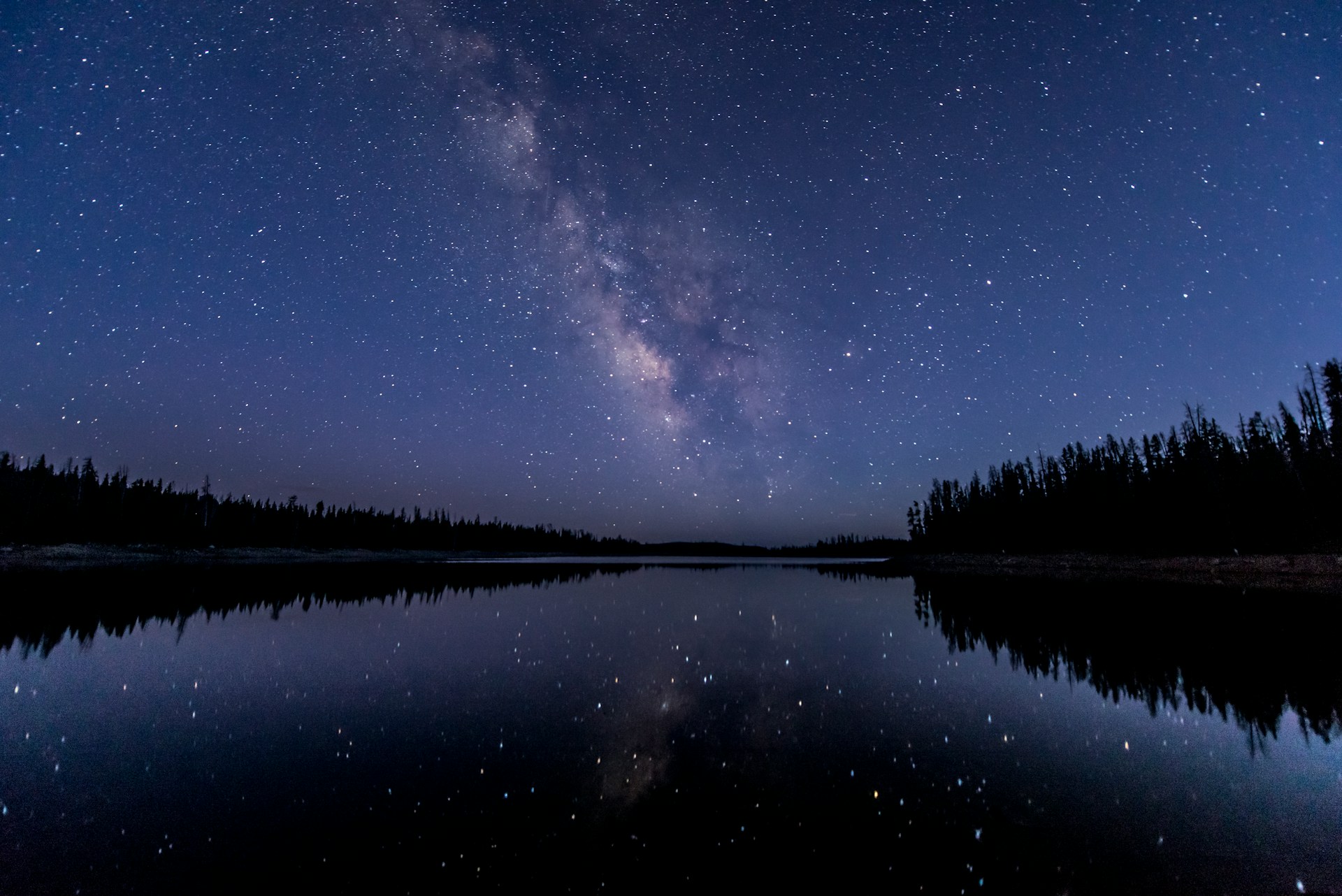
A road disappearing toward the horizon would lead the eye toward a luminous ring. A quiet lake might reflect both the stars and the glowing band above it. The silhouette of a city skyline would become part of a much larger cosmic composition.
Earth would not need to become a different planet to look extraordinary. It would simply need a different view from the ground.
3. Daylight and Nighttime Could Become More Complicated
The rings would not shine by producing their own light. Like Saturn’s rings, they would primarily reflect sunlight.
This distinction matters because the brightness of the rings would depend on their composition, density, orientation, and illumination.
During the day, a reflective ring system might appear as a pale band against the blue sky. Its brightness would vary according to atmospheric conditions and the angle of sunlight.
At night, the rings could become much more noticeable.
When sunlight illuminates the ring particles while the surrounding landscape is dark, the rings might appear as an enormous glowing structure across the heavens. Depending on their reflectivity and the observer’s location, they could provide some additional natural illumination.
However, we should not imagine that the entire planet would suddenly experience bright nights.
The actual amount of light reaching the ground would depend on how much sunlight the rings intercepted and reflected toward each location. Some regions might receive noticeable illumination, while others would see relatively little.
The rings could also cast shadows.
If portions of the ring system blocked sunlight from reaching Earth’s surface, the shadows might produce broad patterns across the planet. Their locations and intensity would depend on the geometry of the rings and the Sun throughout the year.
A shadow crossing a landscape would not necessarily create complete darkness. Instead, it could reduce direct sunlight, creating differences in brightness and temperature.
The daily cycle would remain familiar, but the sky would gain another moving element.
Sunrise would still arrive. Sunset would still transform the horizon. Yet the interplay between sunlight, atmosphere, and ring particles would create visual effects that our present-day Earth cannot reproduce on a comparable scale.
4. Would the Rings Change Earth’s Climate?
This is where the thought experiment becomes particularly interesting.
A planetary ring system could influence Earth’s climate, but the result would depend on its properties.
The most important factors would include the rings’ total mass, their thickness, their composition, their reflectivity, and the amount of sunlight they block or redirect.
A sufficiently opaque ring system could cast shadows on portions of Earth’s surface. If those shadows reduced the amount of incoming solar energy reaching particular regions, they could affect local temperatures and seasonal patterns.
The consequences would not necessarily be uniform.
Some regions might receive less direct sunlight during certain periods. Other locations might experience relatively small changes. The distribution of ring shadows would depend on the system’s orbital geometry and Earth’s axial tilt.
The atmosphere and oceans would also influence the outcome. Heat moves around the planet through winds, ocean currents, and other processes, so a reduction in sunlight over one region would not translate directly into an identical reduction in its average temperature.
Reflectivity would introduce another complication.
Bright, icy particles could send a portion of incoming sunlight back into space, potentially reducing the energy absorbed by Earth. However, the rings could also redirect some light toward the atmosphere or surface.
The overall effect would require detailed modelling.
There is also a difference between a ring system that looks spectacular and one that substantially changes the climate. A visually impressive ring could be relatively transparent, allowing much of the sunlight to pass through. A denser ring system might have a greater effect.
Consequently, we cannot simply conclude that Earth would become colder or warmer. The outcome would depend on the physical characteristics of the rings.
What we can say is that Earth’s climate scientists would have an entirely new variable to study.
Climate models would need to account for ring shadows, changing illumination, and the interaction between the ring system and the planet’s existing atmospheric and oceanic processes.
The familiar relationship between sunlight and the seasons would become more complicated.
5. The Moon Would Have a New Neighbour in the Sky
Earth’s Moon is already one of the most visually recognizable objects in the night sky.
With rings surrounding our planet, the Moon would have to share the spotlight.
Imagine watching a full Moon rise above a distant mountain range while a vast ring stretches behind it. The two celestial features would create an extraordinary scene, especially when viewed through the atmosphere near the horizon.
The Moon’s position relative to the rings would change over time. Sometimes it would appear above the ring plane. At other times, it might seem to pass across the luminous band.
Depending on the geometry, the rings could even obscure portions of the Moon from certain viewing locations.
There would also be scientific consequences.
The Moon’s gravity affects the motion of material around Earth. A ring system would therefore need to be studied in relation to lunar perturbations, orbital stability, and the long-term evolution of the particles.
The Moon could influence the distribution and behaviour of ring material, although the precise outcome would depend on the ring particles’ orbital distances and the system’s structure.
Meanwhile, the rings would become a new subject for lunar observers.
Astronomers could study the way the Moon appears against different ring regions, while photographers would have an endless supply of opportunities to capture unusual celestial alignments.
For the first time in human history, our natural satellite would appear to share its planetary stage with a permanent structure of enormous scale.
6. Astronomy Would Become More Exciting—and More Difficult
A ring system would give Earth a spectacular astronomical feature, but it would also introduce new challenges for observing the universe.
The rings could reflect sunlight, obscure parts of the sky, and affect observations of celestial objects near their apparent position.
For ground-based astronomers, the difficulty would depend on the rings’ brightness, opacity, and location in the sky. Some observations might become harder, particularly when researchers needed to study faint objects against the background of the rings.
Other observations could become more interesting.
Scientists would have a nearby natural laboratory for studying planetary ring dynamics. They could investigate how particles collide, how gravitational forces create patterns, and how small moons or clumps of material influence the structure of a ring system.
Saturn’s rings have already taught astronomers valuable lessons about orbital mechanics and the behaviour of particles under gravity. Earth’s hypothetical rings would offer an opportunity to study similar processes much closer to home.
Space telescopes and spacecraft could observe the rings from different angles, allowing scientists to compare measurements taken from the ground with observations made above the atmosphere.
Researchers might investigate the distribution of particle sizes, the chemical composition of the material, and the ways in which sunlight interacts with individual particles.
They could also monitor changes over time.
Are the rings spreading outward? Are particles gradually falling toward Earth? Are certain regions becoming thinner? Are gravitational interactions producing new structures?
These questions would turn Earth’s surroundings into a major field of planetary science.
The rings would be beautiful, but their scientific value could be just as extraordinary.
7. Space Travel Would Need a New Set of Rules
Humanity’s relationship with space would change considerably.
Today, spacecraft can be launched into orbit around Earth without having to navigate a dense, extensive ring system. With rings present, mission planners would need to account for the positions and motions of orbiting particles.
Even relatively small pieces of debris can damage spacecraft at high orbital velocities. A dense ring system would therefore present a potentially serious hazard to any spacecraft passing through it.
The level of danger would depend on the density of material along a spacecraft’s trajectory. Not every ring system would be equally hazardous, and a sufficiently sparse system might pose a manageable risk.
Nevertheless, space agencies would need detailed maps of particle distributions before selecting safe orbital paths.
Engineers would study the rings’ structure, identify regions with lower debris concentrations, and design trajectories that minimize the probability of collisions.
Satellites would also require careful planning.
Communications, weather forecasting, navigation, Earth observation, and scientific research all depend on spacecraft operating in carefully selected orbits. A ring system could restrict some orbital options or make particular routes more complicated.
Spacecraft travelling beyond Earth would face similar considerations during launch and departure.
The challenge would not necessarily make space exploration impossible. It would make the surrounding environment more complex.
Indeed, once scientists understood the system well enough, the rings could become an important destination for robotic missions.
Specialized spacecraft might collect samples, map particle distributions, and investigate the physical properties of the material. Future explorers could learn how to operate safely within a ring system, creating new capabilities for planetary research.
A feature that initially complicates space travel could also expand our understanding of how to navigate complex orbital environments.
8. The Rings Would Transform Human Culture
There is another consequence that physics alone cannot fully explain.
A permanent ring system would change the way humans imagine their world.
For thousands of years, people have used the Sun, Moon, stars, and planets to organize calendars, navigate landscapes, and develop stories about the heavens.
Earth’s rings would become another powerful visual reference.
Different societies might develop distinctive artistic traditions inspired by the rings’ appearance. Painters could represent them as symbols of continuity. Architects might incorporate their curves into buildings. Designers could use their layered geometry in clothing, furniture, and public spaces.
Musicians might describe the rings as a metaphor for distance, memory, or the passage of time. Writers could build entire fictional worlds around the changing appearance of the sky.
The rings would also influence everyday language.
People might use them to describe the time of year, identify directions, or explain the appearance of particular evenings. Children would grow up drawing the rings around Earth, just as children today often draw the Sun, clouds, and Moon.
For people living in cities, the rings could become part of the urban experience. Rooftop observatories, public viewing areas, and planetariums might focus on their movement and appearance.
For travellers, the rings would become a major attraction. Destinations with particularly striking views could draw visitors interested in photography, astronomy, and landscape observation.
However, the cultural significance would not be identical everywhere. Geography, climate, visibility, and local traditions would influence how communities experienced the rings.
Some people would see them almost every clear night. Others might encounter them through brief openings in clouds or during visits to different regions.
That variation would become part of the story.
The same planetary feature could inspire countless interpretations, each shaped by the environment and imagination of the people looking upward.
9. Plants and Animals Might Respond to the New Sky
Life on Earth depends on environmental signals, including the duration and intensity of daylight.
If the rings substantially altered the amount of sunlight reaching particular regions, plants could experience changes in their growing conditions.
Reduced direct sunlight might affect photosynthesis, especially in environments where light is already a limiting factor. Changes in temperature and seasonal illumination could also influence flowering, leaf development, and the timing of growth.
The effects would vary widely between species and habitats.
Some plants are adapted to shade. Others require strong sunlight. A ring system that produced modest, predictable changes might have different consequences from one that created extensive shadows.
Animals could respond as well.
Many species use light levels to regulate daily activity, migration, reproduction, and other behaviours. A brighter night sky could affect animals that rely on darkness, including certain nocturnal species.
For example, animals that use the contrast between the night sky and the landscape for navigation might respond to additional illumination. Species that depend on particularly dark conditions could experience changes in their behaviour.
However, a ring system would not automatically disrupt every ecosystem. The outcome would depend on the amount of light reaching the surface, the timing of changes, and the adaptability of individual species.
The important point is that the sky is not separate from life on Earth.
Light influences biological rhythms, and large changes in illumination can have consequences that extend from individual organisms to entire ecosystems.
A ringed Earth would therefore require scientists to study not only the rings themselves but also their influence on the living world below.
10. Would Earth Become More Beautiful?
Beauty is subjective, but a ringed Earth would offer visual experiences unlike anything we currently encounter on our planet.
Imagine the first light of dawn spreading across a landscape while the rings remain visible in the fading darkness. Imagine watching their reflection move across a lake as the Sun rises. Imagine standing on a snowy mountain and seeing the ring system stretch across an enormous field of stars.
These scenes would be difficult to describe using the visual vocabulary of our present world.
Yet beauty would not be the only consideration.
If the rings were formed through a disruptive event that endangered life or substantially altered Earth’s environment, their appearance would be only one part of a much larger story.
The most appealing version of our thought experiment is therefore one in which the ring system already exists in a relatively stable configuration and does not introduce catastrophic environmental consequences.
Under those conditions, the rings could become one of Earth’s defining natural features.
They would remind us that a planet’s appearance is not determined solely by its oceans, mountains, atmosphere, and continents. The space surrounding a planet can be just as important to its identity.
Saturn is famous for its rings because they make the planet immediately recognizable. Earth has its own defining characteristics: liquid oceans, a complex atmosphere, and an extraordinary diversity of life.
A ring system would add another dimension to that identity.
11. The Scientific Catch: Earth Cannot Simply Copy Saturn
There is one final detail worth considering.
Saturn’s rings are not merely decorative structures placed around a planet. They exist because of a complicated history involving gravity, collisions, orbital motion, and material left over from earlier events.
Creating a comparable system around Earth would require suitable material and a stable arrangement of orbits.
A ring’s location matters enormously. Material too close to Earth can experience strong tidal forces, while material farther away may be more capable of gathering into larger bodies under the right conditions. The actual outcomes depend on several factors, including particle properties, orbital dynamics, and gravitational interactions.
Earth’s atmosphere also complicates the picture.
Particles in sufficiently low orbits encounter atmospheric drag, which can gradually remove orbital energy and cause them to descend. A long-lived ring would need to occupy regions where the particles could remain in orbit for an extended period.
The Moon introduces additional gravitational effects, and collisions between particles can redistribute energy and material.
Consequently, Earth’s hypothetical rings might not remain unchanged forever. They could evolve, spread, thin out, or gradually lose material.
Their lifetime would depend on their mass, composition, orbital distance, and interactions with the surrounding environment.
This is part of what makes planetary rings so scientifically interesting. They are dynamic systems, not frozen pictures.
Even Saturn’s rings, which appear magnificent and stable from a distance, undergo change over time.
A ringed Earth would therefore have a history and a future of its own.
Conclusion: A Different Earth Beneath the Same Sun
What if Earth had rings like Saturn?
The answer would depend on the details, but the possibilities are extraordinary.
Our sky could become a vast display of reflected sunlight. The Moon would share its surroundings with an immense celestial structure. Astronomy would gain a nearby laboratory for studying orbital physics. Spacecraft engineers would face new challenges, while artists, writers, photographers, and scientists would discover entirely new ways to interpret the world.
The rings could also influence sunlight, climate, ecosystems, and the distribution of light across the planet. Their effects would depend on their physical properties, making careful scientific modelling essential.
Yet perhaps the most interesting consequence would be psychological.
Humanity has spent centuries studying the universe from the surface of a planet that appears relatively ordinary from space. We have discovered distant galaxies, measured the ages of stars, explored the surfaces of other worlds, and developed technologies capable of sending machines beyond our solar system.
Still, our daily experience remains grounded in familiar surroundings.
We wake up beneath the same sky. We watch the Sun disappear beyond the horizon. We look toward the Moon and recognize a companion that has accompanied Earth throughout human history.
A ring system would alter that familiar picture without changing the fundamental fact that we live on a planet orbiting a star.
It would make the connection between Earth and the rest of the solar system visible every day.
And perhaps that is the most fascinating part of this thought experiment.
We do not need to change the laws of physics to imagine a more extraordinary world. We only need to explore how those laws might produce a different arrangement of familiar things.
Earth already has oceans that cover most of its surface, an atmosphere that scatters sunlight into brilliant colours, and a Moon that changes shape throughout the month.
Add a magnificent ring system to that collection, and the ordinary act of looking up could become an entirely different experience.
The planet beneath our feet would still be Earth.
But the sky above it would remind us, every single day, that even the most familiar world can be imagined in a completely new way.
Software in My Mind. Rock in My Soul. And sometimes, a little astronomy to remind us that reality is more imaginative than we think.

