Could a Video Game Build a New World Every Time You Close It?
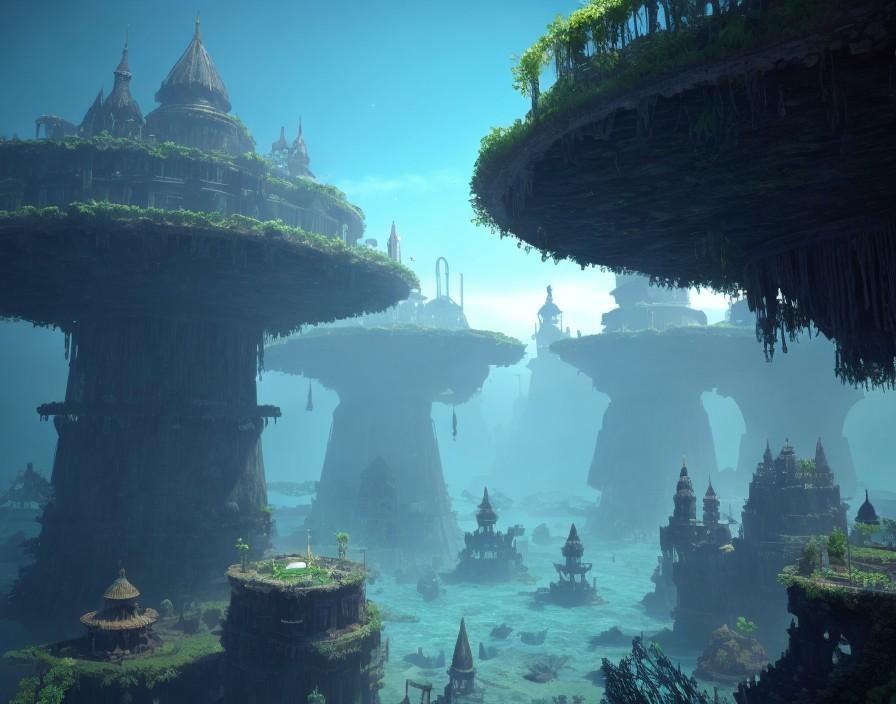
Exploring persistent simulations, procedural generation, and virtual ecosystems that continue evolving between visits.
Imagine opening a video game on Monday and discovering a world that feels familiar. Your wooden house stands beside a river. The forest stretches toward the mountains, and the small village you visited yesterday is beginning its morning routine.
You spend an hour exploring, collecting resources, and watching a herd of animals cross the plains. Then you save your progress and close the game.
When you return the following evening, something has changed.
The river has carved a new channel through the valley. A forest fire has cleared a distant hillside, allowing fresh vegetation to grow. The village has expanded its farms, unfamiliar creatures have appeared near the mountains, and a road that once ended at a lake now leads into an entirely new region.
You did not download an expansion pack. You did not install an update. The world simply continued its journey while you were away.
What if a video game could do more than remember where you left off? What if it could build, reshape, and evolve its own world every time you closed it?
This idea sits at the intersection of procedural generation, persistent simulations, artificial intelligence, and virtual ecology. It challenges the traditional relationship between a player and a game world, suggesting that the most interesting adventure might begin when the player is no longer there to witness it.
1. A World That Does Not Need Its Player
Most video games are designed around the player’s presence. Characters react to nearby activity, missions advance when certain objectives are completed, and important events are triggered by specific actions.
Even in games with large open worlds, much of the environment remains dormant when the player is far away. The illusion of a living world is often maintained by carefully timed events, scripted behavior, and systems that activate when needed.
There are good reasons for this approach. Simulating an entire world continuously would require substantial computing resources, particularly if the environment contained thousands of characters, complex weather patterns, economic systems, and interacting animal populations.
However, a different design becomes possible when the game distinguishes between what must happen in real time and what can happen in the background.
Instead of calculating every movement of every creature while the game is closed, the simulation could record its previous state, advance its internal clock, and calculate the most important changes when the player returns.
A village might produce a certain quantity of food each day. Animals might reproduce according to seasonal conditions. A storm might alter a river’s water level, while a settlement might gradually expand into nearby grassland.
The game would not need to simulate every second of the player’s absence. It would need to calculate a believable sequence of consequences.
This distinction is important. A persistent world does not necessarily need to run continuously. It needs to preserve enough information to make its history meaningful.
The result could be a game that feels less like a stage waiting for an actor and more like a place with its own existence.
2. Procedural Generation: The Art of Creating What Was Never Designed by Hand
Procedural generation is one of the technologies that could make such a world possible.
Rather than requiring designers to create every mountain, cave, tree, river, and abandoned settlement individually, procedural systems use rules, algorithms, and controlled randomness to generate content.
A terrain generator might combine mathematical noise functions, elevation rules, and simulated erosion to create a landscape. A settlement generator might examine water sources, terrain, and available resources before deciding where buildings should appear.
A creature generator could combine body shapes, colors, behaviors, and environmental adaptations to produce species that differ from one another.
These systems can already create enormous amounts of content. The more ambitious idea is to make generation responsive to the history of the world.
Consider a landscape with a large lake surrounded by grasslands. The game might initially generate a small settlement near the water because the location provides access to food, transportation, and building materials.
As the settlement grows, its inhabitants cultivate nearby fields. Increased farming changes the distribution of vegetation. Wildlife moves toward less disturbed areas, and new paths form between farms and the settlement.
Eventually, the village might develop into a trading town.
The world has not simply generated a collection of buildings. It has generated a sequence of related changes.
This is where procedural generation becomes particularly interesting: it can create not only places but also the conditions under which those places develop.
A useful system would combine randomness with constraints. Pure randomness could produce mountains in strange locations, settlements without access to resources, or ecosystems that make little sense. Rules provide structure, while randomness introduces variation.
The goal is not to create a world without logic. It is to create a world whose logic produces outcomes that even its designers cannot predict in advance.
3. What Happens While the Game Is Closed?
A game that changes between visits would need a method for advancing time.
One possible design would use a background simulation that stores the world’s important variables whenever the player exits. These variables could include population, food supplies, climate conditions, resource availability, construction projects, animal populations, and relationships between settlements.
When the player returns, the game calculates how much time has passed and advances the simulation accordingly.
Imagine that you leave a farming village on the first day of spring.
During your absence, several systems interact. Rainfall improves soil moisture. Crops grow. A neighboring settlement experiences a shortage of grain and begins trading with your village. Increased trade brings new materials, allowing local builders to construct a bridge.
The bridge attracts more merchants, and the village gradually becomes a regional trading center.
Each event emerges from the interaction of several underlying rules.
A simplified implementation might look like this:
def advance_world(world, elapsed_days):
    for day in range(elapsed_days):
        update_weather(world)
        update_ecosystems(world)
        update_resources(world)
        update_settlements(world)
        update_creatures(world)

    generate_world_events(world)
    save_world(world)

    return world
This is conceptual pseudocode rather than a complete simulation. A real implementation would need to handle dependencies, performance, random seeds, saved state, and the order in which events occur.
For a large world, the simulation could use different levels of detail. A nearby animal might receive detailed movement and behavior calculations, while an animal thousands of kilometers away might be represented by a population count and a few ecological variables.
The simulation could also skip unnecessary intermediate steps when the player has been away for a long time.
If a settlement has remained stable for thirty days, there may be no reason to calculate every individual resident’s daily activities. The game could estimate population growth, resource consumption, and construction progress, then return to detailed simulation when the player approaches.
The result would be a world that advances without requiring a powerful computer to reproduce every moment of its existence.
4. Virtual Ecosystems That Develop Their Own Balance
One of the most fascinating possibilities involves ecosystems.
In a conventional game, wildlife often serves a limited purpose. Animals may provide resources, create combat encounters, or add atmosphere to a landscape. Their populations are sometimes controlled through respawning rules rather than complex ecological relationships.
A persistent simulation could treat wildlife as part of an interconnected system.
Imagine a forest containing deer, wolves, rabbits, insects, and several plant species. Each population responds to food availability, reproduction, predation, disease, and environmental conditions.
When deer populations increase, wolves may find more food and reproduce more successfully. As the number of wolves rises, deer populations may decline. Reduced grazing allows some vegetation to recover, changing the habitat available to smaller animals.
A drought could alter the entire system. Water sources shrink, migration patterns change, and animals concentrate around the remaining rivers. Certain plant species struggle while others survive the dry conditions.
When the rains return, the ecosystem begins another phase of recovery.
The player might return after several weeks and discover that a familiar hunting ground has become a wetland, that a previously abundant species is now rare, or that a new predator has moved into the region.
These changes would make exploration more meaningful because the environment would possess a history.
However, believable ecosystems require careful design. If every population is allowed to grow without limits, the world may become unstable. If every predator eliminates its prey, the ecosystem may collapse.
The game would need balancing mechanisms such as carrying capacity, seasonal variation, migration, and resource constraints.
The objective would not necessarily be to reproduce nature perfectly. It would be to create a convincing ecological model in which changes have understandable causes and lasting consequences.
5. A World That Remembers Your Decisions
Procedural generation becomes even more compelling when combined with persistent player choices.
Suppose you build a road through a remote valley. The road makes transportation easier, attracting merchants and encouraging settlement. Over time, the surrounding region develops new industries.
Alternatively, you might establish a protected forest where hunting is prohibited. Wildlife populations recover, rare plants spread, and the forest becomes an important habitat.
If you abandon a settlement, its future could depend on the resources you left behind, the people who remain, and the environmental conditions surrounding it.
Perhaps the buildings gradually deteriorate. Perhaps another community occupies them. Maybe the settlement survives by adapting to a changing climate.
The world would not simply remember that an action occurred. It would incorporate that action into its future development.
This introduces a powerful design principle: the player’s decisions become part of the world’s history rather than temporary interactions with a mission.
A player who returns after several months could recognize the consequences of choices made during an earlier session. The bridge they constructed might now connect two growing towns. A neglected farm might have become overgrown, while a thriving settlement might have developed an entirely new identity.
The game would become a record of both generated events and personal decisions.
In such a system, no two players would necessarily experience the same world, even if they began with identical terrain and initial conditions.
Their decisions would gradually separate their worlds into different histories.
6. Could Artificial Intelligence Become the World’s Architect?
Artificial intelligence could add another layer to this concept.
Traditional procedural systems are effective at generating content within predefined rules. AI could help interpret broader patterns, generate descriptions, design narrative events, and coordinate changes across multiple systems.
For example, a simulation might determine that a coastal settlement has lost access to an important fishing area because of environmental changes. An AI-assisted narrative system could translate this development into a local story.
Residents might discuss declining fish supplies. A merchant might begin importing food from another region. A local leader might propose constructing a new harbor.
The underlying simulation would determine whether these events make sense. AI could help express them through dialogue, missions, environmental storytelling, or character behavior.
The distinction matters because an AI-generated explanation should not replace the actual simulation.
If a character claims that a bridge collapsed during a storm, the game should have a recorded event or a valid simulated cause to support that claim. Otherwise, the world risks becoming a collection of convincing statements disconnected from its actual state.
A strong architecture would separate world simulation from narrative presentation.
The simulation determines what happened. The AI helps communicate why it matters.
AI could also assist with generating settlements, naming geographical features, designing fictional cultures, or suggesting plausible adaptations to changing environments. Designers would still establish the rules, boundaries, and creative direction.
The most interesting outcome would not necessarily be a game in which AI invents everything. It would be a game in which intelligent tools help a coherent world express the consequences of its own development.
7. The Technical Challenge: Remembering an Entire World
A world that changes between visits needs persistent storage.
A simple game might save the player’s location, inventory, and completed missions. A more ambitious simulation could need to preserve thousands of additional variables.
These might include terrain modifications, population statistics, construction progress, resource inventories, ecological conditions, weather history, and relationships between communities.
Saving every detail would quickly become expensive. The solution would be to distinguish between essential state and information that can be reconstructed.
For example, the game might store the seed used to generate a mountain range, along with a list of changes made to it. The original terrain could be regenerated from the seed, while the stored changes would restore the player’s modifications.
A settlement could be represented by a compact collection of statistics rather than a separate record for every building component and resident activity.
The system could also store important events in a world history log.
A record might contain the event type, its approximate time, the affected location, and its consequences. When the player returns, the game could use this history to reconstruct important developments and generate a summary of what happened.
Imagine receiving a message such as:
During your absence, the northern farms experienced two weeks of drought. Grain production declined, the eastern village began importing food, and a new trade route opened through the hills.
This would provide useful context without forcing the player to inspect hundreds of separate statistics.
There are also important questions about consistency. What happens if two systems attempt to consume the same resource? How does the game prevent impossible population growth? What happens when an environmental change invalidates an existing structure?
These are familiar challenges in simulation engineering, database design, and distributed systems.
A persistent game world would need clear rules for updating state, resolving conflicts, and preserving a consistent history.
In other words, building an evolving virtual world is not just a graphics problem. It is also a problem of architecture.
8. Would the World Need to Be Online?
Not necessarily.
An offline game could simulate changes whenever the player returns. It would compare the saved timestamp with the current time, estimate the elapsed period, and advance the world accordingly.
This approach would provide persistence without requiring a permanent internet connection.
An online game could take a different approach. Its world might continue evolving on a server while players are offline, allowing communities, economies, and environmental systems to develop continuously.
A shared world would introduce additional possibilities. Players could return to discover that other players have established settlements, changed trade routes, or transformed entire regions.
However, online persistence introduces additional challenges. Server costs, synchronization, cheating, account security, and the possibility of world disruption all become important considerations.
A hybrid system might offer an attractive compromise. Individual worlds could advance locally, while selected events or shared regions synchronize with a server.
The appropriate design would depend on the game’s purpose, scale, and audience.
An atmospheric exploration game might work best offline. A civilization simulator could benefit from a server-based world. A cooperative survival game might combine local persistence with shared multiplayer regions.
The essential idea remains the same: the world should retain a meaningful history, regardless of whether its simulation runs locally or remotely.
9. The Danger of Creating Change Without Meaning
There is an important design question hidden inside this concept.
Should a game change simply because time has passed?
Not every change makes a world more interesting. A landscape that constantly rearranges itself could become difficult to navigate. A settlement that disappears without explanation might frustrate players. A world that generates too many events could overwhelm its own storytelling.
Change needs context.
A mountain should not move merely because the player has been away for a week. A river might change course after prolonged flooding, while a forest could recover over several seasons. A city might grow when trade increases, but its expansion should depend on available land, food, and infrastructure.
Different systems should operate at different speeds.
Weather might change hourly. Animal populations could shift over days or seasons. Forest regeneration might require years. Cultural and architectural transformations could take even longer.
These timescales would help the world feel coherent.
Players should also have some ability to influence or understand major developments. A journal, map, timeline, or collection of environmental clues could explain why the world has changed.
The best persistent simulation would not attempt to surprise the player at every opportunity. It would create a world in which surprises emerge from understandable processes.
That balance between predictability and uncertainty is what makes a living environment believable.
10. A New Kind of Replayability
Traditional replayability often comes from alternative missions, branching storylines, higher difficulty levels, randomized maps, or different character builds.
A continuously evolving world could offer another source of variation: history.
Two players might start in the same valley, but one develops a farming community while the other builds a mining settlement. Over time, their choices influence local populations, trade, vegetation, and the distribution of resources.
Even if both players stop playing for a month, their worlds might develop in different directions.
A third player might return to discover that a storm has destroyed a bridge, forcing the construction of an alternative route. Another might encounter an ecosystem that has recovered from an earlier disturbance.
The world would not need an infinite number of handcrafted missions to remain interesting. Its systems could generate new circumstances from existing conditions.
This would not eliminate the need for good writing, compelling objectives, or carefully designed encounters. Rather, it would give those elements a changing environment in which to operate.
A mission to restore a damaged settlement would feel different if the surrounding region had changed since the player’s last visit. Exploring an abandoned factory could become more interesting if a nearby community had recently begun using it as a trading post.
Replayability would emerge partly from the fact that the world has a past, and that past continues to influence the future.
11. The First Prototype Could Be Surprisingly Small
A game developer does not need to begin with an entire planet.
A useful prototype could contain one valley, a handful of settlements, several animal populations, and a simple weather model.
The first version might support only a few persistent variables:
- Environment: temperature, rainfall, soil moisture, and vegetation.
- Wildlife: population size, food availability, reproduction, and migration.
- Settlements: population, food supplies, construction, and trade.
- Player influence: buildings, roads, cultivated land, and protected areas.
- World history: important events recorded with timestamps.
The development process could begin with a fixed map and simple numerical simulations. Once the underlying systems behaved consistently, procedural terrain generation could be introduced.
The next stage would add persistence, allowing the game to save its state and calculate changes after a simulated period of absence.
Finally, a visual interface could communicate those changes through maps, environmental details, character dialogue, and historical summaries.
A small prototype might reveal whether the central idea is enjoyable before the developer invests in advanced graphics, complex AI, or large-scale world generation.
The most important experiment would be simple: leave the game, return later, and discover something that feels surprising but makes sense.
If that experience creates curiosity rather than confusion, the foundation is promising.
Conclusion: A Game World That Has Its Own Tomorrow
Could a video game build a new world every time you close it?
Yes, at least in a carefully designed and technically practical sense. Procedural generation can create environments, persistent simulations can advance their state, ecological models can produce interconnected changes, and AI can help communicate the resulting history.
The challenge is not to make every possible detail change continuously. It is to decide which changes matter, how they influence one another, and how the world preserves their consequences.
Imagine a game in which the player is not the center of every event. Forests grow, rivers change, settlements develop, animals migrate, and communities adapt. The player’s arrival introduces new possibilities, but their departure does not bring the world to a standstill.
Such a game would transform the simple act of returning into an adventure of discovery.
You might close the game with a thriving settlement, a quiet forest, and a familiar road. When you return, the settlement could have expanded, the forest could have recovered from a storm, and the road might lead toward a new community.
You would recognize the world, but it would no longer be exactly the world you left.
Perhaps that is the most compelling possibility of all: a virtual environment that does not merely offer new places to explore, but creates new reasons to explore places you already know.
In a world like that, saving your progress would mean more than preserving your own achievements. It would mean preserving one moment in a much larger history.
And every time you closed the game, its next chapter would be waiting to unfold.