
The Strange History of Mechanical Calendars That Predicted Celestial Events
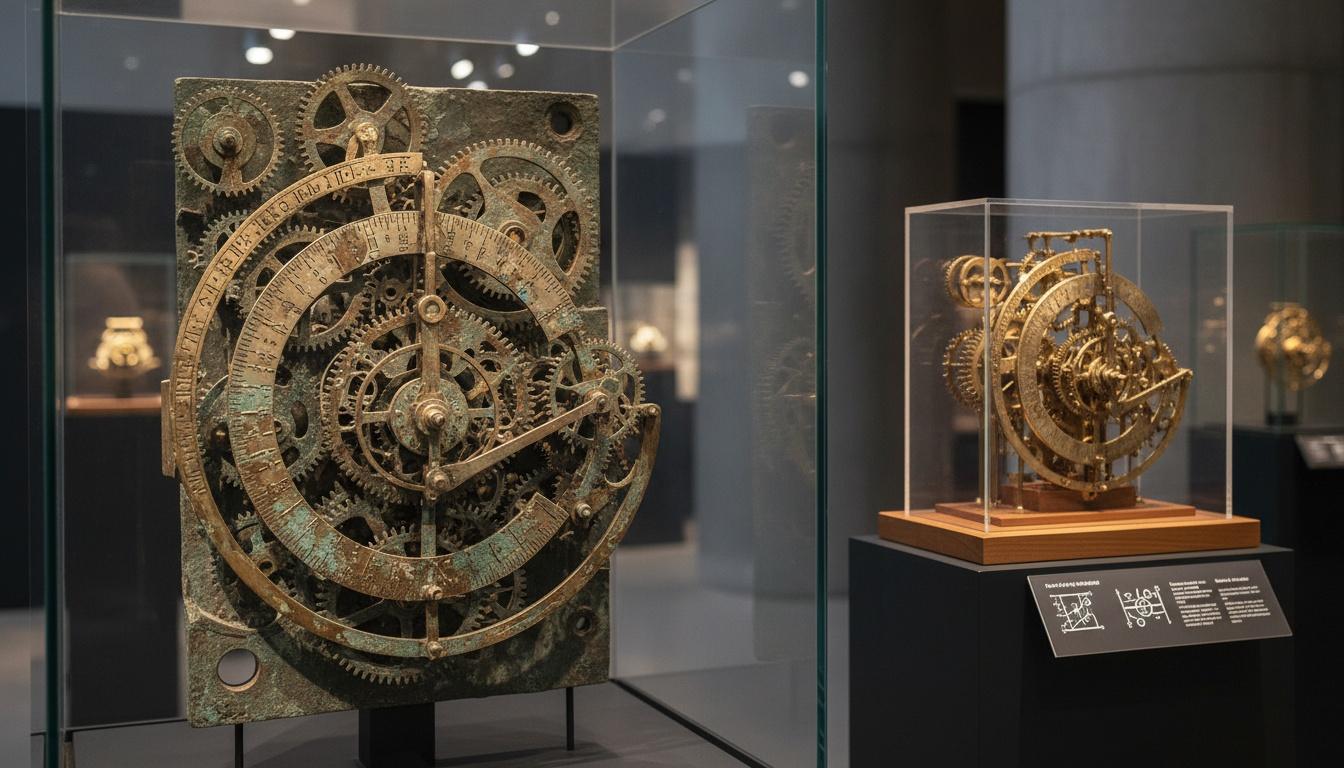
How ancient engineers transformed the movements of the heavens into gears, dials, and extraordinary machines designed to make the future visible.
Humanity has always looked toward the sky for answers.
Long before digital clocks displayed the time, before satellites mapped the Earth, and before computers calculated the precise positions of distant planets, people watched the Sun rise, followed the Moon through its phases, and recorded the slow movements of the stars. These observations were more than beautiful spectacles. They were clues to the structure of time itself.
A particular star appeared in the morning sky. The Moon grew brighter, disappeared, and returned. The Sun moved between familiar points on the horizon. Eclipses occasionally transformed daylight into something extraordinary. To people who depended on agriculture, navigation, religious ceremonies, and seasonal cycles, these celestial movements were essential parts of life.
But there was a fascinating problem.
Observing the heavens was one thing. Predicting what they would do next was another.
The solution required mathematics, patience, imagination, and eventually, mechanical engineering. Across centuries, inventors developed devices that represented the movements of celestial bodies through carefully arranged wheels, rotating discs, indicators, and gears. Some tracked the calendar. Others illustrated planetary positions. A few could even anticipate astronomical events that might otherwise seem impossible to predict.
These machines occupied a remarkable space between astronomy and technology. They were calendars, calculators, scientific instruments, and mechanical models of the universe.
Their history reveals something particularly interesting about human ingenuity: long before the invention of electronic computers, people were already building physical machines to calculate the future.
1. Before Gears: When the Sky Became a Calendar
The earliest astronomical calendars did not need complicated machinery. They began with observation.
Every day, the Sun appeared to travel across the sky. Every month or so, the Moon passed through a familiar sequence of phases. Over longer periods, the changing positions of stars revealed recurring seasonal patterns.
By recording these cycles, ancient communities developed practical systems for organizing time.
A lunar month lasts approximately 29.53 days, while a solar year lasts about 365.24 days. These cycles do not divide neatly into one another. Twelve lunar months total approximately 354 days, leaving a difference of about eleven days compared with the solar year.
That small discrepancy creates a surprisingly complicated calendar problem.
A calendar based exclusively on the Moon gradually shifts relative to the seasons. A calendar based on the Sun must account for the fact that a year is not an exact number of days. Systems designed to reconcile the two require rules, observations, and calculations.
Ancient astronomers developed different approaches to these challenges. Some calendars relied on the appearance of particular stars. Others introduced additional months to keep lunar dates aligned with seasonal activities.
The important development was not simply the invention of a calendar. It was the recognition that celestial movements followed patterns that could be recorded, compared, and anticipated.
Once a pattern could be expressed mathematically, it could also be represented mechanically.
A rotating disc could represent the Moon. A pointer could indicate the day of the year. A wheel could complete one revolution for every twelve months. Another could turn at a different rate to represent a longer astronomical cycle.
The sky was beginning to acquire a mechanical equivalent.
2. The Antikythera Mechanism: An Ancient Computer Hidden Beneath the Sea
Few historical objects demonstrate the extraordinary possibilities of early mechanical astronomy as vividly as the Antikythera mechanism.
[Image suggestion: The corroded bronze fragments of the Antikythera mechanism alongside a reconstruction showing its intricate gear system.]
<PRIVATE_PERSON> discovered this extraordinary device in 1901 among the remains of an ancient shipwreck near the Greek island of Antikythera. The wreck contained objects from the ancient Mediterranean world, including bronze fragments that initially offered few clues about their original purpose.
Those fragments would eventually transform historians’ understanding of ancient technology.
Researchers discovered that the object contained a sophisticated arrangement of interlocking bronze gears. Its surviving inscriptions and mechanical structure indicated that it had been designed to represent astronomical cycles and calculate information associated with celestial movements.
The mechanism dates to approximately the second or early first century BCE, although its exact construction date remains uncertain.
What makes it remarkable is not merely its age. It is what its gears were designed to accomplish.
The device incorporated systems for representing calendar cycles and the movements of the Sun and Moon. Its lunar calculations accounted for the changing apparent speed of the Moon across the sky, using a mechanical arrangement that went beyond a simple uniform rotation.
Other components tracked longer cycles connecting lunar and solar calendars.
One particularly important cycle was the Saros cycle, a period of approximately 223 synodic months, or about 18 years and 11 days. Eclipses tend to recur in related patterns over this interval because the relative positions of the Sun, Earth, and Moon return to configurations favorable for similar eclipses.
The Antikythera mechanism included a dial associated with this cycle. Its purpose was to represent eclipse possibilities and related timing patterns.
It did not function like a modern astronomical observatory capable of independently predicting every detail of an eclipse. Instead, it used established astronomical relationships to calculate and display information about recurring celestial events.
That distinction makes the machine even more interesting.
Its creators had transformed abstract astronomical mathematics into a physical instrument that could be operated by turning a handle.
Imagine living more than two thousand years ago and encountering such a device. Instead of consulting several separate tables or repeating a long calculation, an operator could manipulate a compact arrangement of gears and observe coordinated changes across multiple displays.
The mechanism effectively encoded astronomical knowledge in its physical structure.
A gear ratio represented a mathematical relationship. A rotating pointer represented the passage of time. A dial connected separate cycles into a single system.
In modern engineering language, it was a specialized analog computer.
Its discovery also revealed that ancient mechanical craftsmanship could reach levels of sophistication that surviving historical records had not fully prepared researchers to expect.
The Antikythera mechanism was not an isolated curiosity in the history of astronomy. It was evidence of a much larger intellectual achievement: the construction of machines capable of representing the changing geometry of the heavens.
3. Why Predicting an Eclipse Is a Difficult Engineering Problem
An eclipse looks like a momentary event, but predicting one requires understanding several overlapping cycles.
A solar eclipse occurs when the Moon passes between Earth and the Sun and the alignment allows the Moon to obscure the Sun from some location on Earth. A lunar eclipse occurs when Earth moves between the Sun and the Moon, placing the Moon within Earth’s shadow.
The Moon completes an orbit around Earth in approximately 27.3 days relative to the stars. However, the interval between one new moon and the next is approximately 29.53 days.
These periods differ because Earth is also moving around the Sun.
There is another complication: the Moon’s orbital plane is tilted by about five degrees relative to Earth’s orbital plane around the Sun. Consequently, a new moon does not automatically produce a solar eclipse, and a full moon does not automatically produce a lunar eclipse.
The Moon must also be near one of the points where its orbital path crosses the apparent plane of the Sun’s path.
This creates a problem involving multiple interacting cycles.
A mechanical calendar designed to represent eclipse possibilities must account for relationships between lunar phases, orbital positions, and longer repeating patterns.
The Antikythera mechanism approached this challenge by encoding relevant cycles into its gear arrangements and displays. Its eclipse-related calculations drew on recurring patterns that ancient astronomers had identified through centuries of observation.
The lesson is surprisingly modern.
Complex behavior does not always require a machine to reproduce every physical detail of the system being modeled. Sometimes, carefully chosen mathematical relationships are sufficient to calculate useful outcomes.
A mechanical eclipse predictor does not need to reproduce the Sun, Earth, and Moon at their actual physical sizes. It needs to represent the relationships that matter for the calculation.
That principle remains central to computer modeling, simulation, and scientific forecasting.
4. The Mystery of the Gear Ratios
Mechanical calendars are fascinating because their mathematics is hidden in plain sight.
A gear with 20 teeth connected to a gear with 40 teeth causes the second gear to rotate at half the speed of the first, assuming direct engagement. A series of gears can therefore transform one rotation into another rotation representing a different period.
If one wheel represents a month and another represents a year, their relative speeds can coordinate the two cycles.
But astronomical periods rarely fit into simple whole-number relationships. The lunar month does not divide evenly into the solar year, and the Moon’s apparent motion is not perfectly uniform.
Engineers must therefore choose approximations, combine multiple gears, or design additional mechanisms to represent the cycles with sufficient accuracy.
This is where the ingenuity becomes especially impressive.
A mechanical calendar is not merely a collection of wheels that happen to turn. It is a physical expression of mathematical relationships.
The number of teeth on a gear can encode a ratio. The position of an indicator can represent a calculated value. A repeating arrangement of markings can communicate a cycle that lasts far longer than the time required to turn the machine.
Consider the difference between memorizing a sequence of astronomical numbers and building a machine that embodies those numbers. The first depends on human calculation each time the information is needed. The second allows a carefully designed mechanism to carry much of the computational burden.
Once constructed, the device becomes a reusable mathematical instrument.
Its limitations are equally instructive. Every gear has manufacturing tolerances. Teeth wear down. Axles develop friction. A small error in one component can affect the accuracy of the entire system.
Mechanical astronomy required both mathematical knowledge and practical craftsmanship.
The equations might describe an ideal system, but the machine had to function in the physical world.
That combination of theory and construction is one of the defining characteristics of engineering.
5. The Islamic Golden Age and the Mechanical Representation of the Heavens
The history of astronomical instruments did not end with the ancient Greeks.
During the medieval period, scholars working across the Islamic world made major contributions to astronomy, mathematics, instrument design, and the development of astronomical tables.
Observatories, libraries, and scholarly centers became places where inherited knowledge was studied, refined, translated, and extended. Astronomers developed increasingly sophisticated methods for calculating celestial positions and measuring time.
One of the most important instruments was the astrolabe.
Unlike a gear-driven calendar, a traditional astrolabe primarily used rotating plates and a movable star map to represent the sky as observed from a particular latitude. By aligning its components with the Sun or a star, an operator could determine information about celestial positions and time.
Some astrolabes incorporated calendar scales and markings associated with seasonal or astronomical events. They were versatile instruments, although not all astrolabes were designed to predict eclipses directly.
Their significance lies in how they converted complex astronomical relationships into something that could be manipulated by hand.
A user did not need to calculate every relationship from the beginning. The instrument’s geometry helped organize the problem.
Mechanical clocks and other astronomical devices developed alongside these instruments. Scholars and craftsmen explored ways to measure time more consistently, represent planetary motion, and improve the practical application of astronomical calculations.
In this environment, astronomy was not simply an abstract intellectual pursuit. It served navigation, timekeeping, calendrical organization, and other practical needs.
The broader story is one of accumulated knowledge.
No single civilization developed astronomical science in isolation. Ideas moved through translation, trade, scholarship, and the exchange of instruments. Later European astronomers benefited from mathematical and observational traditions preserved and advanced by scholars across several regions.
Mechanical astronomy emerged from this long, interconnected history.
6. Al-Jazari and the Art of Making Time Visible
In the early thirteenth century, the engineer and inventor Ismail al-Jazari produced a remarkable illustrated treatise describing mechanical devices, water-powered machines, automata, and clocks.
His work, completed around 1206, demonstrated an extraordinary understanding of mechanical design.
Al-Jazari’s clocks used combinations of water, floats, gears, weights, and moving indicators to transform the passage of time into visible action.
Some incorporated elaborate figures and mechanisms that moved according to predetermined sequences. Others used displays that communicated the time through changing positions or coordinated movements.
Not every clock he described was an astronomical predictor, and his work should not be confused with the specific eclipse-calculating functions of the Antikythera mechanism.
Nevertheless, his engineering belongs to the same broader tradition of making abstract processes visible through machinery.
A clock translates an invisible quantity—elapsed time—into physical movement. An astronomical clock extends that idea by coordinating indicators with the cycles of the Sun, Moon, planets, or calendar.
The challenge is to make several different rhythms operate together.
A clock’s hour indicator moves at one rate. Its calendar display may change daily. A lunar display follows another cycle. A planetary indicator may require an entirely different gear ratio.
The resulting mechanism is a carefully coordinated system in which each moving part represents a different aspect of time or celestial motion.
Al-Jazari’s designs remind us that mechanical engineering can be both functional and theatrical.
A clock can provide useful information while simultaneously demonstrating the beauty of coordinated motion. Moving figures, turning wheels, and timed sequences make the underlying principles understandable through observation.
This was science presented as a physical experience.
7. Medieval Astronomical Clocks: The Universe on a Dial
By the later medieval period, large astronomical clocks had become some of Europe’s most impressive public mechanical achievements.
Unlike ordinary clocks, astronomical clocks attempted to communicate several kinds of information simultaneously.
Their displays could include the time, date, zodiac signs, lunar phases, and representations of celestial motion. Some incorporated calendar mechanisms or indicators associated with astronomical cycles.
One famous example is the Prague Astronomical Clock, whose origins date to 1410.
Its astronomical dial presents a stylized representation of the sky, including the positions of the Sun and Moon relative to the zodiac. Its calendar display communicates additional information about dates and the annual cycle.
The clock is not a modern precision instrument for forecasting every astronomical event. Instead, it demonstrates how astronomical knowledge could be organized into a public mechanical display.
A person standing before the clock could see several systems operating together.
The Sun followed its apparent annual path. The Moon changed phase. The calendar advanced. The clock’s components translated these different patterns into coordinated movement.
Other historical astronomical clocks developed similar ambitions, although their mechanisms and displays varied.
These machines occupied a special place in the built environment. They brought the study of the heavens into public squares, churches, and civic spaces.
A large astronomical clock was a technical achievement, but it was also an educational object and a symbol of craftsmanship.
It showed that time could be measured, modeled, and displayed through a complex system of gears.
More importantly, it suggested that apparently different forms of time—the daily cycle, the lunar month, the solar year, and the movement of celestial bodies—could be brought together within one mechanical framework.
The clock face became a miniature map of an ordered universe.
8. The Difference Between a Calendar, an Orrery, and an Eclipse Predictor
It is easy to group all astronomical mechanisms together, but they serve different purposes.
Understanding those differences reveals how inventive their designers had to be.
Mechanical calendars primarily represent dates and recurring calendrical cycles. They may include lunar phases, solar-year information, or other astronomical indicators.
Orreries are mechanical models of planetary motion. They typically use a system of gears to represent the relative movement of celestial bodies around the Sun. Some show the Moon orbiting Earth as well.
Astronomical clocks combine timekeeping with displays representing selected celestial or calendrical cycles.
Eclipse predictors focus on identifying periods or dates when the geometry of the Sun, Earth, and Moon may allow an eclipse to occur.
These categories can overlap. A sophisticated astronomical mechanism might include calendar functions, planetary displays, and eclipse-related calculations in the same instrument.
The difference lies in what the machine is designed to communicate.
An orrery emphasizes motion and spatial relationships. A calendar emphasizes the organization of time. An eclipse predictor emphasizes the recurring conditions that make a particular celestial event possible.
All of them rely on a similar intellectual strategy: construct a simplified representation of a larger system, then use that representation to calculate or illustrate its behavior.
This is the same general approach used in modern simulation software.
A weather model does not contain a physical atmosphere inside a computer. A flight simulator does not require a miniature aircraft to reproduce every aspect of flight. A planetary simulation uses mathematical relationships to calculate positions over time.
Mechanical astronomy was an early expression of this broader idea.
9. The Renaissance: When Astronomical Machines Became More Ambitious
The Renaissance brought renewed interest in mathematical astronomy, instrument making, and the construction of elaborate mechanical devices.
Improved craftsmanship allowed engineers to produce increasingly intricate gear systems. Astronomers developed new tables, observations, and mathematical models. Clockmakers explored more sophisticated ways to coordinate timekeeping with celestial displays.
During this period, planetary models became especially interesting because the traditional geocentric understanding of the heavens was being challenged and eventually transformed by new astronomical theories.
In 1543, Nicolaus Copernicus published a work presenting a heliocentric model in which Earth and the other planets orbit the Sun.
The transition from geocentric to heliocentric astronomy was gradual, and mechanical representations of the heavens did not immediately become uniform. Nevertheless, changing astronomical models created new questions for instrument designers.
If a mechanism was intended to represent planetary motion, which model should it follow? How should the relative periods of planetary revolutions be expressed through gears? How accurately could a physical model communicate changing positions?
These were engineering problems shaped by scientific developments.
A mechanical model could not automatically establish which astronomical theory was correct. It had to be designed according to a particular mathematical framework.
But once the framework was chosen, gears offered a practical means of illustrating its consequences.
The Renaissance tradition of astronomical instruments therefore combined scientific debate, mathematical reasoning, and increasingly sophisticated craftsmanship.
The machines were not merely decorative objects. They were ways of turning mathematical theories into tangible systems that people could inspect and operate.
10. The Mechanical Computer Before the Electronic Computer
There is something almost futuristic about a machine that uses nothing but metal, carefully arranged teeth, and a turning handle to calculate astronomical cycles.
Yet these devices existed centuries before electronic computing.
The reason is that computation does not inherently require electricity.
At its most basic, computation involves applying rules to information to produce a result. A mechanical system can do this by using physical relationships to represent numbers, ratios, and operations.
A gear train can multiply or divide rotational speeds. A rotating disc can represent a periodic cycle. A pointer can display a calculated position. A set of linked components can combine several mathematical relationships.
Such a system is called an analog computer when its physical variables represent quantities in the system being modeled.
The Antikythera mechanism is particularly important because it used mechanical relationships to represent astronomical cycles and calculate associated information.
Its physical construction embodied mathematical operations that would later be implemented in different forms by calculators and computers.
The comparison has limits, of course. Ancient mechanical instruments were specialized devices, not general-purpose computers capable of running arbitrary programs. Their capabilities depended on their particular gear arrangements, scales, and operating procedures.
Nevertheless, the underlying principle is recognizable.
A mathematical relationship can be represented by a physical system. Once that system is constructed, it can perform a calculation through its behavior.
This idea connects ancient astronomical instruments with slide rules, mechanical calculators, analog computers, and modern scientific simulations.
Technology changes, but the underlying ambition remains remarkably consistent: reduce a complicated calculation to a process that can be performed reliably and repeatedly.
11. What These Machines Could Predict—and What They Could Not
The phrase predicting celestial events can create the impression that ancient mechanical calendars could forecast every detail of the sky.
The reality is more nuanced.
Some devices represented recurring astronomical cycles with considerable sophistication. They could help users identify dates, estimate lunar phases, or recognize periods associated with possible eclipses.
However, the accuracy of a prediction depended on the quality of the underlying astronomical model, the precision of the mechanism, and the information available to its operator.
A machine built around repeating cycles could identify patterns without necessarily calculating every detail of an individual event.
For example, the Saros cycle helps identify recurring eclipse configurations. Yet an eclipse in one Saros series occurs in a different geographic region from its predecessor because Earth rotates an additional fraction of a day during the interval. The exact path and visibility of an eclipse therefore require more detailed calculations.
A mechanism designed to indicate eclipse possibilities should not automatically be interpreted as a device capable of displaying the precise path of totality.
Likewise, an astronomical clock showing the Moon’s position is not necessarily predicting its position with modern observational precision.
These distinctions do not diminish the historical achievements. They help us understand them correctly.
Ancient engineers did not need to possess every detail of modern celestial mechanics to build useful predictive instruments. They needed mathematical relationships that were accurate enough for their intended purposes.
Their work illustrates a fundamental feature of scientific progress: a model can be valuable without being complete.
A good model captures the relationships that matter for a particular problem. Better observations and theories can later improve it.
The history of mechanical astronomy is therefore not a story of primitive machines suddenly discovering the modern universe. It is a story of people developing increasingly useful representations of celestial patterns over many generations.
12. Why We Still Find These Machines Fascinating
Modern astronomy has moved far beyond bronze gears and rotating wooden discs.
Computers calculate planetary positions with extraordinary precision. Spacecraft use mathematical models to navigate between celestial bodies. Astronomers combine observations with numerical simulations to investigate the evolution of stars, galaxies, and planetary systems.
Yet historical astronomical mechanisms remain compelling.
Part of their appeal comes from their physical nature.
When we look at a digital prediction, the calculation is hidden inside electronic components and software. The result appears on a screen, but the underlying process is not immediately visible.
A mechanical astronomical instrument makes the relationships tangible.
Turn one wheel, and another moves at a different rate. A pointer advances. A calendar changes. Several displays remain synchronized because their components have been connected according to mathematical rules.
The machine exposes part of its own logic.
It also demonstrates the remarkable power of abstraction. The actual universe is enormous and complicated, but an instrument can capture selected aspects of its behavior using a small collection of carefully designed parts.
That is an extraordinary achievement whether the components are made of bronze or silicon.
There is also something deeply human about these devices.
People built them because the sky mattered. They wanted to understand the passage of time, anticipate recurring events, coordinate activities, and make sense of the world around them.
Their work required cooperation between observers who recorded celestial movements, mathematicians who identified patterns, and craftsmen who transformed those patterns into physical mechanisms.
The finished instruments preserved that cooperation in metal, wood, and carefully marked dials.
Each machine was a kind of material memory: an object that carried accumulated astronomical knowledge forward into the future.
Conclusion: When Humanity Put the Heavens Inside a Machine
The history of mechanical astronomical calendars is a story about more than gears.
It is about the moment when observation became calculation, when calculation became mechanism, and when a machine could represent events that had not yet occurred.
From ancient lunar calendars to the extraordinary Antikythera mechanism, from medieval astronomical scholarship to elaborate public clocks, inventors repeatedly explored the same possibility: perhaps the movements of the heavens could be translated into a system that people could operate, understand, and use to anticipate the future.
They could not control the stars. They could not stop the Moon from moving or command an eclipse to appear. But by studying recurring patterns, they learned to predict aspects of celestial behavior.
That achievement helped establish a tradition that continues through scientific computing today.
The modern computer and the ancient astronomical mechanism may look like completely different technologies. One relies on electronic circuits, while the other relies on interlocking gears. Yet both demonstrate how mathematical relationships can be encoded in a system and used to produce useful information.
The most extraordinary part is that this idea emerged long before electricity, silicon chips, or digital displays.
Someone, thousands of years ago, looked at the sky and imagined that its repeating patterns might be represented by a machine.
Someone else calculated the necessary relationships, shaped the metal, assembled the gears, and built an instrument that could turn those calculations into movement.
And somewhere along that long journey, humanity discovered that the future was not always an unknowable mystery.
Sometimes, with enough observation, mathematics, and ingenuity, it could be read from a dial.
The heavens continued their ancient movements overhead. Down on Earth, the gears began to turn.