How Ancient Engineers Moved Water Across Mountains Without Electricity
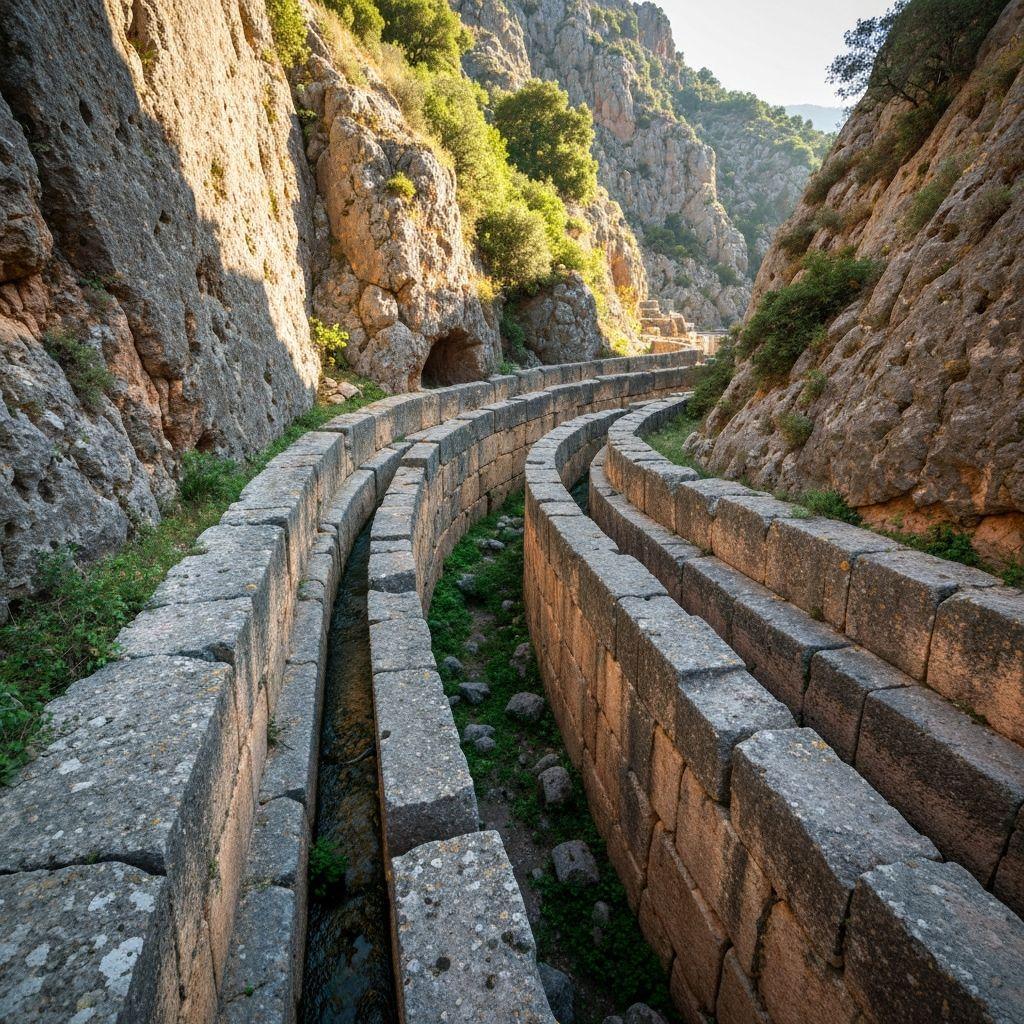
The remarkable story of aqueducts, underground tunnels, gravity-powered systems, and the practical science that allowed ancient civilizations to move water across difficult landscapes.
Long before electric pumps hummed inside modern buildings, before steel pipelines crossed continents, and before engineers could simulate the movement of water on powerful computers, people faced a surprisingly familiar problem: how do you bring water to a place where nature has not conveniently provided it?
A settlement might sit on a dry hillside while a reliable spring flowed from a distant mountain. A growing city might need more water than its nearby wells could supply. An agricultural community might possess fertile land but lack the dependable water needed to cultivate it.
The solution required more than hard work. It demanded an understanding of gravity, elevation, pressure, geology, construction materials, and the behaviour of flowing water.
Ancient engineers developed ingenious systems that carried water through mountains, beneath hills, across valleys, and into cities. Some channels stretched for dozens of kilometres. Some tunnels were excavated through solid rock. Others used carefully constructed underground passages to transport water while protecting it from evaporation and contamination.
The remarkable part is that many of these systems operated without electricity, engines, or modern machinery. Their power came primarily from gravity, their construction relied on practical mathematics, and their continued operation depended on maintenance and an intimate understanding of the landscape.
Their achievements offer a fascinating lesson in engineering: sometimes, the most powerful technology is not the machine that pushes something forward, but the design that allows nature to do the work.
1. The Secret Was Not More Power. It Was Understanding Gravity.
Imagine standing beside a mountain spring and looking toward a settlement several kilometres away. Between the two locations lie steep slopes, rocky ridges, and valleys. Carrying water by hand would be exhausting, while transporting it in containers using animals would require constant effort.
An ancient engineer might begin with a simple question: Is the source of the water higher than the destination?
If the answer is yes, the problem becomes much more manageable.
Water naturally flows downhill because gravity pulls it toward lower elevations. By constructing a channel that descends gradually from a source to a destination, engineers could move water continuously without needing a pump.
The challenge was controlling that descent.
If the channel dropped too steeply, the water could accelerate, erode the channel, damage its lining, or overwhelm downstream structures. If the channel was too flat, the water might move too slowly or stop flowing altogether because of irregularities, sediment, or other hydraulic losses.
Engineers therefore had to establish a suitable gradient: a carefully controlled decrease in elevation over a given distance.
Consider a hypothetical water channel that begins 100 metres above a settlement and travels for 10 kilometres. If its route descends by an average of one metre for every 100 metres travelled, it would use approximately 100 metres of elevation across the entire journey.
The calculation is straightforward:
Gradient = vertical drop ÷ horizontal distance
In this example, the gradient is 100 metres divided by 10,000 metres, or 0.01. Expressed as a percentage, that is a 1% gradient.
Actual systems required more sophisticated calculations because terrain, channel shape, surface roughness, and water volume all influenced performance. Nevertheless, the underlying principle was accessible through measurement and observation.
An engineer did not need an electric motor to move water downhill. The engineer needed to make the route work with gravity rather than against it.
This principle became the foundation of some of the world’s most impressive ancient water systems.
2. Roman Aqueducts: Moving Water Across Entire Landscapes
The Pont du Gard demonstrates how Roman engineers used stone arches to carry a water channel across a valley.
When people imagine ancient water engineering, Roman aqueducts are often the first structures that come to mind.
Their monumental stone arches are instantly recognizable, but the arches represent only one part of a much larger engineering system. Much of a Roman aqueduct travelled along the ground, through underground passages, or inside covered channels. The spectacular elevated sections appeared where the landscape made them necessary.
Roman engineers developed extensive water-supply networks to serve cities, public baths, fountains, and households. Their systems combined surveying, masonry, hydraulic design, and organized maintenance.
One of the best-known examples is the Pont du Gard, a surviving Roman aqueduct bridge built in southern France during the first century CE. Its three levels of arches carried an aqueduct across the Gardon River valley.
The structure demonstrates a central principle of ancient construction: build only what the terrain requires.
Instead of forcing the entire water channel to remain at one elevation, Roman engineers followed a route that generally descended from the source toward the destination. Where a valley interrupted the route, they could build an elevated bridge that preserved the channel’s required height.
The arches were not simply decorative. They allowed a heavy structure to span a wide valley while using masonry efficiently. Each arch transferred loads through compression into its supports, making the form particularly suitable for stone construction.
Another remarkable example is the Aqueduct of Segovia, whose monumental arcades carry the historic watercourse through the Spanish city. Its surviving structure illustrates how a carefully planned water system could become part of a city’s infrastructure for centuries.
Roman aqueducts were not necessarily built to climb mountains from low valleys. Their essential strategy was to locate water at a higher elevation and maintain a suitable route to the destination. Hills, ridges, and valleys became surveying and construction challenges rather than automatic barriers.
Yet even the Romans recognized that building enormous bridges everywhere would be impractical.
Sometimes, the best solution was to go underground.
3. The Persian Qanat: Bringing Mountain Water Beneath the Desert
Qanats transported groundwater from elevated areas through gently sloping underground tunnels, helping communities obtain water in dry regions.
Perhaps one of the most ingenious ancient approaches to moving water across difficult terrain was the qanat, a system developed in ancient Persia and subsequently adopted in different forms across parts of the Middle East, North Africa, and beyond.
A qanat was designed to collect groundwater in elevated areas and transport it through a gently sloping underground tunnel to farms, gardens, and settlements at lower elevations.
The system was particularly valuable in dry regions, where surface water was scarce and evaporation could destroy much of the supply carried by an exposed channel.
Its operation depended on several interconnected components.
First, engineers identified a suitable groundwater source, often in an elevated foothill or alluvial fan where water from rainfall and snowmelt had accumulated underground.
They then excavated a gently descending tunnel that intercepted the groundwater and allowed it to flow toward lower ground.
Vertical shafts connected the underground passage to the surface at intervals. These shafts provided access for excavation, the removal of spoil, ventilation, and subsequent repairs.
The resulting structure resembled an underground river with a carefully engineered outlet.
The qanat did not generally lift water from a deep underground reservoir. Instead, it intercepted groundwater at a higher elevation and allowed the water to emerge at a lower point through gravity.
This distinction is crucial. The system worked because the source possessed sufficient hydraulic head, meaning the water had available gravitational energy relative to the outlet.
The underground route also offered important advantages. Temperatures below the surface are generally more stable than those above it, and water travelling underground experiences less direct exposure to sunlight and wind. These conditions help reduce evaporative losses compared with many exposed channels, although actual savings depend on local geology and design.
Qanats also required exceptional practical knowledge.
Excavators had to maintain a consistent downward slope without allowing the tunnel to descend so quickly that it reached the wrong depth or missed the intended groundwater supply. Workers needed to manage unstable rock, ventilation, water seepage, and the difficult task of removing excavated material through narrow shafts.
A mistake could leave a tunnel too high to intercept water or too low to deliver it to the intended destination.
The system demanded patience, surveying, and coordinated labour.
Some qanats became so extensive that their underground passages reached several kilometres in length, with numerous shafts extending toward the surface. Their construction transformed otherwise challenging landscapes into productive agricultural regions.
The ancient Persian qanat tradition is a powerful example of designing infrastructure around the natural movement of water rather than attempting to overpower it.
4. How Engineers Tunnelled Through Mountains Before Modern Drilling Machines
The Eupalinos Tunnel on the Greek island of Samos illustrates the extraordinary surveying and excavation skills of ancient engineers.
A mountain presents a difficult problem for any water engineer.
Its surface may rise far above the elevation of the desired channel, creating a barrier that would require an enormous bridge or a lengthy detour to cross. Yet if the mountain’s interior contains suitable rock, an underground tunnel may offer a more direct route.
Ancient engineers understood this possibility long before the arrival of mechanical tunnel-boring machines.
One important example is the Eupalinos Tunnel, constructed in the sixth century BCE on the Greek island of Samos.
The tunnel was built to carry water from a spring through Mount Kastro to the ancient settlement of Pythagoreion. Rather than relying on a channel that went around the mountain, engineers excavated a passage through it.
What makes the project particularly remarkable is that excavation proceeded from opposite ends.
Workers began digging from both sides, intending to meet somewhere inside the mountain. This method required a dependable understanding of direction, elevation, and distance.
Without satellite positioning, electronic surveying instruments, or modern drilling equipment, the builders had to establish the tunnel’s alignment using contemporary surveying techniques and carefully transferred measurements.
The tunnel demonstrates that ancient engineers could undertake complex underground projects requiring coordinated excavation and precise spatial planning.
It also reveals an important truth about engineering history: the absence of modern equipment did not mean the absence of sophisticated methods.
Workers could use measuring rods, cords, sighting techniques, plumb lines, and practical geometric reasoning to establish directions and levels. Their instruments were comparatively simple, but the problems they solved were not.
The Eupalinos Tunnel was approximately 1 kilometre long, and the water supply system included additional underground infrastructure beyond the main passage.
Its surviving remains provide a tangible connection to a period when a city’s water supply could depend on a passage carved through a mountain by human labour.
The builders could not simply drill in a straight line and trust a computer to correct their position. They had to plan the route before excavation, check their progress, and make adjustments when necessary.
Their achievement illustrates how mathematics becomes especially valuable when a mistake is expensive to reverse.
5. The Mathematics Behind Underground Water Systems
The engineering behind these projects becomes easier to understand when we examine the physical principles involved.
Water flowing through a channel or tunnel is affected by gravity, friction, elevation, and the geometry of the passage.
Three concepts are especially important.
Elevation difference. Water generally flows from higher hydraulic head toward lower hydraulic head. A higher source can provide the energy required to move water along a route.
Hydraulic gradient. The available head decreases along a real watercourse because energy is lost through friction and other effects. The route must provide enough elevation difference to overcome those losses while delivering water at a useful rate.
Cross-sectional area. The width, depth, or diameter of the passage influences how much water it can carry. A narrow channel may restrict flow, while an appropriately sized channel can transport more water without requiring a steep descent.
Engineers also had to consider the materials used to construct their channels.
A channel carved into sound rock might need little lining in some locations, whereas a passage through loose soil could require masonry, stonework, or other forms of support. In exposed aqueducts, builders used materials and construction methods appropriate to the local conditions.
A practical design had to balance all these factors.
A tunnel that descended too little might fail to carry the required flow. A tunnel that descended too much could emerge at an unsuitable elevation or create difficult conditions farther downstream.
The problem was therefore not simply to find the shortest distance between two points. It was to create a route that could deliver the required amount of water reliably.
This is an important distinction in engineering. The shortest path on a map is not always the best path for a working system.
Sometimes a longer route with a gentle slope is more useful than a shorter route that demands extensive excavation or creates an excessive drop.
6. When Gravity Was Not Enough: Ancient Solutions to Elevation Problems
Inverted siphons allowed ancient water systems to cross certain valleys using pressurized conduits rather than elevated bridges.
Gravity-powered systems were remarkably effective, but they had a fundamental limitation: the water source generally needed sufficient elevation relative to its destination.
What happened when the terrain did not cooperate?
Ancient engineers developed other approaches, including stepped channels, reservoirs, and systems that used pressure to cross local obstacles.
One particularly fascinating example is the inverted siphon.
Despite its name, an inverted siphon is not a device that sucks water uphill through a vacuum. It is a pressurized conduit that carries water down one side of a valley and up the other.
If the water begins at a sufficiently high elevation, the available hydraulic head can maintain flow through a pipe or conduit, even as the route dips below the level of the destination before rising again.
The system works because pressure within the conduit helps drive the water upward on the far side. Friction and other losses reduce the available energy, so the receiving point cannot be higher than the effective hydraulic head supplied by the source.
Roman engineers used inverted siphons in suitable locations, including parts of their water-supply networks where valleys made an elevated bridge impractical.
Such systems presented demanding construction problems.
The pipes or conduits needed to withstand internal pressure, joints had to remain sufficiently watertight, and the route had to be designed around the source elevation and expected flow.
In some locations, builders used stone blocks with carefully drilled channels. Elsewhere, different materials and arrangements were appropriate.
The important insight was that a valley did not always require a bridge. Water could descend into it under gravity, travel through a pressurized conduit, and rise again on the opposite side.
However, the system could not deliver water to an elevation beyond what the available hydraulic head allowed.
This was not a way to defeat gravity. It was a way to use pressure and gravity together.
The distinction demonstrates how ancient engineers expanded their options by understanding the physical behaviour of water rather than relying on a single construction technique.
7. How Workers Built These Systems Without Modern Machinery
Stoneworking, hand tools, and coordinated labour made many ancient water infrastructure projects possible.
A completed aqueduct or underground tunnel can look deceptively simple.
Water enters one end, travels along a channel, and emerges somewhere else. But the construction process could involve years of work, large labour forces, specialist knowledge, and careful coordination.
Excavation was often performed with hand tools such as picks, hammers, chisels, and shovels. The precise methods depended on the geology, the civilization, and the period.
Where rock was too hard for efficient direct excavation, some ancient miners used fire-setting techniques. Heating rock and then cooling it could cause cracking in certain conditions, making subsequent removal easier. The method was labour-intensive and required careful control, but it provided an additional way to work through difficult material.
Workers removed debris using baskets, ropes, and other practical arrangements. In underground tunnels, vertical shafts could shorten the distance that excavated material needed to travel.
Surveyors established the route before and during construction. Builders then created channels, supports, retaining walls, and linings where needed.
Large stone structures also depended on knowledge of weight distribution. Arches, for example, could carry loads efficiently by directing forces through their curved forms and into supporting masonry.
The construction of a water system therefore involved several related disciplines: surveying, excavation, structural engineering, materials science, and hydraulic design.
It also required organization.
A long aqueduct might cross multiple types of terrain, each presenting different challenges. Workers needed materials, tools, food, transport, and a coordinated plan for completing different sections of the project.
The physical structure was only one part of the achievement. The ability to organize the work was equally important.
Modern construction equipment makes many of these tasks faster, but it does not eliminate the need for careful planning. Even today, a tunnel can fail to meet its target if the alignment is wrong, and a pipeline can underperform if the pressure and elevation have not been properly calculated.
The ancient builders encountered many of the same fundamental engineering questions that contemporary professionals still solve.
8. Keeping Water Clean and the System Working
Constructing a water route was only the beginning.
A system that delivered clean water during its first year could become unreliable if its channels filled with sediment, its masonry deteriorated, or its groundwater source changed.
Ancient engineers and maintenance workers therefore had to think about long-term operation.
Aqueduct channels needed periodic cleaning to remove deposits. Some water sources contained dissolved minerals that gradually formed hard crusts along channel surfaces. These deposits could reduce the effective cross-sectional area and restrict flow.
Underground tunnels required inspections and repairs. Shafts provided access to some qanat systems, allowing workers to reach the passage and remove obstructions or repair damaged sections.
Channels could also be affected by earthquakes, landslides, floods, and seasonal changes in water availability.
The source itself mattered just as much as the infrastructure. A beautifully constructed aqueduct could not supply its intended volume if the spring feeding it weakened or the groundwater level fell.
Water quality presented another challenge. Bringing water into a city did not automatically make it safe to drink. Source selection, protection from contamination, storage practices, and distribution arrangements all influenced the quality of the final supply.
Ancient water systems were therefore not isolated monuments. They were operating infrastructure, and their usefulness depended on the relationship between construction, maintenance, environmental conditions, and human management.
Their longevity is impressive, but it should not be mistaken for an absence of maintenance. Surviving structures are often the result of repeated repairs, adaptations, and changes in use over time.
An aqueduct’s engineering achievement lies not only in the fact that it was built, but also in the fact that people developed ways to keep it useful.
9. What These Ancient Systems Teach Modern Engineers
The techniques used by ancient water engineers may appear distant from contemporary infrastructure, yet their underlying principles remain relevant.
Gravity-fed water systems are still used today because they can reduce dependence on pumping equipment and the energy required to operate it. Where suitable elevation differences exist, a well-designed gravity system can provide a dependable water supply with relatively simple operating requirements.
Modern qanat-like systems and traditional water channels also demonstrate the value of adapting infrastructure to local geology and climate. In some environments, underground conveyance can reduce evaporative losses, although its suitability depends on groundwater conditions, construction costs, water quality, and the need to protect the aquifer.
Ancient tunnels offer another lesson: infrastructure should follow a route that makes physical and economic sense, not merely the route that looks simplest on a map.
The Eupalinos Tunnel shows the importance of surveying and alignment. Roman aqueducts demonstrate how to combine different structural forms within one continuous system. Persian qanats illustrate how underground water resources can be connected to communities without requiring mechanical pumping along the entire route.
These examples also remind us that engineering is rarely a contest to use the greatest amount of power.
A well-designed system can achieve more with less energy by taking advantage of natural conditions. Sometimes a carefully selected elevation, an accurately measured slope, or a strategically placed tunnel can eliminate the need for an expensive mechanism.
That does not mean gravity alone can solve every water problem. Water must still be lifted when the source is too low, and pumping, treatment, monitoring, and modern controls are essential in many contemporary systems.
The lesson is to choose the right method for the problem.
Technology is most effective when it combines an understanding of physical laws with the practical requirements of the people who depend on it.
10. Engineering That Outlived Its Builders
Roman aqueducts, Greek tunnels, and Persian qanats reveal different approaches to the same engineering challenge: delivering water across difficult terrain.
There is something extraordinary about standing beside an ancient aqueduct or entering a tunnel excavated more than two thousand years ago.
The builders are gone. Their tools may survive only as archaeological evidence, and many details of their working lives remain uncertain. Yet the physical results of their reasoning can still be examined.
A sloping channel reveals a decision about elevation. A tunnel through rock reveals a decision about distance and terrain. An arch spanning a valley reveals an understanding of structural forces. A line of underground shafts reveals a method for accessing a passage hidden beneath the surface.
These structures are records of practical intelligence.
They show how observation became measurement, how measurement became design, and how design became infrastructure capable of supporting communities.
The people who built them did not possess electricity or modern computers, but they could observe how water behaved, compare elevations, test materials, learn from previous construction, and improve their methods.
Their achievements also remind us that useful inventions do not always emerge from complicated machinery. Sometimes, the breakthrough is a better understanding of the world that already exists.
A mountain may appear to be an obstacle, but its slopes can provide the energy needed to move water. A valley may seem to interrupt a route, but an arch or a pressurized conduit can carry the supply across it. A dry landscape may seem unable to support agriculture, but an underground channel can connect communities to water stored in the surrounding geology.
The landscape becomes a system of possibilities once its physical properties are understood.
Conclusion: The Power of Working With Nature
How did ancient engineers move water across mountains without electricity?
They measured elevations, studied the terrain, excavated tunnels, constructed aqueducts, developed underground channels, and learned how gravity and pressure could work together.
Roman aqueducts carried water across valleys and into growing cities. Persian qanats transported groundwater through underground passages toward settlements and agricultural land. The Eupalinos Tunnel demonstrated how surveying and coordinated excavation could carry a water supply through a mountain. In suitable locations, inverted siphons allowed water to cross valleys through pressurized conduits.
Each solution addressed a different version of the same fundamental challenge: moving a limited resource from where it was available to where it was needed.
Their methods were not identical, and they did not solve every problem without mechanical assistance or enormous human effort. Nevertheless, their work demonstrates how much can be achieved through careful observation, mathematics, construction skill, and an understanding of natural forces.
Electricity changed what engineers could do, making it possible to pump water uphill, automate distribution, and manage enormous networks. But electricity did not replace the principles that ancient engineers discovered. Gravity still matters. Pressure still matters. Elevation, friction, and the geometry of a channel still determine how water moves.
The next time water flows from a tap, consider the long history behind that simple action. Somewhere between a distant source and the point of use lies a system designed to overcome distance, elevation, friction, and the limitations of the landscape.
Some systems rely on electric pumps and digital controls. Others use carefully managed gravity. Both depend on the same physical world.
The ancient engineers understood something that remains central to every generation of engineering: the smartest solution is often not to fight nature, but to understand its rules well enough to make them work for us.