

Could a Planet Have Two Suns That Rise at Different Times?
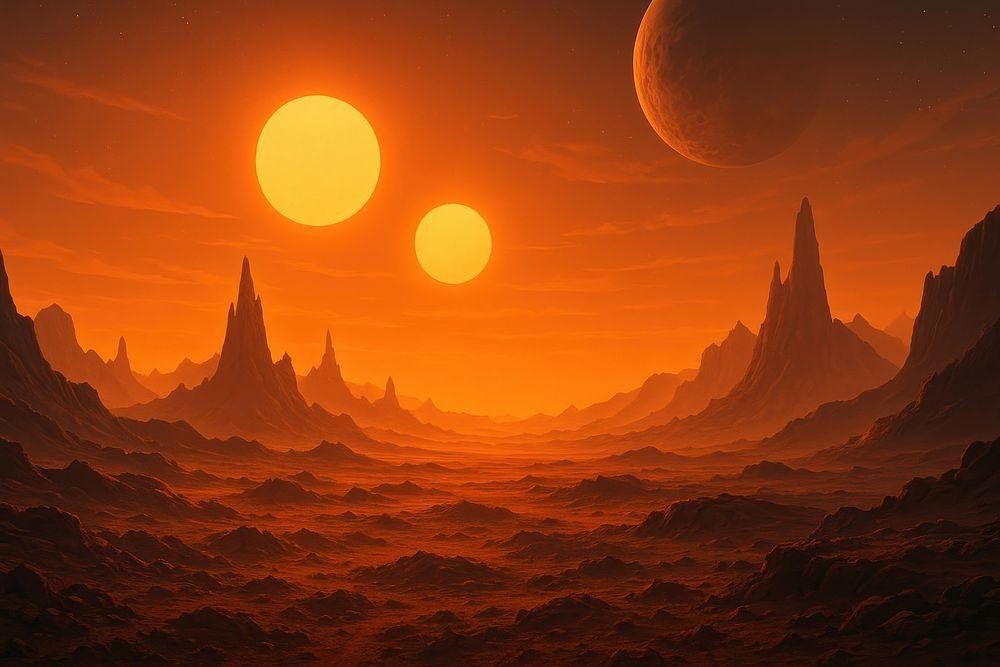
Imagine waking up to watch one sun rise over the horizon, only for a second sun to appear hours later. It sounds like something from a science-fiction movie, but the universe already contains planetary systems where two stars share the sky.
There are certain things we take for granted about our planet. The Sun rises in the morning, climbs across the sky, and eventually disappears below the horizon. The sky darkens, stars emerge, and the cycle begins again. Tomorrow, the same familiar process repeats.
It is one of the most predictable events in our lives.
But imagine living on a planet where the sunrise was not quite so simple. Perhaps a golden star appeared over the eastern horizon in the early morning. Its light spread across mountains, illuminated oceans, and warmed the landscape. Then, several hours later, another star emerged from behind the horizon, bringing a second wave of daylight to a world already awake.
Or perhaps the second sun rose first, followed by the primary star later in the day.
Would the planet experience two separate sunrises? Could its inhabitants have two sunsets? And would the sky ever become completely dark?
As extraordinary as these questions sound, they lead us into a fascinating area of astronomy: binary-star systems, where two stars orbit a shared center of mass.
The most surprising part is that planets with two suns are not merely a product of imagination. Astronomers have already discovered planets orbiting two stars, demonstrating that the architecture of our solar system is only one of many arrangements nature can produce.
To understand how a planet could experience two suns rising at different times, we need to look beyond our familiar neighborhood and consider how stars, planets, gravity, and orbital motion work together.
1. The Universe Does Not Require Every Planet to Have One Sun
Our solar system contains one star: the Sun. Its gravitational influence holds the planets in their orbits, while its light provides most of the energy that drives Earth’s climate and supports life at the surface.
However, stars frequently form in groups rather than always forming alone. Two stars can emerge from the same collapsing cloud of gas and dust, eventually settling into an orbit around their common center of mass.
Astronomers call such an arrangement a binary-star system.
The two stars might be relatively similar in mass, or one might be substantially larger and brighter than the other. They could orbit each other closely, or they might be separated by a considerable distance.
The details matter because the arrangement of the stars determines what a planet in that system would experience.
Imagine two stars moving around one another. From a distant observer’s perspective, they trace a repeating orbital dance, held together by gravity. A planet in the same system could receive light from both stars, potentially seeing two distinct stellar disks in its sky.
Depending on the planet’s orbit, rotation, and the stars’ positions, the view could change dramatically from one day to the next.
The familiar concept of a single sunrise would suddenly become much more complicated.
2. Yes, a Planet Can Have Two Suns
One of the best-known examples of a planet orbiting two stars is Kepler-16b.
Discovered using NASA’s Kepler space telescope, Kepler-16b orbits a pair of stars rather than a single star. This type of arrangement is known as a circumbinary orbit: the planet travels around both stars, while the stars orbit their shared center of mass.
Imagine standing on a hypothetical world in such a system and looking toward the horizon.
Instead of seeing one star, you might see two. Depending on their apparent sizes and brightness, one could resemble a small, brilliant point of light while the other appeared larger and more dominant.
If both stars were above the horizon, the landscape would receive light from two directions in the sky. Shadows could overlap, and the combined illumination would depend on the stars’ brightness and positions.
There is an important distinction, however. Kepler-16b is a gas giant, so it is not a place where we can simply imagine walking around on a solid surface and watching the sunrise. It is a real example of a planet orbiting two stars, not proof that a habitable, Earth-like world with two visible sunrises has been found.
Nevertheless, it demonstrates that the basic arrangement is physically possible.
A planet does not need to choose between one star and another. Under the right gravitational conditions, it can orbit both.
And that brings us to the more intriguing question: would both suns necessarily rise together?
3. How Could Two Suns Rise at Different Times?
The answer depends on the geometry of the system.
On Earth, the Sun appears to move across the sky primarily because our planet rotates. The same principle would apply to a planet with two suns. As the planet turned, both stars would change their apparent positions relative to the horizon.
However, the stars would not necessarily occupy the same position in the sky.
Suppose two stars were separated by a visible angle of 60 degrees. One star might be positioned well to the east of the other. As the planet rotated, the eastern star could cross the horizon first.
The second star would follow later.
The result would be two distinct sunrise events.
The time separating them would depend on their angular separation and the planet’s rotation rate. On an Earth-like planet rotating once every 24 hours, a separation of 30 degrees along the apparent daily path could correspond to roughly two hours between horizon crossings, provided the stars’ motion during that interval was relatively small.
A separation of 60 degrees could produce a difference of approximately four hours under the same simplified assumptions.
These are illustrative calculations rather than predictions for a particular discovered planet. Real binary systems involve orbital motion, and the stars’ apparent paths may not follow Earth’s familiar pattern.
Still, the underlying principle is straightforward: if two stars occupy different positions along their apparent paths across the sky, they can cross the horizon at different times.
The first sunrise would not have to wait for the second. Each star would follow its own apparent trajectory.
Picture the scene.
A pale gold star appears over a distant mountain range. The sky begins to brighten. Birds, if the planet has them, might respond to the increasing light. A few hours later, a brighter star emerges on another part of the horizon.
For an observer on that world, sunrise would not be a single moment. It could be a sequence of celestial appearances.
4. Could One Sun Rise in the Morning and the Other in the Afternoon?
This is where things become even more interesting.
The answer is yes, in principle, if the stars’ apparent positions and the planet’s rotation produce sufficiently separated horizon crossings.
Imagine a world rotating in the same general sense as Earth. One star appears in the morning, moves across the sky, and eventually sets. The second star might rise later in the day, depending on the orientation of the system.
The planet could experience a first period of daylight, followed by a second period of illumination.
However, there is a catch.
The first star would not necessarily disappear before the second one rose. If their paths overlapped above the horizon, there could be a period when both suns were visible simultaneously.
Alternatively, the first star might set before the second rises, producing a temporary interval in which neither star is above the horizon.
That interval could resemble twilight or darkness, depending on the stars’ brightness, their positions, the atmosphere, and the planet’s topography.
The result would depend on the specific orbital arrangement rather than following one universal schedule.
A world with two suns could therefore have a sky that changes in ways unfamiliar to Earth.
One day might feature a long period when both stars illuminate the landscape. Another arrangement could produce two separate daylight periods divided by a darker interval.
The precise pattern would require calculations involving the planet’s rotation, orbital motion, and the changing positions of both stars.
The important point is that two suns do not automatically mean twice the length of a day or twice as much daylight. Their combined effect depends on how the entire system moves.
5. What Would the Sky Look Like?
Imagine standing on an Earth-like planet in a system where two stars are visible to the naked eye.
The first thing you might notice is that the sky could contain two distinct stellar disks, provided the stars were sufficiently large in apparent size and close enough to appear as disks rather than points.
One might be orange, while the other appeared yellow-white. Their actual colors would depend on their surface temperatures and atmospheric effects along the line of sight.
When both were above the horizon, the landscape could be illuminated from two directions.
A tree might cast two shadows, although the shadows could overlap or become difficult to distinguish depending on the stars’ positions. Mountains could appear differently lit as the stars moved through the sky. Reflections on a lake might show two bright paths of light.
The sky would also change as the stars orbited one another.
Unlike the Sun in our solar system, whose position relative to distant stars follows a relatively predictable annual pattern, binary stars introduce another layer of motion. Their changing separation and orientation could alter their apparent positions over time.
Depending on the system, the two stars might appear close together during one period and farther apart during another.
Sometimes, one star might pass in front of the other from the planet’s perspective. This could create an eclipse, temporarily reducing the combined light reaching the planet.
If the stars had different brightness levels, the eclipse might be dramatic. If one star were much dimmer, its disappearance could produce a subtler change.
The sky would not simply contain an extra object. It would become a moving display of celestial geometry.
6. Would Two Suns Make the Planet Twice as Hot?
Not necessarily.
This is one of the most common assumptions about planets with two stars, but the number of stars alone does not determine a planet’s temperature.
What matters is the total energy the planet receives from both stars.
A planet orbiting two relatively dim stars might receive less energy than Earth receives from the Sun. Another planet orbiting two luminous stars could receive substantially more.
Distance matters enormously.
A planet located farther from its stars receives less energy from them, while a planet closer to them receives more, all else being equal. The brightness of each star also influences the total energy arriving at the planet.
Astronomers can estimate this combined energy using the stars’ luminosities and their distances from the planet.
For a simplified case in which the planet receives light from two stars at distances (r_1) and (r_2), the combined irradiance can be approximated by adding their individual contributions:
[
F_{\text{total}} \approx
\frac{L_1}{4\pi r_1^2}
+
\frac{L_2}{4\pi r_2^2}
]
Here, (L_1) and (L_2) represent the stars’ luminosities, while (r_1) and (r_2) represent their respective distances from the planet.
This simplified expression assumes the stars can be treated as sources of radiation spreading outward in all directions. Real systems require more detailed orbital calculations, but the principle remains useful.
Two stars can provide a comfortable amount of energy if the planet’s orbit and the stars’ luminosities allow it.
They can also provide too much energy, potentially creating conditions that are unsuitable for liquid water at the surface.
The presence of two suns does not automatically make a planet a scorching desert. Nor does it guarantee a pleasant climate.
The planet’s atmosphere, rotation, oceans, clouds, and orbital characteristics would all contribute to its environmental conditions.
7. Would the Planet Have Two Sunsets, Too?
If two stars rise separately, it is reasonable to wonder whether they would also set separately.
Under suitable viewing conditions, yes.
Imagine the first star crossing the western horizon while the second remains high in the sky. The first star disappears, but the landscape continues to receive light from the remaining star.
The sky might become somewhat dimmer, yet daylight would continue.
Later, the second star approaches the horizon and finally sets. Only then would the planet lose direct illumination from both stars, assuming neither was visible above another part of the horizon.
This would create an extraordinary daily sequence: a sunrise, a second sunrise, a sunset, and another sunset.
But the order and timing would depend on the geometry of the system.
There might be two clearly separated sunsets. There might be only one apparent sunset because the stars set close together. Or one star could remain above the horizon for an extended period while the other rises and sets.
A planet’s rotation axis and the orbital plane of its stars would influence the details.
Earth already provides a useful reminder that sunrise and sunset are not identical everywhere. High latitudes experience long seasonal days and nights, and some regions experience periods when the Sun does not rise or set at all.
A binary-star planet could introduce additional patterns on top of these familiar effects.
Its inhabitants might develop a much more elaborate understanding of the daily sky.
8. Could a Two-Sun Planet Support Life?
This is a more complicated question, but it is worth exploring.
For life as we understand it, a potentially habitable planet needs more than a suitable amount of starlight. Its surface environment must also allow essential chemical processes to occur.
Liquid water, an appropriate atmosphere, and sufficiently stable environmental conditions are among the factors scientists consider when evaluating habitability.
A binary-star system can make those calculations more complicated because the planet receives energy from two moving sources.
Nevertheless, having two stars does not automatically prevent a planet from supporting life.
The planet’s orbit must remain stable over long periods, and its environment must avoid extreme variations that would make surface conditions unsuitable.
There are two broad orbital arrangements to consider.
In a circumbinary system, the planet orbits both stars. For this arrangement to remain stable over long periods, the planet generally needs to orbit far enough outside the stars’ individual orbits.
In another arrangement, a planet may orbit one star while a second star travels much farther away. Such a planet could experience conditions resembling those around a single star, although the distant companion would still influence the system gravitationally and contribute some light.
Each configuration presents different possibilities and challenges.
A planet’s atmosphere could also influence how it responds to variations in incoming energy. Oceans and atmospheric circulation redistribute heat, while clouds and other atmospheric properties affect how much energy is absorbed or reflected.
Scientists would need to consider all these factors before determining whether a particular two-star planet could be habitable.
A beautiful sky is not enough to establish that a world can support life. But neither is the presence of two suns a reason to dismiss that possibility.
The universe offers many ways to arrange the ingredients of a planetary system.
9. What Would a Calendar Look Like on Such a World?
If the planet’s inhabitants were intelligent and developed a calendar, they might face a fascinating challenge.
On Earth, our everyday calendar is based on a familiar combination of day-night cycles and the planet’s orbit around the Sun. The Moon also plays an important role in many traditional calendars.
A planet with two suns could have additional cycles to track.
The stars might complete their mutual orbit in days, weeks, months, or longer periods, depending on their separation and masses. Their apparent positions relative to one another would change as they orbited.
Meanwhile, the planet would continue rotating on its axis and moving around the stars.
These overlapping motions could create several distinct astronomical periods.
The inhabitants might distinguish between the rotational day, the time required for a particular pattern of stellar positions to repeat, and the longer orbital cycle associated with their planet’s year.
They could also track periods when the stars appeared close together, far apart, or aligned from their perspective.
For an early civilization, observing these cycles might be essential for agriculture, navigation, and organizing daily life.
A sunrise would remain a useful reference point, but it might not be the only one.
Perhaps the first sun’s appearance would mark the beginning of the working day, while the second sun’s arrival would signal another part of the daily routine.
That is speculation about how intelligent inhabitants might organize their lives, of course. The underlying astronomy, however, provides plenty of real phenomena they could observe and measure.
10. The Real Wonder Is That Such Systems Exist
The idea of two suns rising at different times is visually compelling, but the deeper lesson is that planetary systems are not required to resemble our own.
Our solar system contains eight recognized planets orbiting one star. That arrangement has shaped our understanding of days, seasons, and the movement of objects across the sky.
Yet the universe contains binary stars, multiple-star systems, planets with unusual orbital configurations, and worlds whose environments differ dramatically from Earth’s.
Astronomers use telescopes and sophisticated measurement techniques to investigate these systems, studying how stars move and how their light changes when planets pass in front of them.
Sometimes, a small dip in a star’s brightness reveals the presence of an orbiting planet. In a binary system, repeated changes in the timing of eclipses can also help researchers investigate the gravitational influence of an unseen planet.
These methods allow scientists to discover worlds that would otherwise remain hidden in the glare of their parent stars.
Every new planetary system expands our understanding of what nature can build.
A world with two suns is not merely an entertaining image for a science-fiction story. It is a genuine possibility supported by observed planetary systems.
What remains uncertain is how a specific planet would look from its surface, whether its stars would rise separately, and what environmental conditions might exist there.
Those questions require detailed observations and calculations for each system.
And that is precisely what makes astronomy so fascinating: even when the basic physics is understood, the universe still offers an enormous variety of possible outcomes.
Final Thoughts: A Different Kind of Morning
Imagine waking up on a distant planet.
The horizon glows faintly as the first star appears. Its light spreads across a landscape of unfamiliar mountains and oceans. The sky gradually brightens, and the day begins.
Then, somewhere farther along the horizon, a second star rises.
For a moment, both suns illuminate the world. Two bright objects hang in the sky, casting light across the same landscape from different directions. Later, one sets while the other continues shining.
Eventually, the second star disappears, and darkness returns.
It sounds like an extraordinary scene, but its underlying ingredients are real: binary stars exist, planets can orbit two stars, and the rotation of a planet can cause celestial objects to rise and set at different times.
Whether a particular world experiences two separate sunrises depends on its rotation, the stars’ positions, and their orbital motion.
The number of stars alone does not determine how its day unfolds.
So, could a planet have two suns that rise at different times? Absolutely—in principle, yes.
The universe does not promise every world a morning like ours. Some planets may experience a more complicated celestial rhythm, shaped by two stars moving through the sky.
And somewhere among the countless planetary systems in the galaxy, there may be a world whose inhabitants consider two sunrises as ordinary as we consider one.
For them, the extraordinary might simply be another beautiful part of everyday life.
Derek Mwale — Software in My Mind. Rock in My Soul.

