

What Would Happen If the Moon Suddenly Moved Much Closer to Earth?
Imagine looking up at the night sky and discovering that the Moon has grown so enormous that it occupies a terrifying portion of the horizon. The tides are changing, the oceans are behaving strangely, and the familiar rhythm of life on Earth is beginning to unravel. What would happen if our closest celestial neighbor suddenly moved much closer to us?
There are few sights in nature as universally recognizable as the Moon.
It hangs above cities, deserts, forests, and oceans, quietly accompanying humanity through the passage of time. It has inspired musicians, guided travelers, influenced calendars, and appeared in countless works of art. For most of human history, it has been a distant companion whose appearance changes throughout the month but whose position in the sky remains reassuringly familiar.
Yet the Moon is not merely a beautiful object suspended above our world. It is a massive celestial body that exerts a measurable gravitational influence on Earth, affects our oceans, and plays an important role in the stability of our planet’s rotation.
Now imagine that something extraordinary happens.
Without warning, the Moon begins moving closer to Earth.
At first, the change might seem almost magical. The Moon appears larger, its surface features become easier to distinguish, and its familiar silver glow transforms the night into something resembling twilight. But beneath this spectacular view, the gravitational relationship between our planet and its natural satellite is changing.
The consequences would depend on one crucial detail: how close does the Moon get?
A modest change in its orbit would produce different effects from an extreme approach that brought it dangerously close to Earth’s surface. The speed of the movement would also matter. A gradual orbital change would give scientists time to study the consequences, while a sudden displacement would create a much more dramatic and potentially catastrophic situation.
To understand what might happen, we must first understand the extraordinary relationship between Earth and the Moon.
The Moon Is Much More Important Than It Looks
The Moon is approximately 384,400 kilometers from Earth on average. That distance is difficult to appreciate because we rarely encounter anything comparable in everyday life.
Light travels between Earth and the Moon in about 1.28 seconds. Even traveling at the speed of a commercial passenger aircraft, the journey would take weeks under an unrealistic assumption of continuous flight.
Despite this enormous distance, the Moon has a substantial influence on our planet.
Its gravitational pull is one of the primary forces responsible for ocean tides. As Earth rotates, the changing gravitational relationship between the planet, the Moon, and the oceans produces the familiar rise and fall of sea levels.
The Moon also helps stabilize Earth’s axial tilt over long periods, although the details of that influence involve complex gravitational interactions with the Sun and other planets.
Its presence has shaped the natural environment in which life developed.
Now consider what would happen if the Moon were suddenly much closer.
Gravity would become the central character in this cosmic story.
The important point is that the Moon’s gravitational influence does not increase in a simple, linear fashion as the distance decreases. For the difference in gravitational pull across Earth, which drives tides, the effect grows approximately with the inverse cube of the distance.
In simpler terms, reducing the distance can dramatically amplify the Moon’s tidal influence.
And that is where the real adventure begins.
1. The Moon Would Become an Astonishing Giant in the Sky
The first change would be visual.
The Moon currently appears relatively small in the sky, covering only about half a degree of angular width. Its apparent size depends on its distance from Earth, so bringing it closer would make it look substantially larger.
If the Moon moved to half its current distance, it would appear approximately twice as wide and four times as large in apparent area.
At one-quarter of its current distance, it would appear roughly four times as wide and sixteen times as large in apparent area.
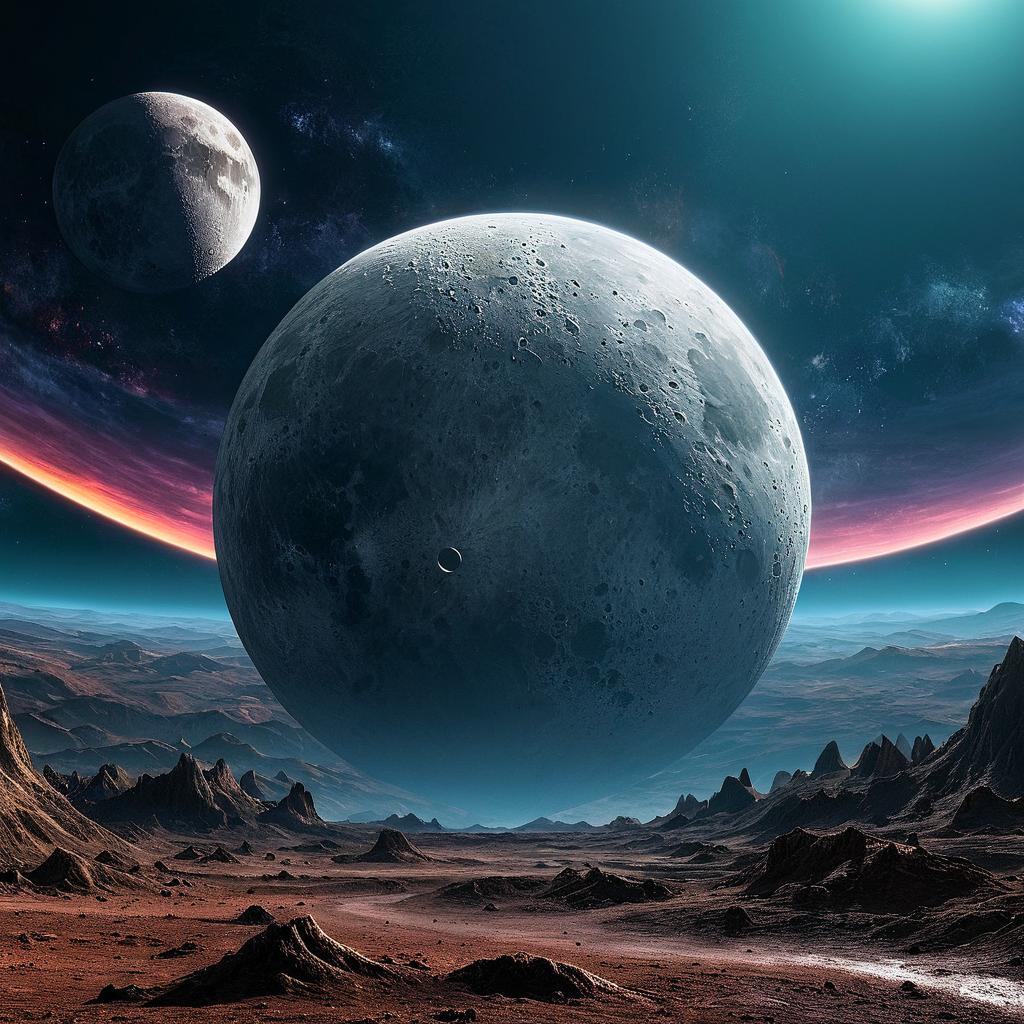
Imagine stepping outside after sunset and finding a lunar disk that dominates the sky.
Instead of appearing as a distant circle, the Moon might look like an enormous world suspended above the landscape. Mountains, craters, and broad dark plains would become more visually prominent. The familiar markings that people observe through telescopes would become easier to distinguish with the naked eye.
The Moon would no longer feel like a distant decoration. It would appear like a neighboring world drawing uncomfortably close.
Its brightness would also increase. Under otherwise comparable conditions, reflected sunlight received from the Moon would rise approximately with the inverse square of its distance.
A Moon at half the present distance could therefore appear about four times brighter, while a Moon at one-quarter the distance could appear about sixteen times brighter, assuming its orientation and illumination remained comparable.
Nighttime landscapes could look dramatically different.
Shadows might become sharper and more pronounced. The lunar glow could illuminate open fields, mountain slopes, and coastlines with a brilliance that people today might associate with unusually bright moonlit nights.
However, the Moon would not necessarily remain in the same position in the sky or produce an identical pattern of illumination. Those details would depend on its new orbit.
And while the spectacle might be beautiful, it would be only the visible beginning of a much larger transformation.
2. Ocean Tides Could Become Far More Powerful
If there is one consequence that scientists would immediately investigate, it is the effect on Earth’s oceans.
The Moon’s gravity contributes significantly to the tides experienced around the world. As the Moon approaches, the difference between its gravitational pull on the near side and far side of Earth becomes stronger.
This difference is called the tidal force.
It is what causes the oceans to respond to the Moon’s position, although actual tides also depend on the Sun, the shape of coastlines, ocean depth, and the geometry of individual seas.
Suppose the Moon moved to half its current distance.
Its tidal influence would become approximately eight times stronger, all else being equal.
That does not mean every coastline would experience tides exactly eight times higher. Ocean tides are complicated, and their actual heights depend on local geography and the dynamic behavior of the water.
Nevertheless, the change would be enormous.
Coastal communities could experience much more extreme tidal variations. Ports, beaches, estuaries, and low-lying coastal regions would face unfamiliar conditions. Areas that normally experience modest tidal ranges might undergo substantial changes, while places already prone to large tides could encounter even greater challenges.
The ocean would not simply rise everywhere by the same amount.
Instead, the pattern of high and low water would change according to the interaction between the stronger lunar forces and the shape of Earth’s oceans.
Some regions could experience particularly dramatic tidal responses. Others might experience less pronounced changes because local geography can amplify or suppress tidal movement.
If the Moon approached even more closely, the effects could become increasingly severe.
Imagine standing on a coastline where the familiar rhythm of the sea has become unpredictable. Harbors that once operated according to established tidal schedules would require new forecasts. Coastal ecosystems would face changes in water movement, sediment transport, and exposure to seawater.
Mangrove forests, tidal flats, coral reef environments, and estuaries all depend on particular combinations of water levels, currents, and exposure to the atmosphere.
A substantial change in tides could disrupt those conditions.
The oceans would still obey the same physical laws, but the environment built around their familiar behavior would have to adapt.
3. Coastal Flooding Could Become a Major Global Concern
Stronger tides would create another problem: the possibility of widespread coastal flooding.
The extent of the danger would depend on how close the Moon moved, how quickly the change occurred, and how the new gravitational conditions interacted with Earth’s existing ocean systems.
It is important to distinguish ordinary tides from tsunamis.
Tides are primarily driven by gravitational interactions involving the Moon and Sun. Tsunamis are generally generated by the displacement of large volumes of water, often following undersea earthquakes, landslides, or volcanic activity.
A closer Moon would not automatically generate a tsunami every time it moved through the sky.
However, substantially altered tidal conditions could increase coastal hazards and change the way existing ocean disturbances affect shorelines.
For example, a storm arriving during an unusually high tide could produce more damaging coastal flooding. Stronger tidal currents could also affect navigation, sediment movement, and the stability of some coastal structures.
If the Moon moved close enough for its gravitational influence to become extreme, the resulting ocean dynamics could be far more destructive than anything associated with normal lunar cycles.
Entire communities might need to reconsider where and how they build.
Ports, roads, power stations, water-treatment facilities, and transportation networks located near sea level could become more vulnerable. Emergency planners would need to use new tidal models to understand which areas were at greatest risk.
The impact would not be limited to the coastline itself.
Modern societies depend on interconnected systems. A disruption to a major port can affect international trade, food distribution, manufacturing, and fuel supplies far inland.
A change in the Moon’s orbit could therefore create consequences that extend well beyond the places where the water physically rises.
What began as an astronomical event could become a global engineering challenge.
4. Earth’s Crust Would Experience Stronger Tidal Forces
The oceans are not the only parts of Earth affected by the Moon’s gravity.
The solid planet also experiences tides.
Earth’s crust and mantle deform slightly under the changing gravitational influences of the Moon and Sun. These movements are normally small enough that people cannot feel them directly, but sensitive scientific instruments can measure them.
If the Moon moved closer, these solid-Earth tides would become stronger.
The resulting deformation would depend on the Moon’s distance, its orbital position, and the mechanical properties of Earth’s interior.
A closer Moon would also change the gravitational stresses acting on the planet. Scientists would need to investigate how these altered stresses interacted with existing geological conditions.
Could stronger lunar tides trigger earthquakes or volcanic eruptions?
The answer requires care.
Small tidal stresses can influence the timing of certain geological events under particular circumstances, especially when faults or volcanic systems are already close to failure. However, this does not mean lunar tides routinely cause major earthquakes, nor does it mean that every increase in tidal forces would automatically produce global volcanic activity.
A dramatically closer Moon would create a substantially different gravitational environment, but predicting specific earthquakes or eruptions would require detailed models of Earth’s complex interior.
The important distinction is between changing the forces acting on a geological system and knowing exactly how that system will respond.
We could expect scientists to monitor seismic activity, crustal deformation, and volcanic systems with exceptional urgency.
Even if the resulting geological effects varied considerably from place to place, the change would provide an extraordinary natural experiment in planetary physics.
Earth would still be the same planet, but it would be experiencing a gravitational relationship unlike the one its inhabitants had grown accustomed to.
5. The Night Sky Would Transform Into Something Almost Alien
The closer Moon would change more than the oceans and Earth’s crust. It would also transform the experience of observing the universe.
Astronomers would gain a spectacular opportunity to study the lunar surface.
Features that currently require binoculars or telescopes could become easier to see without specialized equipment. Depending on the new distance and viewing geometry, large lunar craters, mountain ranges, and dark plains could become dramatically more prominent.
Space agencies would also have a new scientific environment to investigate.
A closer Moon could potentially make some space missions shorter and reduce the travel time required for certain trajectories, although actual mission planning would depend on orbital mechanics, launch windows, and the Moon’s changing motion.
Yet the Moon’s enlarged appearance could create a surprising problem for astronomy on Earth.
A brighter Moon would scatter more sunlight through Earth’s atmosphere, increasing the brightness of the night sky. This would make faint stars and distant galaxies more difficult to observe with ground-based optical telescopes.
The most sensitive astronomical observations often require dark skies.
If moonlight became substantially stronger, astronomers might have to schedule more observations around periods when the Moon was below the horizon or otherwise less disruptive.
Some observations would become more difficult, while others could benefit from the Moon’s proximity.
It would be an unusual trade-off: humanity’s nearest celestial neighbor would become easier to study, but the distant universe might become harder to observe from the ground.
And for everyone else, the emotional experience of the night sky would change.
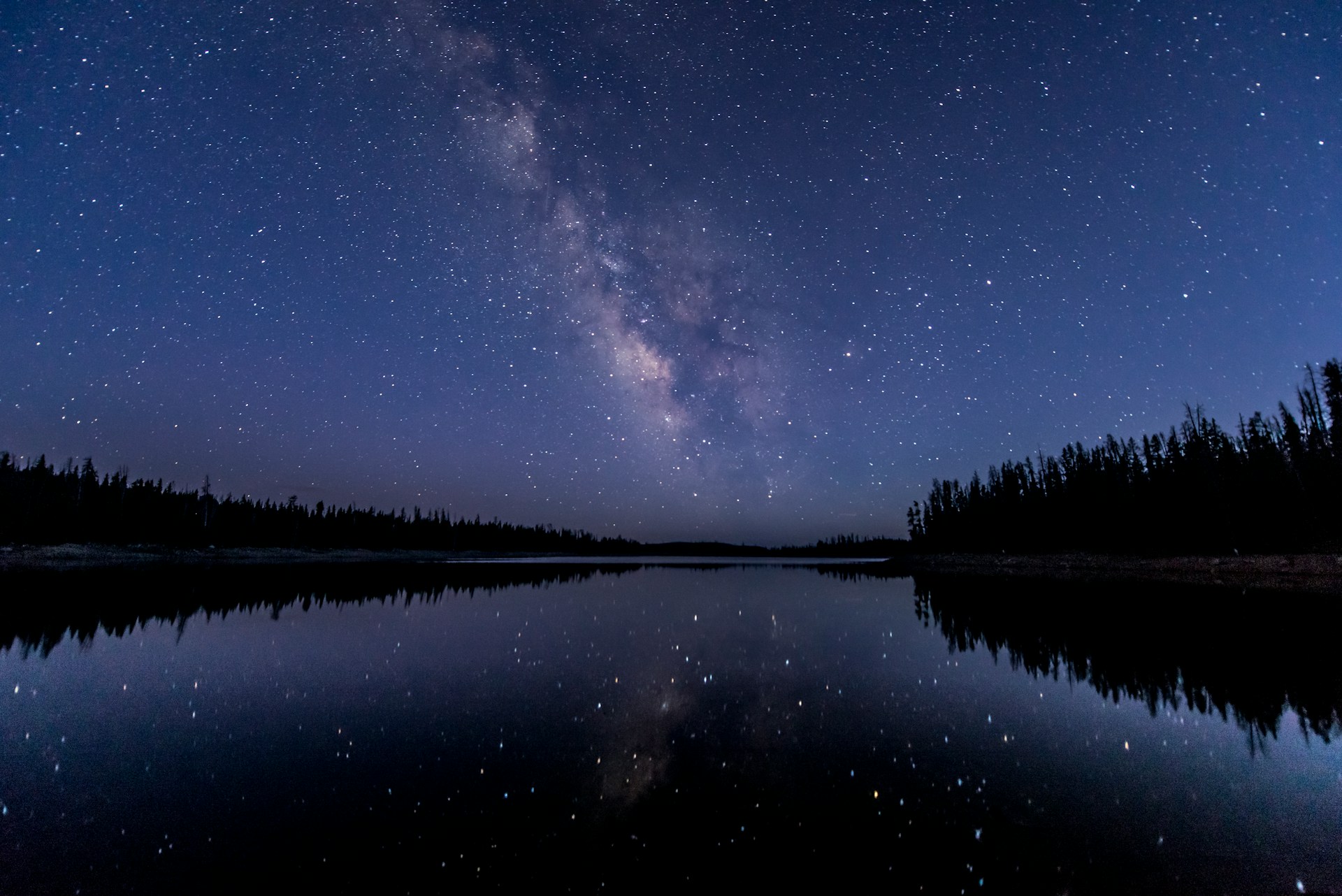
A huge Moon rising above a mountain range would be unforgettable. Its light reflecting across a lake could create a scene that seemed almost impossible to photograph.
Poets, photographers, filmmakers, musicians, and painters would find themselves with an entirely new source of inspiration.
But that beauty would exist alongside a physical reality that could not be ignored.
The closer the Moon came, the more important it would become to understand what its gravity was doing to Earth.
6. Earth’s Rotation and Day Length Could Change
Earth’s rotation and the Moon’s orbit are connected through gravity.
The Moon’s gravitational influence produces tidal friction. Over long periods, this process transfers rotational energy from Earth into the Earth-Moon system, causing Earth’s rotation to slow very gradually while the Moon moves away from us.
The present-day recession of the Moon is approximately 3.8 centimeters per year.
That change is extremely small on a human timescale, but over geological periods it becomes significant.
What if the process ran in the opposite direction and the Moon moved closer?
The answer depends on how the Moon’s orbital change occurred.
If it were somehow moved inward while retaining a suitable orbit, the new gravitational relationship would alter the exchange of angular momentum between Earth and the Moon. Depending on the orbit and its evolution, tidal interactions could change the rate at which Earth’s rotation slowed or sped up.
A sudden relocation would be especially complicated because the Moon’s orbital speed and direction would determine the resulting trajectory.
The Moon cannot simply be placed closer to Earth without considering orbital mechanics. A stable orbit at a smaller radius requires a different orbital speed, and an object that is moved inward with the wrong velocity may follow an eccentric orbit or fall toward its primary body.
Consequently, there is no single prediction for how quickly Earth’s day would change in every possible closer-Moon scenario.
What is clear is that a substantially altered orbit would change the tidal interactions that connect the two worlds.
Over time, that could influence Earth’s rotation and the Moon’s own orbital evolution.
For a hypothetical Moon that moved closer and remained there, scientists would need to calculate the combined behavior of both bodies rather than simply assume that a shorter distance automatically produces shorter days.
The universe rarely rewards oversimplified assumptions.
7. Could the Moon Eventually Break Apart?
This is where the hypothetical becomes especially dramatic.
There is a distance known as the Roche limit, beyond which the tidal forces exerted by a massive body can overcome the self-gravity holding a nearby satellite together.
The exact Roche limit depends on factors such as the densities of the two bodies and whether the satellite behaves like a rigid object or a loosely held collection of material.
For a fluid-like body with approximately the Moon’s density approaching Earth, the classical Roche limit is roughly 18,000 kilometers from Earth’s center. That is about 11,000 kilometers above Earth’s surface, although the precise outcome would depend on the physical characteristics of the approaching body.
The Moon’s current average distance is approximately 384,400 kilometers from Earth’s center.
That leaves an enormous gap between its present orbit and the approximate Roche limit.
But imagine the Moon somehow crossing that boundary.
Earth’s gravity would pull more strongly on the near side of the Moon than on its far side. If the resulting tidal forces became sufficiently strong, they could deform the Moon and potentially tear it apart.
The process would not necessarily happen at one exact distance or instant. The Moon’s internal structure, rotation, orbital eccentricity, and material strength would all matter.
A rigid body can resist disruption differently from a loosely bound or fluid-like object.
Still, if the Moon approached sufficiently close, tidal disruption could become a serious possibility.
Rather than remaining an intact sphere, the Moon could begin to deform and shed material. Fragments might spread along its orbit, creating a stream of debris around Earth.
Some material could remain in orbit, while other fragments might eventually collide with Earth or be scattered into different trajectories.
The result could be a temporary or longer-lived ring system, depending on how the debris evolved.
Saturn provides a spectacular example of a planet surrounded by rings, although its rings formed and evolved under different circumstances. Earth’s hypothetical lunar debris would not necessarily resemble Saturn’s rings in composition, brightness, structure, or longevity.
Nevertheless, the thought of Earth acquiring a ring system is fascinating.
From the ground, a ring of debris could appear as a broad band across the sky, depending on its orientation relative to Earth’s equator and the observer’s location.
The night sky might become more spectacular than anything humanity had ever witnessed.
However, a debris ring would not be a harmless decoration. Its evolution would depend on collisions, gravitational interactions, and the distribution of material. Some debris could eventually descend toward Earth, creating additional hazards.
A beautiful astronomical structure could emerge from a profoundly dangerous event.
8. Would the Moon Crash Into Earth?
Not every inward-moving Moon would inevitably collide with Earth.
Orbital mechanics allows a body to occupy many different trajectories, and the outcome depends on its speed, direction, and gravitational interactions.
A Moon placed in a stable circular orbit closer to Earth could, in principle, continue orbiting for some time. A Moon that lost too much orbital energy or followed an orbit intersecting Earth’s surface could instead approach a collision.
If the Moon were suddenly displaced closer without receiving the correct orbital velocity, its path could become highly eccentric. It might swing toward Earth, travel outward again, or eventually collide, depending on the new trajectory.
The consequences of an actual lunar collision would be catastrophic.
The Moon has approximately 1.23 percent of Earth’s mass. That may sound small, but it is still an extraordinary quantity of matter. The Moon’s mass is roughly 73.5 billion billion metric tons.
An impact involving a substantial fraction of that mass would release immense amounts of energy.
The collision would not resemble an ordinary asteroid impact. It would be a planet-scale event capable of radically reshaping Earth’s surface, atmosphere, and oceans.
Material could be vaporized, molten rock could spread across enormous regions, and the planet’s environment could become uninhabitable for complex life.
However, this is an extreme outcome, not the inevitable consequence of every closer lunar orbit.
The distinction matters because a Moon at half its present distance is a very different situation from a Moon passing dangerously close to Earth’s surface.
The original question is therefore not simply whether the Moon would become more dangerous. It is how far it moved, how quickly it moved, and what trajectory it followed.
Those details determine whether humanity would witness a spectacular astronomical transformation, face severe environmental disruption, or confront a planetary catastrophe.
9. What Would Happen to Life on Earth?
Life has developed within a particular range of environmental conditions.
Organisms living along coastlines are especially sensitive to tidal cycles. Many marine species synchronize feeding, reproduction, migration, or egg-laying with changes in water level and the timing of tides.
A substantial increase in tidal strength could alter these patterns.
Some coastal habitats might experience more frequent or more extensive flooding. Others could face stronger currents, changes in sediment distribution, or shifts in the amount of time they spend exposed to the atmosphere.
Species that depend on predictable tidal cycles could struggle to adapt if the changes occurred quickly.
Marine ecosystems would not respond uniformly. Some organisms might benefit from altered conditions, while others could lose suitable habitats or face new environmental stresses.
The consequences for land-based life would depend on the broader effects of the changing Moon-Earth system.
If the Moon remained at a moderately closer distance without triggering extreme geological or oceanic disruption, life would not automatically disappear. Organisms are capable of adapting to environmental changes, although the speed and scale of the change would strongly influence which species could survive.
If the Moon approached close enough to cause widespread coastal destruction, severe gravitational disturbances, or eventual collision, the risks to ecosystems would become much greater.
Human civilization would face its own challenges.
Agriculture, freshwater supplies, transportation, coastal settlements, and energy infrastructure could all be affected by changes in ocean behavior and other environmental conditions.
The most immediate difficulties would likely involve predicting the new conditions and protecting vulnerable communities.
Scientists would need to work alongside engineers, meteorologists, oceanographers, ecologists, and emergency planners.
In this hypothetical, understanding the Moon would become essential to managing life on Earth.
10. Could Humanity Do Anything About It?
If the Moon began moving closer, humanity’s first priority would be understanding what was happening.
Astronomers would measure its position and velocity. Space agencies would calculate its trajectory. Researchers would use gravitational models to estimate future tidal effects, while oceanographers would investigate how the altered forces might influence coastlines around the world.
The ability to predict the Moon’s path would be crucial.
If the change were gradual, scientists might have considerable time to develop more accurate models, monitor environmental effects, and help governments prepare.
If the Moon were moving inward rapidly, the available response time could be much shorter.
Could humanity push the Moon back into its original orbit?
With present-day technology, there is no practical way to move an object as massive as the Moon by the enormous amount that such a scenario might require.
The Moon’s mass is approximately (7.35 \times 10^{22}) kilograms. Changing its orbit substantially would require an extraordinary amount of energy or a sustained transfer of momentum.
Even the most ambitious current space-engineering projects operate on a vastly smaller scale.
Humanity could potentially develop strategies to reduce some consequences of a changed lunar orbit, such as improving coastal protection, updating navigation systems, and revising disaster-preparedness plans.
But redirecting the Moon itself would be far beyond our current capabilities.
If the hypothetical were caused by an unknown force or an extraordinary astronomical event, the first challenge would be identifying its cause and determining whether the movement could be stopped.
Until then, humanity would have to rely on observation, prediction, and preparation.
The situation would be a reminder that technological progress does not eliminate our dependence on the physical universe.
We can build satellites, launch spacecraft, map distant galaxies, and develop increasingly powerful computers. Yet our civilization remains deeply connected to the gravitational relationships that govern the planet we inhabit.
The Moon Is a Neighbor We Should Never Take for Granted
The Moon has accompanied Earth for billions of years.
Its presence has influenced the evolution of the Earth-Moon system, shaped ocean tides, and provided a natural laboratory for understanding the history of our Solar System.
Today, its distance and movement are measured with extraordinary precision. Scientists can track its orbit, investigate its geological history, and study the subtle effects of its gravitational influence on Earth.
Under normal circumstances, the Moon is not approaching us. It is gradually moving away at a rate of a few centimeters each year.
That makes the hypothetical scenario all the more fascinating.
If the Moon suddenly moved much closer, the night sky could become astonishingly beautiful. Lunar features would appear larger, moonlight would brighten the landscape, and astronomers would gain new opportunities to study our nearest celestial neighbor.
But the same gravitational forces responsible for that spectacle could also transform ocean tides, affect coastal environments, and create increasingly severe hazards if the Moon approached too closely.
At extreme distances inward, tidal disruption and collision scenarios could turn the event into a planetary catastrophe.
The outcome would depend on orbital mechanics, the Moon’s new distance, and the speed and circumstances of its movement.
There is a deeper lesson hidden inside this thought experiment.
Earth is not an isolated object floating independently through space. It belongs to a dynamic system of interacting worlds, each exerting gravitational influences on the others. The conditions that make our environment familiar are connected to relationships that extend far beyond the atmosphere.
The Moon may look peaceful, but its presence is part of an immense cosmic balancing act.
So the next time you look up at the night sky, take a moment to appreciate that familiar silver disk.
It is close enough to influence our oceans, distant enough to remain safely in orbit, and large enough to remind us that even the quietest objects in the universe can play extraordinary roles in shaping a world.
And perhaps that is the most fascinating part of the question.
The Moon does not need to crash into Earth to change everything.
Sometimes, all it would take is a change in distance—and a universe whose rules have never stopped being remarkable.

