10 Strange Facts That Send You Down a Rabbit Hole
There are facts you learn once and immediately forget.
Then there are facts that refuse to leave.
You read one sentence, pause for a moment, and suddenly you are searching for another explanation. Then another. Then another. Twenty minutes later, you have somehow gone from reading about an ordinary object on your desk to learning about ancient civilizations, deep-sea creatures, computer algorithms, forgotten inventions, and the mathematics of things you never knew had mathematics.
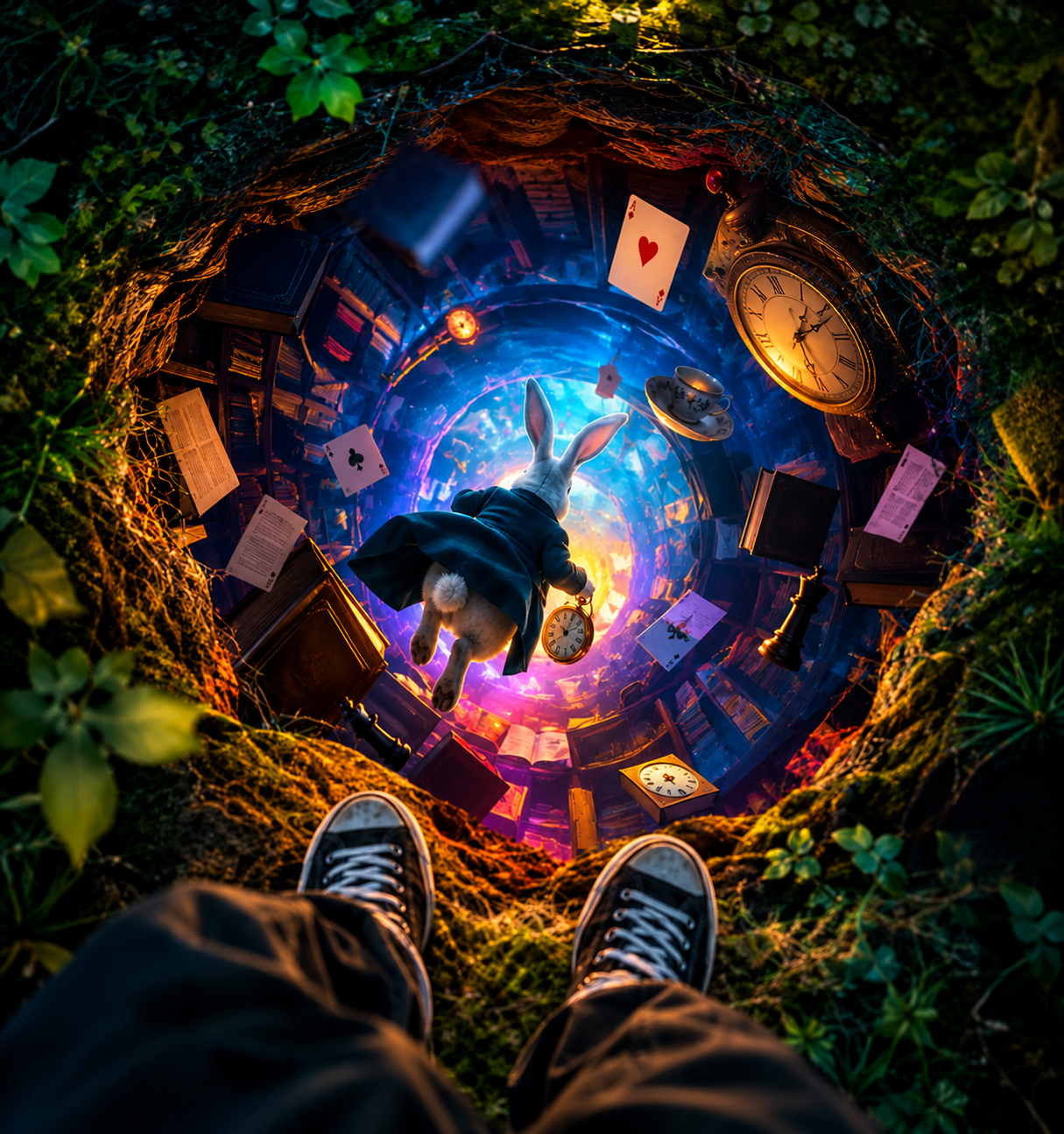
That is the beauty of a rabbit hole.
A rabbit hole begins with curiosity.
It rarely ends there.
The internet has made this experience almost effortless. One strange fact can become a doorway into an entire world of knowledge. Sometimes the most interesting discoveries are not the complicated ones. They are the small observations hiding inside ordinary things.
A clock.
A banana.
A computer.
A cloud.
A map.
A song.
Something you have seen hundreds of times can suddenly become fascinating once you know the story behind it.
Here are ten strange facts that can send you down a rabbit hole.
1. A Day on Venus Is Longer Than a Year on Venus
Venus has one of the strangest relationships with time in our solar system.
A year on Venus—the time it takes to orbit the Sun—is about 225 Earth days.
But one rotation of Venus on its axis takes about 243 Earth days.
That means Venus takes longer to rotate once than it takes to complete an orbit around the Sun.
That sentence alone is enough to make you stop.
Imagine living on a planet where your “day” is longer than your “year.”
The strange part becomes even more interesting when you discover that Venus rotates in the opposite direction from most of the planets in our solar system.
This leads to another question.
Why?
And that question leads to planetary formation, collisions between young worlds, gravitational interactions, atmospheric effects, and the chaotic history of the early solar system.
Suddenly, a strange fact about Venus becomes a lesson in how planets are built.
That is how rabbit holes work.
You begin with a number.
You end up thinking about the history of an entire planet.
2. Bananas Are Berries, But Strawberries Technically Aren’t
Botany has a habit of making everyday language surprisingly complicated.
In ordinary conversation, we have a clear idea of what a berry looks like.
Small.
Round.
Juicy.
Often colorful.
But botanical definitions do not care much about what we casually call things.
From a botanical perspective, bananas qualify as berries because they develop from a single flower with a particular structure.
Strawberries, meanwhile, do not technically qualify as berries in the botanical sense.
This is one of those facts that sounds almost like a joke.
Then you start investigating.
What exactly makes something a berry?
Why do bananas develop the way they do?
What is the difference between a botanical fruit and a culinary fruit?
Why do some fruits have seeds on the outside?
And suddenly you are looking at diagrams of flowers and learning about ovaries, reproductive structures, and plant development.
The banana sitting in your kitchen has become a biology lesson.
There is something beautiful about that.
Nature does not organize itself according to the categories humans casually create.
We give things names because names help us navigate the world.
But underneath those names is a much stranger and more detailed system.
3. There Are More Possible Chess Games Than Atoms in the Observable Universe
Chess looks simple.
A board.
Thirty-two pieces at the beginning.
A fixed set of rules.
Yet the number of possible chess games is enormous.
Estimates of the number of possible chess games are often placed around 10¹²⁰ or higher, depending on how games are counted and what assumptions are made.
The estimated number of atoms in the observable universe is often around 10⁸⁰.
That means the space of possible chess games is vastly larger than the number of atoms in the observable universe.
Think about that.
A physical board with sixty-four squares can produce an almost unimaginable number of different sequences.
This is where chess turns into computer science.
You start thinking about search trees.
Then algorithms.
Then optimization.
Then artificial intelligence.
Then why computers can evaluate millions or billions of positions while still needing sophisticated strategies to make good decisions.
A chessboard becomes a model of a much bigger idea:
Complexity can emerge from simple rules.
This idea appears everywhere in computing.
A few lines of code can produce millions of possible states.
A small set of rules can create complicated behavior.
A simple game can become an enormous mathematical universe.
The rabbit hole is no longer about chess.
It is about complexity itself.
4. Your Brain Is Constantly Predicting What Happens Next
Your brain does not simply sit there waiting for reality to arrive.
It constantly works with expectations.
You hear the beginning of a familiar song and can often predict what comes next.
You see someone reach toward a cup and understand what they are probably about to do.
You read a sentence and can sometimes predict the next word before you finish it.
You walk through your home without consciously thinking about every step.
Much of everyday life depends on expectations built from previous experience.
This becomes fascinating when you realize how much of perception involves interpretation.
The world provides information.
Your brain processes that information using previous knowledge and context.
That raises a much bigger question:
How much of what we experience is direct observation, and how much is interpretation?
That question can take you into neuroscience, psychology, artificial intelligence, machine learning, language models, visual perception, memory, and even interface design.
Computers are increasingly being designed to predict.
Humans are prediction machines in their own way.
Every autocomplete suggestion, recommendation system, navigation route, and language model raises the same basic computational idea:
Given what happened before, what is likely to happen next?
A simple observation about the brain becomes a rabbit hole into the architecture of intelligence.
5. The Smell After Rain Has a Name
There is something strangely satisfying about the smell of rain.
Especially after a long dry period.
The ground changes.
The air feels different.
The atmosphere seems cleaner.
And there is a distinctive earthy smell that many people recognize immediately.
That smell has a name: petrichor.
The word itself is fascinating.
It was coined by researchers in the 1960s to describe the pleasant earthy scent associated with rain.
One contributor to the smell is a compound called geosmin, which is produced by certain microorganisms in soil.
When raindrops hit the ground, they can help release tiny particles and compounds into the air.
So the smell that feels almost poetic has a scientific explanation.
But knowing the explanation does not make it less beautiful.
If anything, it makes the experience more interesting.
Now you can ask:
Why does rain smell different in different places?
Why does the smell seem stronger after dry weather?
Why do humans detect geosmin so easily?
What role do soil microorganisms play in ecosystems?
How do plants interact with the atmosphere?
Suddenly, a rainy afternoon becomes microbiology.
This is one of my favorite kinds of rabbit hole.
The kind where science does not remove the mystery.
It adds another layer to it.
6. Some Trees Communicate Through Underground Networks
Forests can look incredibly quiet.
Trees stand still.
Branches move with the wind.
Leaves respond to sunlight.
From a distance, the forest appears almost motionless.
But underneath the surface, an enormous biological network can exist.
Fungi form relationships with plant roots, creating structures known as mycorrhizal networks.
These networks can connect plants and facilitate the movement of nutrients and chemical signals within ecosystems.
This has sometimes been described in popular discussions as a “wood wide web.”
The metaphor is memorable because it resembles something familiar from computing.
But the biological system is much more complicated than simply saying trees have an internet.
And that distinction makes the topic even more interesting.
The real rabbit hole is the relationship between organisms.
A tree is not necessarily an isolated object.
Its life is influenced by soil, fungi, insects, bacteria, neighboring plants, water, sunlight, and countless other interactions.
That changes how you look at a forest.
What appears to be a collection of individual trees can actually be part of a much larger ecological system.
The same idea appears in software architecture.
A component may look independent.
But its behavior can depend on dozens of relationships around it.
Sometimes the most important part of a system is not the individual object.
It is the connections between objects.
7. The First Computer Programmers Were Not All Working With Modern Computers
When people hear “programmer,” they often imagine someone sitting in front of a modern laptop.
But the history of programming goes much further back.
One of the most famous early figures associated with computer programming is Ada Lovelace.
In the nineteenth century, Lovelace wrote notes about Charles Babbage’s proposed Analytical Engine and described a method for calculating Bernoulli numbers.
The machine itself was never completed in the form originally envisioned.
Yet the ideas surrounding it were remarkably forward-looking.
Lovelace recognized that a general-purpose machine could potentially manipulate symbols beyond simple numerical calculations.
That idea is fundamental to modern computing.
A computer does not fundamentally care whether the data represents numbers, words, images, music, or video.
At a low level, everything can be represented as information.
This is one of those ideas that can completely change the way you see computers.
Your phone is not “a phone” in the narrow sense.
It is a programmable machine capable of transforming information.
A camera becomes software.
A music player becomes software.
A map becomes software.
A game becomes software.
A bank becomes software.
A communication system becomes software.
Once you understand that, you start seeing computers less as machines with fixed purposes and more as machines for transforming ideas into processes.
And that is a very deep rabbit hole.
8. The Moon Is Slowly Moving Away From Earth
The Moon feels permanent.
It has been in the night sky for as long as human history can remember.
But its relationship with Earth is not completely static.
The Moon is slowly moving away from Earth.
The average rate is roughly 3.8 centimeters per year.
This happens because of tidal interactions between Earth and the Moon.
Earth’s rotation and the Moon’s orbit are connected through the transfer of angular momentum.
The result is that Earth’s rotation is gradually slowing while the Moon moves farther away.
At today’s rate, the change is extremely small on a human timescale.
You would never notice it by looking at the Moon tonight.
But over enormous spans of time, tiny changes become significant.
This is another recurring pattern in nature.
Small does not necessarily mean unimportant.
A centimeter repeated over millions of years becomes something much larger.
The same principle appears in technology.
A tiny improvement repeated every day can become a dramatic transformation over years.
A few lines of code can become a huge software system.
A small habit can become part of someone’s identity.
A small decision can change the direction of a project.
Scale changes everything.
9. Your Computer Can Generate Random Numbers Without Truly “Knowing” Randomness
Randomness sounds simple.
Pick a number.
Any number.
But computers are deterministic machines.
If a computer follows exactly the same instructions with exactly the same starting conditions, it will generally produce the same result.
So how does a computer generate something that looks random?
Often through pseudorandom number generators.
These algorithms start with an initial value called a seed and produce sequences that appear random for practical purposes.
If you know the algorithm and the seed, you can reproduce the sequence.
That is actually extremely useful.
Games need randomness.
Simulations need randomness.
Scientific experiments can use random sampling.
Cryptography needs carefully designed sources of unpredictable randomness.
And this leads to another fascinating distinction:
Random-looking is not necessarily random.
A sequence can appear unpredictable while being generated by a completely deterministic process.
That distinction matters enormously in computing.
It teaches a broader lesson too.
Appearances are not always explanations.
Something can behave in a complicated way because a relatively simple mechanism is operating underneath.
This is one reason programmers love debugging.
You see an unexpected result.
Then you start following the breadcrumbs.
A strange output.
A function.
A variable.
A dependency.
A hidden state.
Eventually, the mystery becomes understandable.
The rabbit hole turns into a map.
10. There Is No Single “Color” Called Blue in the World
This one sounds philosophical, but it begins with something very physical.
Light exists across a range of wavelengths.
Objects interact with light in different ways.
Your eyes detect portions of the electromagnetic spectrum, and your brain processes those signals into visual experiences.
When you look at a blue object, you are not literally receiving “blue” as a physical substance from the object.
You are receiving light with particular properties, and your visual system interprets that information as a color experience.
That leads to an enormous rabbit hole.
What is color?
Why do different animals see different parts of the electromagnetic spectrum?
Why can some animals detect ultraviolet light?
Why does lighting change how colors appear?
Why can two people sometimes describe the same color slightly differently?
Why do screens create millions of colors using combinations of only a few channels?
A simple blue button on a website can therefore lead into optics, biology, neuroscience, physics, digital displays, design, photography, and computer graphics.
This is what makes ordinary reality so fascinating.
The things we take for granted are often interfaces hiding complicated systems underneath.
A color is an interface.
A sound is an interface.
A photograph is an interface.
A computer screen is an interface.
Even a word is an interface between an idea and a human mind.
Once you start noticing that, almost everything becomes interesting.
The Rabbit Hole Is the Point
The best strange facts are not necessarily the ones that sound the most unbelievable.
They are the ones that open doors.
You learn that Venus has a longer day than year.
That leads to planetary science.
You discover that bananas are berries.
That leads to botany.
You discover that chess has an enormous number of possible games.
That leads to mathematics and computer science.
You learn that rain has a smell with a name.
That leads to microbiology.
You discover that forests contain complex relationships beneath the soil.
That leads to ecology.
You learn that computers can produce sequences that only appear random.
That leads to algorithms and cryptography.
One fact becomes ten questions.
Ten questions become a hundred.
Eventually, curiosity stops being about finding an answer.
It becomes about understanding the system behind the answer.
That is one of the most enjoyable parts of learning.
You do not always need a course.
You do not always need a textbook.
Sometimes you just need one strange sentence.
Something that makes you pause and say:
“Wait. How is that possible?”
That question is powerful.
It is the beginning of research.
It is the beginning of experimentation.
It is the beginning of programming.
It is the beginning of invention.
It is the beginning of creativity.
Some of the best ideas begin with a tiny moment of confusion.
A programmer sees an unexpected output.
An engineer notices something behaving differently.
An artist sees a strange combination of colors.
A musician hears an unusual sound.
A scientist notices an unusual pattern.
Someone simply asks a question that nobody around them was asking.
Then they follow it.
One link becomes another.
One observation becomes another.
One idea connects to another.
And eventually, the rabbit hole becomes a path.
Maybe that is why strange facts are so addictive.
They remind us that the world is much larger than our everyday experience.
There are patterns underneath the patterns.
Systems underneath the systems.
Stories behind ordinary objects.
History behind familiar technologies.
Mathematics behind games.
Biology beneath forests.
Physics inside colors.
Algorithms inside applications.
And questions hiding inside answers.
The world is full of doors.
Sometimes all it takes to open one is a strange fact.
And sometimes, once you open it, you have no idea where you are going to end up.
That is the fun.
Keep following the questions.
You never know what you will find at the bottom of the rabbit hole.
Software in My Mind. Rock in My Soul.