


The Fish That Build Elaborate Geometric Patterns on the Ocean Floor
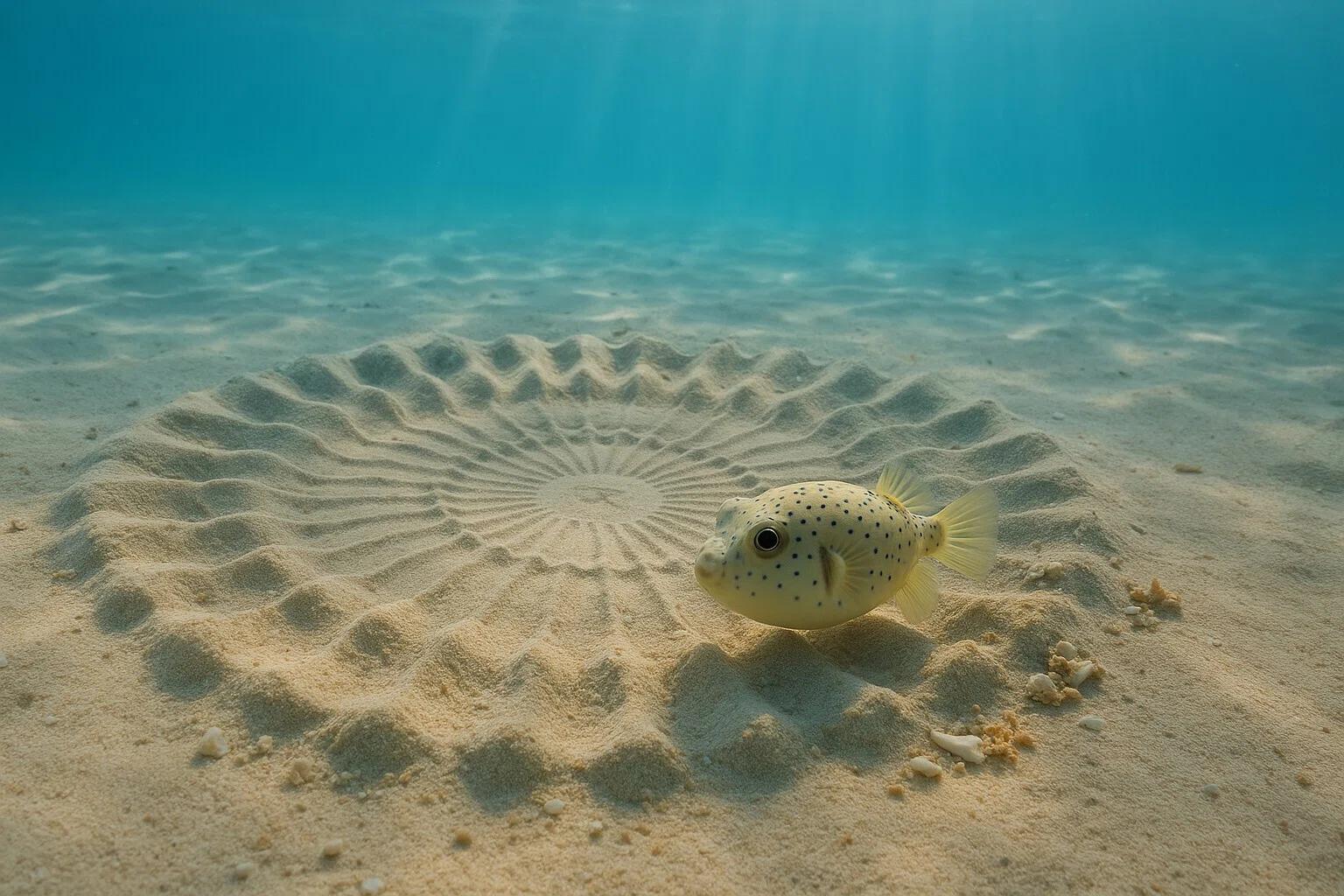
Deep beneath the ocean’s surface, a small fish creates enormous geometric masterpieces in the sand. The mystery is not who designed them, but how evolution turned an ordinary seabed into a canvas for one of nature’s most extraordinary courtship displays.
There are places on Earth where nature appears to have borrowed the imagination of an architect.
Mountains rise in almost impossible shapes. Snowflakes develop intricate symmetrical patterns. Spiders construct webs that resemble delicate engineering projects, while birds build nests using materials gathered from their surroundings. Yet beneath the ocean, in a world where sunlight fades and the seabed stretches into seemingly endless darkness, another kind of architect has been quietly creating masterpieces.
Its building material is sand.
Its tools are fins and a remarkably determined body.
And its finished product can resemble a gigantic geometric mandala, complete with circular ridges, carefully arranged grooves and patterns radiating outward from a central point.
The surprising part? The architect is a fish.
Meet the white-spotted pufferfish, a small marine animal whose extraordinary courtship behavior has fascinated scientists, photographers and ocean enthusiasts. In particular, male white-spotted pufferfish have become famous for constructing elaborate circular structures on the seabed, transforming ordinary sand into one of the most visually remarkable displays of animal behavior known to science.
These structures are not random disturbances left behind by a fish swimming around. They are organized formations with repeating geometric features, carefully shaped ridges and intricate patterns.
For years, underwater photographs of these mysterious circles have circulated widely, sometimes appearing so precise that viewers wonder whether a human hand must have been involved.
But no human architect is hiding beneath the waves.
The designer is a fish, the construction site is the ocean floor, and the purpose of the entire project is connected to one of the oldest and most fascinating forces in the natural world: reproduction.
What makes the story even more remarkable is that these structures are not permanent monuments. They are temporary creations built by a small animal working in an environment where currents, waves and passing creatures can disturb its carefully arranged sand.
This is a story about geometry without mathematics lessons, architecture without blueprints and an animal whose behavior challenges our assumptions about what intelligence, design and craftsmanship can look like in nature.
1. An Architect Smaller Than Its Masterpiece
Imagine descending through clear blue seawater until the surface becomes a distant, shimmering ceiling. Sunlight filters through the water in shifting columns, illuminating the seabed below.
At first, the landscape looks ordinary.
There is sand, scattered marine life and perhaps a few rocks. Nothing suggests that the area is about to become the location of an extraordinary construction project.
Then you notice a circular formation.
It spreads across the seabed like an enormous flower made from sand. Its outer edge is decorated with repeated grooves, while raised ridges divide the surrounding surface into intricate sections. The pattern appears deliberate, balanced and surprisingly symmetrical.
Some formations measure roughly two metres across, making them enormous relative to the fish responsible for creating them.
The builder is the male white-spotted pufferfish, scientifically known as Torquigener albomaculosus. The species was described by scientists in 2014 following research in Japanese waters, including the region around Amami-Oshima.
The fish itself is not a giant marine creature. Like many pufferfish, it has a compact body and distinctive appearance. Its natural proportions make its construction achievement even more impressive.
A human standing beside a structure two metres wide might not consider it particularly enormous. But imagine constructing a building many times your own body length using nothing but your body, the surrounding environment and a series of repeated movements.
That is a much better way to appreciate the scale of this fish’s work.
The male does not simply swim around until the sand happens to form an attractive arrangement. He actively manipulates the seabed, creating channels and ridges through repeated movements of his fins and body.
The result is a carefully organized structure that serves a biological purpose.
This is where the story becomes particularly interesting: the fish is not building a home in the conventional sense. He is creating a courtship display, a temporary environment intended to attract a female and provide a suitable place for reproduction.
The seabed becomes a stage, the geometry becomes part of the performance, and the fish becomes both builder and performer.
2. How a Fish Draws Circles in the Sand
The construction process begins with a simple material: loose sediment on the ocean floor.
There are no tools in the human sense. No measuring tape, no compass, no wooden framework and certainly no computer-assisted design software.
Instead, the pufferfish uses its body and fins to move sand.
The male swims close to the seabed, repeatedly beating his fins to disturb and redistribute the sediment. By moving through particular paths and working the same area over time, he gradually creates a circular arrangement of ridges and grooves.
The construction is not completed in one dramatic movement. It develops through many small actions.
A fish passes over the sand. A groove becomes deeper. A ridge takes shape. Another section is adjusted. Gradually, a recognizable pattern emerges.
The process resembles a natural form of iterative design: create a section, modify it, repeat the movement and continue until the larger structure develops.
Of course, the fish is not necessarily following a conscious architectural plan in the human sense. Its behavior is better understood through the interaction of evolved instincts, sensory information, movement and environmental conditions.
Nevertheless, the resulting structure is genuinely complex.
The central area is surrounded by carefully arranged channels, and the outer sections feature repeated radial patterns. The ridges and grooves help produce the distinctive appearance that makes these constructions so striking in photographs.
The fish also has to contend with the physical properties of its environment. Sand behaves differently depending on grain size, water movement and the characteristics of the seabed. A ridge that forms easily in one location may be difficult to maintain in another.
Every movement matters because the material is loose and the building site is underwater.
This is not architecture in the conventional human sense, but it demonstrates something equally fascinating: complex structures can emerge from repeated biological behavior operating within the rules of physics.
No concrete is required. No steel supports are necessary. The design emerges from motion, material and time.
And because the builder is a living animal, the entire process is connected to a practical biological objective rather than an interest in decoration alone.
3. Why Does the Fish Build Such an Elaborate Pattern?
The obvious question is why a fish would invest so much effort in creating an elaborate arrangement of sand.
The answer lies in courtship.
Male white-spotted pufferfish construct these circles as part of their reproductive behavior. The formations function as courtship displays and spawning sites, helping males attract females.
In the natural world, courtship can take many forms.
Some birds display colorful feathers. Others perform dances, sing elaborate songs or construct nests. Certain insects produce sounds, while some marine animals change their colors or perform repeated movements to attract potential mates.
The pufferfish takes a different approach.
Instead of relying only on its appearance or movements, it changes the environment around itself.
It builds something.
That distinction is remarkable because the structure becomes part of the courtship display. The male’s work creates a visual feature on the seabed that would not ordinarily exist in that form.
The circle also provides a location where reproduction can take place. Females can inspect the construction, and successful courtship may lead to spawning in the central area.
Researchers have studied the behavior because it provides an unusual opportunity to investigate how animals construct structures that influence reproductive success.
Why should a female choose one male rather than another? What features of the formation matter? How much do the fish respond to environmental conditions? These are questions that behavioral ecology can investigate through observation and experimentation.
One important point is that the structure should not be treated as proof that the fish understands geometry as a human mathematician would.
A human architect might draw circles using a compass and calculate angles using mathematical formulas. A pufferfish does not need to perform those activities to produce a geometric pattern.
Its behavior can generate a complex outcome without requiring human-like mathematical reasoning.
Nature repeatedly demonstrates this distinction. A spider can create a remarkably organized web without using engineering software, and a bird can construct a functional nest without studying structural mechanics.
The pufferfish belongs to this wider story of animals whose evolved behaviors produce structures that appear designed because they perform specific functions.
The result is not less fascinating because it has a biological explanation.
In many ways, the explanation makes it more fascinating.
4. The Secret Behind the Circle’s Geometry
The most captivating feature of the pufferfish’s construction is its geometry.
Look closely at photographs of these formations, and the seabed begins to resemble a carefully planned mathematical illustration. Grooves radiate outward from the centre. Ridges form repeating patterns, and the circular arrangement gives the entire structure a sense of order.
Why does this happen?
Part of the explanation lies in the way the fish moves.
As the male swims across the sand, his fins disturb and displace sediment. Repeated movements along particular paths create grooves, while the redistribution of sand helps form raised ridges. When the fish repeats this process around a central area, the movements can produce a radial pattern.
In other words, the geometry is closely connected to the mechanics of construction.
The fish does not need to draw a perfect circle on a flat surface before beginning. Its repeated movements help establish the shape as the structure develops.
This is an important distinction between the finished result and the process that creates it. When we look at a completed circle, we see the whole pattern at once. The fish experiences the construction as a sequence of movements, adjustments and interactions with the seabed.
It is similar to watching a complicated drawing appear through hundreds of individual pencil strokes. The final image looks unified, even though it was created one action at a time.
There is also an important role for the surrounding environment. Gravity, water movement and the physical properties of sand influence which shapes can form and how long they remain intact.
The fish is therefore not working in isolation. Its behavior interacts with the laws of physics, producing a structure that reflects both biological activity and environmental conditions.
This combination is one reason the formations have attracted scientific interest. They offer an opportunity to study how repeated animal movements can create organized patterns on a scale much larger than the animal itself.
The ocean floor becomes a record of behavior.
Instead of reading words or examining blueprints, a researcher can study the grooves and ridges to understand something about the animal that made them.
The construction is both a physical object and evidence of a living process.
5. A Construction Project That Can Take Days
Creating a structure of this complexity requires considerable effort.
The male pufferfish must repeatedly move across the seabed, displacing sand and shaping the surrounding area. Construction can take several days, depending on conditions and the progress of the fish.
That is a substantial investment for a small marine animal.
Imagine spending hours carefully arranging the surface of a sandy beach, only to discover that a passing wave has disturbed part of your work. You would need to repair the damage or begin again.
The pufferfish faces comparable challenges, although underwater currents and sediment movement create their own set of conditions.
The fish must maintain the structure as it develops, refining the pattern and keeping the central area suitable for its intended purpose.
This makes the process more than a single act of construction. It is an ongoing interaction between the builder and the building site.
The male’s success depends on more than the ability to produce an attractive pattern. He must also complete the structure under suitable environmental conditions and attract a female.
From an evolutionary perspective, this helps explain why such elaborate behavior can persist. If the structure contributes to reproductive success, the energy spent constructing it can have a biological benefit.
That does not mean every construction attempt succeeds. Natural behavior takes place in environments full of uncertainty, and not every courtship display results in reproduction.
Nevertheless, the behavior illustrates a principle found throughout nature: an animal may invest substantial resources in an activity that improves its chances of passing its genes to the next generation.
For humans, this might sound like an unusual use of time and energy.
For the pufferfish, it is part of the reproductive strategy shaped by its evolutionary history.
And unlike a human building project, there is no expectation that the finished structure will remain intact for decades.
Its value is connected to a particular stage in the animal’s life.
Once that purpose has been fulfilled, the sand can return to its ordinary state.
6. The Female Is More Than an Audience
It is tempting to imagine the female pufferfish arriving at the completed formation as a visitor admiring an underwater art exhibition.
The analogy is visually appealing, but the biology is more interesting than that.
The female’s role is not simply to appreciate the pattern. Her interaction with the male and the structure is part of a reproductive process.
A female may inspect the construction before mating and spawning occur. The central region serves as the spawning site, connecting the elaborate outer pattern with the biological function of the entire formation.
This raises an intriguing question: what makes one construction suitable or attractive compared with another?
Researchers have investigated the relationship between the male’s construction behavior, the characteristics of the resulting formation and reproductive success. Such questions are central to the study of sexual selection, a field that examines how traits and behaviors influence mating opportunities.
In some animal species, females respond to physical characteristics that indicate health, condition or the ability to acquire resources. In others, elaborate displays may play a role in mate choice.
However, it is important not to assume that every groove in the pufferfish’s formation has a specific meaning to the female. A visually impressive feature does not automatically prove that the animal consciously evaluates that feature in the same way a human evaluates a painting.
The exact contribution of individual design elements is a scientific question, not something that can be established from appearance alone.
What is clear is that the formation belongs to a broader reproductive behavior rather than being an arbitrary decoration.
The fish’s construction has a purpose, and its purpose connects physical labor with the continuation of its species.
That connection makes the structure especially interesting. The geometry is not merely something beautiful to look at; it is part of a living interaction between two animals.
7. What Happens After the Fish Finishes Building?
One of the most surprising aspects of these formations is their temporary nature.
People often associate impressive structures with permanence. We build monuments, bridges and houses because we expect them to remain useful for years or even centuries.
The pufferfish’s circle operates on a different timeline.
It is constructed for a particular reproductive opportunity. Its significance is tied to the animal’s courtship and spawning behavior, not to its ability to survive indefinitely.
After the reproductive process, the formation may gradually lose its shape as water movement and other environmental forces redistribute the sand.
The precise timing depends on local conditions. Some structures may remain recognizable for a period, while others can be altered relatively quickly.
Eventually, the seabed may return to an appearance that seems ordinary to a passing observer.
But the disappearance of the structure does not mean the construction was pointless.
A bird’s nest can be abandoned. A spiderweb can be destroyed by rain. A beaver dam can be damaged by changing water levels. These structures matter because of what they enable during the period in which they are used.
The pufferfish’s formation belongs to the same broad category of temporary biological architecture.
Its lifespan is measured not by how long it survives as an object, but by its role in the animal’s reproductive cycle.
This offers a useful way to think about nature’s designs. Permanence is not always the objective. Sometimes, a structure only needs to exist long enough to fulfil a specific function.
The most successful construction is not necessarily the one that lasts the longest.
It may be the one that works when it matters.
8. What These Fish Can Teach Us About Design
The pufferfish’s extraordinary behavior also invites comparisons with human engineering and creative work.
Consider how people approach complicated projects. A software developer begins with a goal, breaks the problem into smaller tasks, tests individual components and gradually assembles a functioning system.
An architect considers materials, environmental conditions, structural requirements and the needs of the people who will use a building.
An artist may repeat small movements until a larger composition begins to emerge.
The pufferfish is not performing these activities in a human professional sense, but its construction demonstrates several principles that also appear in human-made systems.
First, small actions can produce large patterns.
A single movement of a fin does not create an elaborate circle. Repeated movements, organized around the same area, gradually transform the seabed. Complexity emerges through accumulation.
Second, the environment is part of the design process.
The fish cannot separate its construction from the physical properties of the sand and water. The materials and surroundings influence what is possible.
Human engineers face similar constraints. A design that works under one set of conditions may fail under another because materials, temperatures, loads and other environmental factors change its behavior.
Third, a structure should be understood through its function.
The pufferfish’s formation makes sense when we understand its role in courtship and reproduction. Without that context, it might appear to be an inexplicable piece of underwater decoration.
In software development, a similar problem occurs when someone examines a complicated function without understanding the requirement it was created to satisfy. The implementation may seem unnecessarily complex until its purpose becomes clear.
Fourth, impressive outcomes do not always require a single dramatic action.
The pufferfish does not create its formation in one movement. The final structure develops through repeated activity over time.
This is a reminder that complexity can be the result of simple operations interacting within a larger system.
None of these parallels means the fish is secretly practising engineering or programming. The comparison is useful because it highlights patterns shared by different processes, not because it makes animal behavior identical to human thought.
Nature offers examples that can inspire questions about design without needing to be treated as a collection of human inventions in disguise.
9. The Ocean Floor Is Full of Hidden Architecture
The white-spotted pufferfish is not the only animal that modifies its surroundings.
Across the planet, living creatures build structures that influence their immediate environments.
Termites construct mounds with complex internal spaces. Beavers alter waterways through dam construction. Birds produce nests from twigs, leaves, mud and other available materials. Spiders create webs whose arrangements reflect the needs of their particular species.
Underwater, the diversity of animal construction is equally remarkable.
Corals build calcium-carbonate skeletons that accumulate into reefs. Certain fish excavate or rearrange sediment. Crabs dig burrows, while some marine animals create tubes or protective structures from particles gathered from their surroundings.
These examples differ considerably in their materials, purposes and construction methods.
The pufferfish is especially distinctive because of the visual complexity of its courtship formation. Its circular arrangement is not simply a protective shelter or a place to hide. It is a deliberately constructed feature of reproductive behavior.
Studying such structures helps scientists understand how animals interact with their environments and how behavior can shape the physical world.
It also challenges the idea that the seabed is merely a passive landscape.
In reality, the ocean floor can be a dynamic environment continually modified by living organisms. Some changes are subtle, while others are visible in the shape of the sediment itself.
A patch of sand that appears unremarkable today may have been carefully rearranged by an animal only hours earlier.
The challenge is that many of these activities happen far from human observation.
Marine animals live in environments that are difficult to access, and observing them without disturbing their behavior requires patience and appropriate equipment. Underwater photography and scientific diving have helped bring some of these hidden activities into public view.
The pufferfish’s circles are a particularly effective example because their geometry is immediately understandable to a human observer. Even without knowing anything about marine biology, most people can recognize the apparent order in the formation.
That visual accessibility makes the structures a powerful introduction to the wider study of animal behavior.
10. Why Scientists Are Still Interested in This Tiny Builder
The white-spotted pufferfish’s geometric formations are visually striking, but their scientific value extends beyond their appearance.
They provide a way to investigate how animals construct complex structures, how courtship behavior develops and how environmental conditions influence the results.
Researchers can observe the fish’s movements, document the progress of construction and compare the resulting formations under different conditions.
They can also investigate the relationship between the structure and reproductive outcomes, helping distinguish features that are merely noticeable to humans from features that may have a biological significance.
This is an important distinction in science.
A pattern may appear beautiful, symmetrical or mathematically sophisticated without every aspect of it serving a separate function. Determining why a structure looks the way it does requires evidence about how it forms and what happens when animals interact with it.
The fish’s behavior also raises broader questions about the origins of complex patterns in nature.
How much complexity can emerge from repeated movements? What role does the physical environment play in shaping a structure? How can an animal’s behavior produce a consistent result without requiring a human-like plan?
These questions extend beyond one species. They connect to the study of animal cognition, evolutionary biology, biomechanics and the physical principles governing the movement of materials.
The pufferfish does not need to solve these scientific questions for itself. Its behavior provides researchers with an opportunity to study them.
And because the construction takes place in a real environment, the process can reveal interactions that might be difficult to understand by examining a finished structure alone.
The circle in the sand is therefore both a remarkable natural phenomenon and a starting point for deeper investigation.
Conclusion: A Masterpiece That Exists for a Moment
The next time you see an image of an elaborate geometric pattern, you might think of a mathematician, an architect or an artist.
But somewhere beneath the ocean’s surface, a small fish may be creating a formation that looks as though it belongs in a gallery of abstract art.
The white-spotted pufferfish uses its fins and body to move sand, shaping ridges and grooves into an intricate circular structure. The construction takes time and effort, and its purpose is closely connected to courtship and reproduction.
There are no permanent materials, no written plans and no guarantee that the finished structure will remain intact. There is simply an animal engaging in a remarkable behavior that has developed through evolution.
The resulting formation reminds us that nature can produce extraordinary visual complexity through biological processes. It shows how movement, materials and environmental conditions can combine to create a pattern that appears almost impossibly deliberate.
Most importantly, it encourages us to look more carefully at the ordinary landscapes around us.
The ocean floor may seem like a quiet expanse of sand, but it is also a place where living organisms build, rearrange and transform their surroundings. Some of their work is too small to notice. Some disappears before anyone sees it. And occasionally, an animal creates something so visually extraordinary that people stop and wonder how it could possibly exist.
The pufferfish’s circle is one of those creations.
It is architecture without a conventional architect, geometry without a classroom and craftsmanship without human tools.
And perhaps its greatest lesson is this: the natural world does not need to imitate human creativity to produce something extraordinary.
Sometimes, all it needs is a small fish, a patch of sand and a reason to build.


