


The Immortal Jellyfish: The Tiny Ocean Creature That Can Rewind Its Own Life
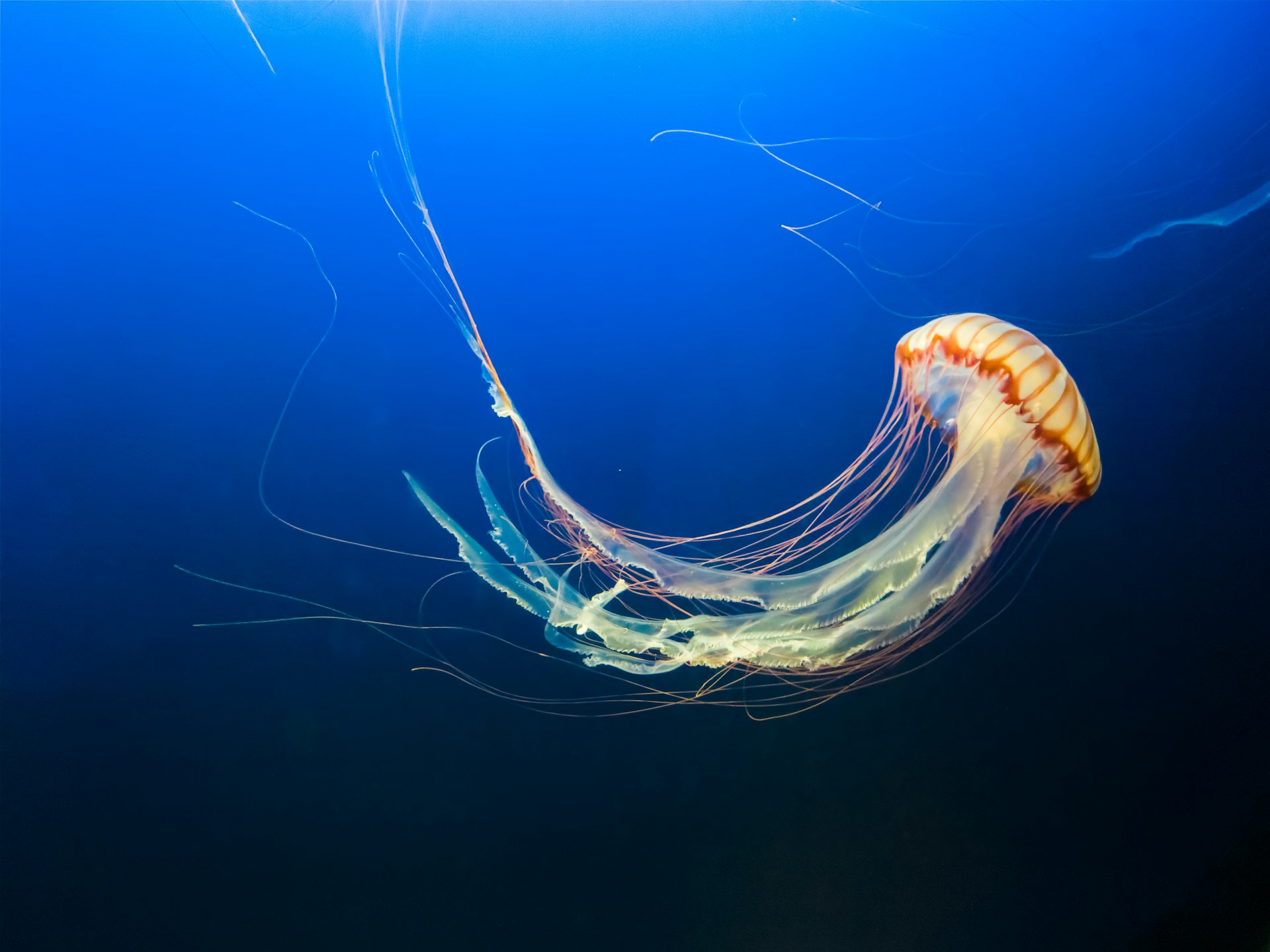
Imagine growing old, becoming physically damaged, or running out of food, only to discover that you possess a biological reset button. Instead of moving toward the end of your life, you could return to an earlier stage of your existence and begin again.
It sounds like something invented by a science-fiction writer who has spent too much time thinking about time travel, genetic engineering, and the secrets of the universe.
But deep in the world’s oceans, a tiny animal performs a version of this extraordinary biological trick.
Meet Turritopsis dohrnii, commonly known as the immortal jellyfish.
This remarkable creature is only a few millimeters across as an adult, making it small enough to fit comfortably on a fingernail. Yet its biological capabilities have attracted the attention of scientists investigating one of humanity’s oldest questions: Is it possible for an organism to reverse the aging process?
The answer, at least for this little jellyfish, is surprisingly complicated.
It does not possess an unlimited lifespan in the practical sense, and it can still be eaten by predators or die from disease and environmental damage. However, it has developed an extraordinary ability to reverse its normal life cycle under certain conditions.
In biological terms, it can transform from its adult jellyfish stage back into an earlier developmental stage, potentially beginning the process of producing a new generation of adult jellyfish all over again.
Think of it as pressing Ctrl + Z on a biological process.
Except that, unlike a computer program, this creature is rewriting the organization of living tissue.
And that is where the story becomes fascinating.
1. The Tiny Creature With an Extraordinary Secret
At first glance, Turritopsis dohrnii does not look particularly impressive.
It belongs to a group of animals called hydrozoans, relatives of other jellyfish that drift through marine environments. Its transparent body, delicate tentacles, and small size make it easy to overlook among the enormous variety of organisms living in the ocean.
There are no visible signs of extraordinary longevity. No protective armor. No giant brain. No complicated machinery.
Its remarkable ability is hidden inside its cells.
Most people understand the life cycle of a butterfly: an egg becomes a caterpillar, the caterpillar develops into a chrysalis, and eventually an adult butterfly emerges.
The adult does not normally transform back into a caterpillar.
The same general principle applies to many animals. Development proceeds through a series of stages, and an organism typically does not return to an earlier stage after reaching adulthood.
Turritopsis dohrnii, however, can break this pattern.
When exposed to certain forms of stress, physical damage, or unfavorable environmental conditions, it can undergo a transformation that takes it from its adult medusa stage back toward its juvenile polyp stage.
This ability is the reason scientists and science enthusiasts have given it the nickname immortal jellyfish.
The name is catchy, but the biology behind it is even more interesting.
The jellyfish is not simply repairing an injury or growing a replacement tentacle. Under the right circumstances, it is reorganizing its life cycle.
It is as though an animal that has already reached the final chapter of its development can reopen the book and return to an earlier chapter.
2. The Biological Reset Button
To understand how this works, we need to look at the jellyfish’s life cycle.
The adult jellyfish is known as a medusa. This is the familiar umbrella-shaped form that swims through the water and participates in reproduction.
Under suitable conditions, the jellyfish can produce offspring that develop into a larval stage. These larvae eventually settle on a surface and develop into polyps.
A polyp is a small, attached organism that resembles a tiny stalk with tentacles. Rather than swimming freely like an adult medusa, it remains attached to a surface and can produce new jellyfish through budding.
Normally, this process moves forward through a sequence of developmental stages.
But Turritopsis dohrnii has another option.
When the adult encounters certain stressful conditions, it can undergo a process that allows it to return to the polyp stage.
The transformation involves major changes in the animal’s body. Its medusa structure breaks down, its swimming capabilities disappear, and its tissues reorganize into a form capable of developing into a new polyp colony.
From there, the colony can produce new medusae.
The result is a remarkable loop:
Adult jellyfish → environmental stress → tissue transformation → polyp colony → new adult jellyfish.
The process does not mean that every individual jellyfish successfully reverses its life cycle whenever it encounters danger. The transformation depends on biological and environmental conditions, and many individuals will never complete it.
Nevertheless, the existence of this ability challenges the familiar assumption that reaching adulthood must always mean continuing toward irreversible biological decline.
For this animal, development can sometimes run in reverse.
3. Cellular Transdifferentiation: When Cells Change Their Jobs
The real scientific mystery lies in the behavior of its cells.
Your body contains many different types of cells. Muscle cells contract, nerve cells transmit signals, and epithelial cells form protective surfaces. Although these cells contain largely the same genetic information, they perform different functions because different sets of genes are active within them.
During development, cells become specialized for particular roles.
A cell that has developed into one specialized type does not ordinarily switch freely into another type whenever the body needs it.
Yet some organisms possess remarkable abilities to reorganize their tissues, and Turritopsis dohrnii is one of the most intriguing examples.
A process relevant to this transformation is called transdifferentiation.
Transdifferentiation occurs when a differentiated cell changes into another differentiated cell type without simply following the usual route through a pluripotent stem-cell state.
In the jellyfish’s life-cycle reversal, cellular reorganization and changes in cell identity help the animal transition from the adult medusa toward the polyp stage.
It is tempting to imagine that every cell in the animal becomes a completely blank stem cell, ready to transform into anything. That description, however, oversimplifies the biology.
The process involves multiple cellular and developmental changes, and researchers continue to investigate precisely how the transformation is regulated.
What makes it remarkable is that the animal can reorganize its existing biological structures into a different developmental form.
Consider a building constructed for one purpose. Its walls, electrical systems, plumbing, and rooms have been arranged to support a particular function. Transforming it into something completely different would require more than repainting the walls.
The underlying organization would have to change.
The jellyfish faces a comparable challenge on a biological scale. Its cells must change their behavior, its tissues must reorganize, and its body must establish the structures associated with a different stage of life.
This is not ordinary regeneration.
It is a much more fundamental transformation of developmental identity.
4. The Jellyfish’s Life Cycle, Explained Like a Computer System
If you are a software engineer, the immortal jellyfish presents an interesting way to think about biological systems.
Imagine an application that moves through several states.
It starts in an initial state, transitions into an active state, and eventually reaches a final state. Under normal conditions, the transitions follow a predefined sequence.
Now imagine that the system contains an unusual recovery mechanism. Under certain conditions, it can reconstruct an earlier state and resume operation from there.
That is a useful analogy for the jellyfish’s life-cycle reversal.
The medusa represents one developmental state. The polyp represents another. Under specific conditions, the organism can transition from the adult state back toward the polyp state, from which a new generation of medusae can emerge.
However, there is an important difference between a computer program and a living animal.
Software can sometimes restore a saved snapshot because the system’s state has been recorded. The jellyfish does not simply retrieve a perfect biological backup of its younger self.
Its cells actively participate in transforming the organism.
There is no literal undo button, no digital save file, and no evidence that the jellyfish remembers its former life in the way a person remembers childhood.
The analogy is useful because it illustrates something important: a system’s current state does not always determine the only possible path forward.
In biology, developmental pathways can sometimes be more flexible than they initially appear.
For a creature this small, that flexibility is extraordinary.
5. Is It Really Immortal?
Here is where the story becomes even more interesting.
The word immortal makes people imagine an animal that can live forever, survive every injury, and remain unaffected by the passage of time.
That is not what scientists mean when they describe Turritopsis dohrnii as biologically immortal.
Its unusual ability refers to the potential to reverse its life cycle and return to an earlier developmental stage under suitable conditions.
It does not make the animal invulnerable.
A jellyfish can still be eaten by a predator. It can still succumb to disease, suffer fatal damage, or fail to survive an unsuitable environment. Its ability to reverse development does not guarantee that every individual will repeat the process indefinitely.
Think of it this way: a system might have a powerful recovery feature without being immune to every possible failure.
A computer with automatic recovery can still lose power, suffer hardware damage, or encounter problems that recovery cannot solve.
Likewise, the immortal jellyfish possesses an unusual biological capability, not a guarantee of endless survival.
Scientists also cannot assume that an individual jellyfish has repeatedly reversed its life cycle indefinitely simply because the species can perform the transformation.
The distinction matters because the biological phenomenon is fascinating enough without exaggeration.
The real discovery is not that an animal has defeated death in every possible form. It is that a normally adult animal can, under certain circumstances, return to an earlier developmental stage.
That alone is a remarkable exception to the developmental patterns commonly observed in animals.
6. Nature’s Other Biological Superheroes
The immortal jellyfish is not the only organism with an extraordinary survival strategy.
Nature has spent millions of years experimenting with different ways to survive environmental challenges. The results include animals that tolerate extreme dehydration, regenerate lost body parts, and repair damaged tissues with astonishing efficiency.
Consider a few examples.
The tardigrade: A microscopic survival specialist
Tardigrades, sometimes called water bears, are tiny animals known for their ability to survive extreme environmental conditions.
When conditions become unfavorable, certain species can enter a dormant state called cryptobiosis. Their metabolism becomes extremely limited, allowing them to withstand conditions that would normally be lethal to active organisms.
Depending on the species and circumstances, tardigrades have demonstrated remarkable tolerance to dehydration, extreme cold, and radiation. Some have also survived exposure to the vacuum of space under experimental conditions.
However, they are not indestructible. Their survival depends on the conditions involved, and extreme heat, among other hazards, can kill them.
Their specialty is surviving difficult conditions by entering a state of suspended activity rather than reversing their entire life cycle.
The planarian flatworm: A regeneration expert
Certain planarian flatworms can regenerate remarkably well after being cut into pieces.
Some fragments can develop into complete worms, provided they contain the necessary cells and the conditions are suitable.
These animals possess populations of adult stem cells called neoblasts, which contribute to tissue replacement and regeneration.
Researchers study planarians to understand how organisms coordinate cell division, tissue formation, and body-pattern reconstruction.
Unlike the immortal jellyfish, whose extraordinary feature is developmental reversal, planarians are especially famous for their regenerative capabilities.
Their bodies demonstrate that biological structures can sometimes be rebuilt from a surprisingly small amount of surviving tissue.
The axolotl: The master of limb regeneration
The axolotl, an aquatic salamander, is another remarkable example.
It can regenerate entire limbs, including bones, muscles, nerves, and other tissues. It can also repair certain other structures, making it valuable to scientists investigating regeneration.
Following an injury, cells near the damaged area participate in forming a structure known as a blastema, which helps generate replacement tissues.
Researchers are studying the molecular signals and cellular processes involved in this ability.
The ultimate goal is to understand how regeneration works, although translating discoveries from axolotls into human medical treatments remains a complex scientific challenge.
Each of these organisms illustrates a different biological possibility.
The tardigrade can endure extreme conditions. The planarian can rebuild substantial portions of its body. The axolotl can regenerate complex structures. The immortal jellyfish can reverse its life cycle.
Nature does not rely on a single strategy for survival.
It has developed an extraordinary collection of solutions.
7. Could Humans Ever Learn to Reverse Aging?
This is the question that makes the immortal jellyfish especially interesting to researchers studying aging.
If an animal can reverse its developmental state, could scientists eventually discover biological mechanisms that help human cells repair damage, maintain their function, or recover from certain forms of deterioration?
The possibility is intriguing, but the answer requires caution.
Human aging is a complex process involving many interacting factors. These include accumulated cellular damage, changes in gene regulation, declining function in certain stem-cell populations, and alterations in tissues and organs.
The jellyfish’s life-cycle reversal is not equivalent to reversing human aging.
The two organisms have very different bodies, developmental pathways, and biological requirements.
A process that works in a tiny marine invertebrate cannot simply be copied into a human body.
Nevertheless, studying unusual organisms can help scientists identify biological mechanisms that might otherwise remain undiscovered.
Researchers investigating Turritopsis dohrnii can examine how cells change identity, how developmental programs are regulated, and how tissues reorganize during the transition from medusa to polyp.
These questions overlap with broader research into cellular reprogramming, regeneration, and aging.
Scientists have already demonstrated that certain mature cells can be reprogrammed into induced pluripotent stem cells under carefully controlled laboratory conditions. Such cells can acquire the ability to develop into many different cell types.
However, cellular reprogramming is not the same thing as making an entire human body younger, and it presents significant challenges involving safety, control, and the risk of abnormal cell growth.
The immortal jellyfish does not provide a ready-made recipe for human immortality.
Instead, it offers a valuable biological comparison that may help researchers better understand what cells are capable of doing.
Sometimes, learning from an unusual organism does not immediately produce a medical breakthrough. It provides a new question, a new hypothesis, or a new direction for investigation.
Those discoveries can still be scientifically important.
8. What Makes This Creature So Important?
The immortal jellyfish challenges the idea that an organism’s life cycle must always move in one direction.
For many animals, development follows a familiar sequence: birth, growth, maturity, aging, and death.
Turritopsis dohrnii demonstrates that this sequence can be more flexible in some organisms.
Its life-cycle reversal also raises questions about how cells maintain their identities, how developmental programs are controlled, and how biological systems respond to stress.
These are not merely questions about one small jellyfish.
They connect to wider areas of research, including developmental biology, stem-cell science, regeneration, and the evolution of aging.
The animal also reminds us that biological complexity does not always correspond to physical size.
A creature only a few millimeters across can possess a capability that challenges our assumptions about how living organisms develop.
It does not need a large brain or an elaborate nervous system to perform this extraordinary transformation. Its cells and developmental mechanisms are sufficient to produce a process that scientists are still working to understand in detail.
That is one of the most fascinating aspects of biology: remarkable capabilities can emerge from systems that look deceptively simple.
9. The Ocean Still Has More Secrets to Reveal
The oceans contain an astonishing diversity of life, from microscopic organisms living in sediments to enormous animals moving through open water.
Many of these organisms possess adaptations that seem almost impossible until scientists investigate how they work.
The immortal jellyfish is a particularly memorable example because its ability touches on something humans have wondered about for centuries: whether the biological processes associated with aging and development can be reversed.
Its answer is neither a simple yes nor a simple no.
It cannot guarantee eternal life. It cannot escape every threat. It does not offer a shortcut to human immortality.
But it can perform something extraordinary: under suitable conditions, it can reverse its normal life cycle and return from the adult medusa stage toward the polyp stage.
That makes it an important subject for scientific investigation and a reminder that the rules we associate with life are sometimes more flexible than they appear.
The next time you imagine the most impressive survival mechanisms in nature, you might picture a giant whale, a powerful crocodile, or an animal capable of surviving extreme cold.
But somewhere in the ocean, a nearly transparent creature only a few millimeters across may be doing something even stranger.
It is reorganizing its own biological existence.
Not through magic. Not through technology. Not through a futuristic machine capable of turning back time.
Through the extraordinary capabilities of living cells.
And perhaps that is the most fascinating part of the entire story.
The immortal jellyfish has not solved every mystery of life, but it has revealed a possibility that makes scientists look more closely at the biology of aging, development, and regeneration.
In a universe filled with complex systems, sometimes the most astonishing discoveries come from the smallest places.
Software in My Mind. Rock in My Soul. And somewhere beneath the ocean’s surface, biology is running a program that still has plenty of secrets left to reveal.


