The Opportunity Visibility Hypothesis
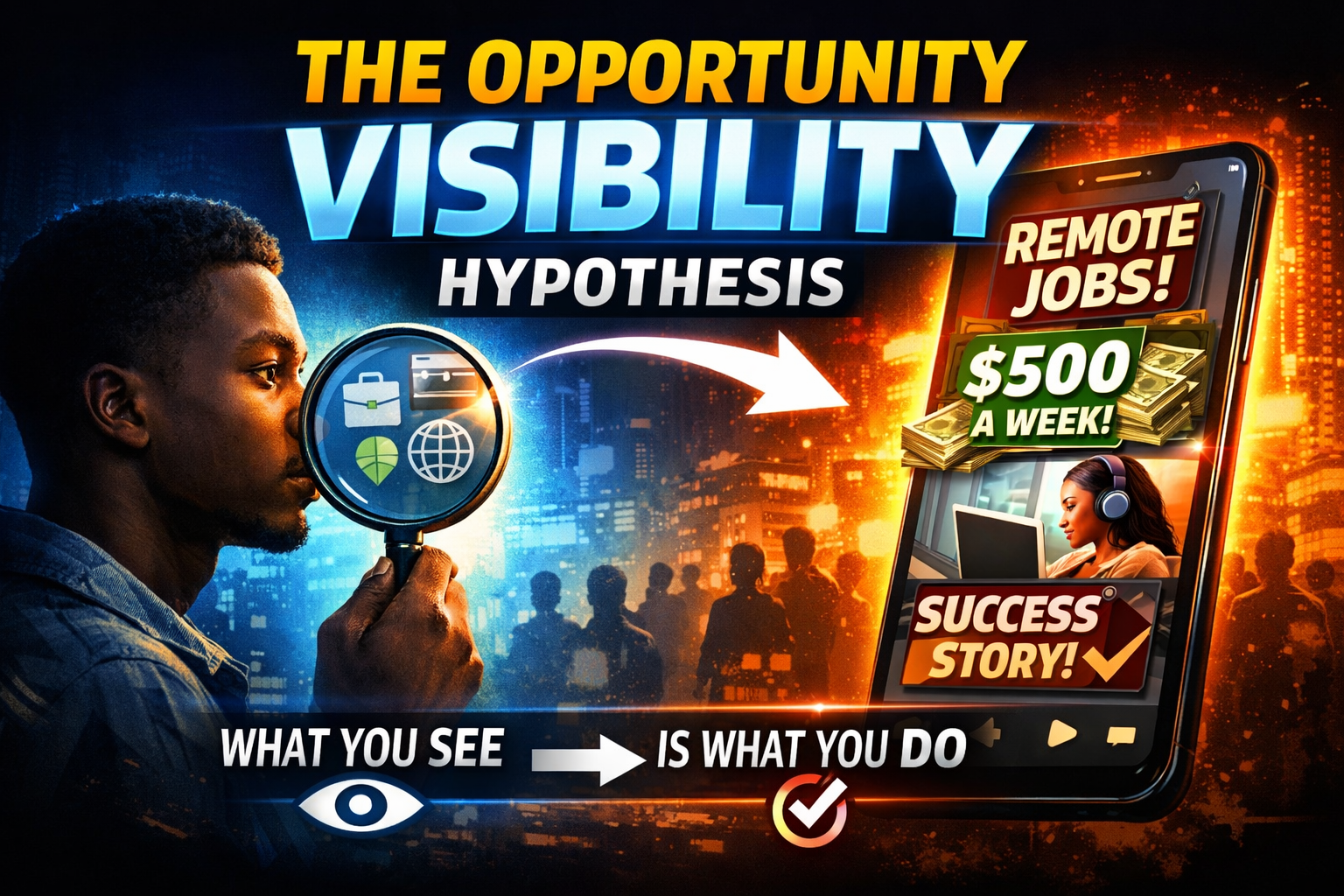
Why What You See Shapes What You Become
There is a quiet lie most of us grow up believing.
It sounds intelligent. It sounds logical. It even sounds like something an economist in a suit would say on TV.
“If opportunities exist, people will find them.”
Clean. Rational. Beautiful.
And completely disconnected from reality.
Because if that were true, then a young man in Ndola with a smartphone and internet access would be swimming in global opportunities. He would be freelancing for companies in Berlin, building apps for startups in San Francisco, trading stocks in Tokyo, and learning AI from open-source communities.
But that’s not what happens.
Instead, he scrolls. He watches. He laughs. He sleeps.
Not because he’s lazy.
But because the opportunities—though real—are invisible.
The Core Idea: Visibility > Availability
The Opportunity Visibility Hypothesis flips a foundational assumption in economics:
People don’t act based on available opportunities.
They act based on visible opportunities.
Let that sink in.
This isn’t about poverty.
This isn’t about intelligence.
This isn’t even about access.
It’s about exposure.
The Broken Assumption of Classical Economics
Traditional economics—especially Information Economics—rests on a quiet belief:
If information exists, rational agents will use it.
This is the same intellectual DNA behind models that assume people compare all options, weigh outcomes, and make optimal decisions.
But reality feels different.
In reality:
- People don’t search exhaustively
- People don’t process everything
- People don’t optimize
People react.
And what do they react to?
What they see.
Repeatedly.
Emotionally.
Socially.
The Street-Level Truth
Walk through Ndola.
Sit at a bus stop. Listen to conversations. Watch what people talk about.
You’ll notice something subtle but powerful:
People don’t talk about everything they could do.
They talk about:
- What someone just did
- What is trending
- What keeps appearing on their phone
- What looks achievable because others are doing it
That’s visibility.
Not availability.
The TikTok Experiment Nobody Designed
Let’s run a thought experiment.
Scenario A:
There are 1,000 remote jobs available online.
They exist on job boards.
They are real.
They are accessible.
But no one around you talks about them.
You never see someone from your environment doing them.
They don’t show up on your feed.
Result?
Nothing happens.
Scenario B:
There are 10 remote jobs.
But:
- You see TikToks about them every day
- You see someone in Lusaka saying “I made $500 this week”
- You see tutorials
- You see screenshots
- You see lifestyle upgrades
Result?
Explosion.
Suddenly:
- Everyone is searching “how to start remote work”
- People are learning skills
- Telegram groups form
- Friends start discussing it
- Momentum builds
The difference?
Not opportunity.
Visibility.
The Psychology of Repetition
Humans are not rational calculators.
We are pattern-recognition machines.
What we see repeatedly becomes:
- Normal
- Possible
- Desirable
This is deeply tied to behavioral economics—ideas explored by thinkers like Daniel Kahneman—who showed that humans rely on mental shortcuts (heuristics) rather than pure logic.
One of those shortcuts is simple:
If I keep seeing it, it must matter.
Another:
If people like me are doing it, I can do it too.
Visibility creates perceived feasibility.
And perceived feasibility drives action.
The Invisible Opportunity Problem
Here’s the uncomfortable truth:
Africa does not lack opportunity as much as it lacks visible opportunity loops.
The internet has already solved access.
- Free courses exist
- Remote jobs exist
- Global marketplaces exist
- Funding opportunities exist
But they are scattered.
Hidden.
Unrepeated.
Unamplified.
So they don’t enter the average person’s mental world.
And if something never enters your mental world…
…it might as well not exist.
The Attention Economy Is the Real Economy
We like to think the economy is about money.
It’s not.
It’s about attention.
Platforms like TikTok and YouTube have already figured this out.
They don’t just show you content.
They repeat content patterns until they shape your beliefs.
That’s why:
- One viral niche creates millions of creators
- One trend creates entire industries
- One story creates mass imitation
Now imagine applying that same mechanism…
…but instead of dances and memes…
…it’s opportunities.
Opportunity as a Feedback Loop
Visibility doesn’t just inform.
It compounds.
Here’s how:
- Initial Exposure
You see someone making money online. - Repetition
You see it again. And again. And again. - Normalization
It stops feeling rare. - Social Proof
Others around you start talking about it. - Action
You try it. - Amplification
You post your results. - Loop Expansion
More people see it.
This is not a linear process.
It’s a network effect.
And once it starts, it becomes unstoppable.
Why This Hypothesis Is Powerful
This idea doesn’t just tweak economics.
It challenges its core.
1. It Rewrites Information Theory
Traditional view:
Information availability = informed decisions
New view:
Information visibility = behavioral activation
That’s a fundamental shift.
2. It Bridges Behavioral Economics
The hypothesis aligns with real human behavior:
- Limited attention
- Social influence
- Emotional decision-making
It doesn’t assume rationality.
It assumes humanity.
3. It Explains Unequal Outcomes
Why do two people with the same internet access end up in different worlds?
Because:
- One sees coding tutorials daily
- The other sees entertainment content
Same access.
Different visibility.
Different life trajectory.
4. It Is Testable
This is where it becomes scientifically dangerous—in a good way.
You can test it.
You can measure it.
You can prove it.
How You Could Test It (Real-World Experiment)
If you wanted to turn this into a Nobel-level paper, you wouldn’t just theorize.
You’d build.
Step 1: Create Two Groups
- Control Group
Normal internet usage - Test Group
A platform where opportunities are repeatedly shown
Step 2: Control Visibility
For the test group:
- Show the same opportunities daily
- Use different formats (videos, testimonials, guides)
- Highlight success stories
- Create social proof
Not more opportunities.
Just more visibility.
Step 3: Measure Behavior
Track:
- Applications submitted
- Skills learned
- Income changes
- Time spent exploring opportunities
Step 4: Compare Outcomes
If the hypothesis holds:
The visibility group will outperform the control group—even if both had access to the same opportunities.
That’s the breakthrough.
The Bigger Implication: You Can Engineer Mobility
This is where things get serious.
If visibility drives action…
Then economic mobility is not just about creating jobs.
It’s about making opportunities impossible to ignore.
Governments could:
- Broadcast opportunities daily
- Create national visibility campaigns
- Partner with influencers
Startups could:
- Build “opportunity feeds” instead of social feeds
- Gamify exposure
- Create viral loops around opportunity
Individuals could:
- Curate their feeds intentionally
- Follow opportunity-focused content
- Surround themselves with visibility
The Dangerous Side of Visibility
But there’s a darker truth.
Visibility doesn’t care what it amplifies.
If you repeatedly see:
- Gambling wins
- Fake lifestyles
- Shortcuts
- Scams
Those become:
- Normal
- Desirable
- Actionable
So the same mechanism that can lift millions…
…can also trap them.
The Ndola Thought Experiment
Imagine two versions of Ndola.
Ndola A:
- People see mostly entertainment
- Opportunities are scattered
- No consistent exposure
Outcome:
- Low experimentation
- Slow mobility
Ndola B:
- Every phone shows:
- Remote jobs
- Business ideas
- Real success stories
- Step-by-step guides
Repeatedly.
Daily.
Relentlessly.
Outcome:
- New behaviors
- New conversations
- New identities
- New economy
Same city.
Same people.
Different visibility.
Different future.
The Personal Level: Your Feed Is Your Fate
This hypothesis isn’t just academic.
It’s personal.
Your life is quietly shaped by:
- What you scroll
- What you watch
- What you see repeatedly
If your feed is:
- Drama → you think life is chaos
- Luxury → you think life is about consumption
- Opportunities → you think life is about creation
So the question becomes:
What are you making visible to yourself?
Because that’s what you will eventually act on.
The Final Insight
Opportunities don’t change lives.
Visible opportunities do.
Not because they are better.
But because they enter the human mind.
And once something enters the mind repeatedly…
…it becomes a path.
A Simple, Dangerous Equation
You can reduce the entire hypothesis to this:
Action ≈ Visibility × Repetition
Not availability.
Not even quality.
Visibility.
Repeated over time.
Why This Could Be Nobel-Level
Because it doesn’t just describe behavior.
It offers a lever.
A small change (visibility) that creates massive outcomes (mobility).
That’s what the most powerful theories do.
They reveal:
Where tiny inputs create disproportionate outputs.
And once you see it…
You can’t unsee it.
Closing Thought
There are people right now, sitting in rooms just like yours.
Same internet.
Same country.
Same starting point.
But they are living in a completely different economic reality.
Not because they are smarter.
Not because they are luckier.
But because they saw something…
…enough times…
…to believe it was real.
And once they believed it was real—
They acted.
So maybe the question is not:
“What opportunities exist?”
Maybe the real question is:
“What opportunities are you being shown… again and again… until you can no longer ignore them?”
Because that’s the one that will change your life.