The Trap of Small Thinking in Small Economies
There is a quiet lie that circulates in small economies. It is not spoken loudly, not declared in policy, not written in textbooks—but it lives in conversations, in choices, in the invisible boundaries people place around their own potential.
It sounds like this: “This is enough.”
Enough ambition. Enough innovation. Enough growth. Enough dreaming.
In places where the economy itself feels limited—where industries are narrow, opportunities feel scarce, and capital seems distant—people begin to unconsciously shrink their thinking to match the environment. Not because they lack intelligence. Not because they lack creativity. But because they have been conditioned to believe that scale does not belong to them.
And that is where the trap begins.
The Environment Becomes the Ceiling
In a small economy, the most dangerous thing is not poverty. It is psychological containment.
You grow up seeing a limited number of success paths. A few professions dominate the narrative—teacher, banker, civil servant, maybe entrepreneur if you are “brave.” The businesses around you are small. The brands are local. The markets are predictable.
So your mind adapts.
You stop asking, “How big can this be?”
And instead ask, “What is realistic here?”
But realism, in this context, is often just disguised fear reinforced by environment.
If the largest company you’ve ever seen operates in one city, then building a company across Africa feels abstract. If no one around you is exporting technology, then building global software sounds like fantasy. If capital is hard to access locally, you start assuming it doesn’t exist at all.
The environment doesn’t just shape your opportunities—it shapes your imagination.
And once imagination is limited, everything else follows.
Small Thinking Feels Practical
The most deceptive part of small thinking is that it feels responsible.
It sounds like:
- “Let me just start something small.”
- “Let me focus on survival first.”
- “This market is not ready for that.”
- “People here can’t afford it.”
These statements are not entirely wrong. That’s why they are dangerous.
They are grounded in partial truth, but they ignore a deeper reality: markets do not grow unless someone builds beyond them.
Every large market today was once a small one. Every global company started in an environment that didn’t fully support its ambition. But someone chose to think beyond the visible constraints.
Small thinking convinces you to optimize for what exists.
Big thinking forces you to build for what could exist.
And the difference between the two is the difference between stagnation and transformation.
The Poverty of Expectation
In many small economies, people don’t just lack resources—they lack exposure.
If you’ve never seen a billion-dollar company being built, your brain struggles to conceptualize it. If you’ve never interacted with global markets, you assume everything must remain local. If your network is limited, your ideas begin to shrink to fit the expectations of those around you.
You start designing your life around what others have already done.
This creates a poverty of expectation.
Not financial poverty—but something deeper.
You don’t expect scale.
You don’t expect global relevance.
You don’t expect exponential outcomes.
So even when opportunities appear, you approach them cautiously, sometimes even suspiciously, because they don’t align with your internal model of what is “normal.”
And so you self-reject before the world ever has a chance to reject you.
Survival Mode vs Expansion Mode
Small economies often push people into survival mode.
You focus on:
- Paying bills
- Securing stable income
- Minimizing risk
- Avoiding failure
These are valid concerns. But survival mode has a hidden cost: it suppresses expansion thinking.
When your primary goal is stability, you stop experimenting.
When your focus is safety, you avoid bold moves.
When your mindset is scarcity, you struggle to see abundance.
And yet, the paradox is this:
The very thing that could lift you out of survival mode—bold, expansive thinking—is the thing survival mode discourages.
So people remain stuck.
Not because they lack ability, but because their thinking is optimized for staying afloat, not for breaking through.
The Geography Illusion
There is another illusion that reinforces small thinking: the belief that geography defines possibility.
You hear it often:
- “That works in America, not here.”
- “That’s for Europe, not us.”
- “Our market is different.”
And yes, markets are different. Context matters. Culture matters. Infrastructure matters.
But the core principles of value creation do not change.
People everywhere want:
- Convenience
- Efficiency
- Entertainment
- Connection
- Solutions to problems
The mistake is assuming that because the environment is different, the ceiling must also be lower.
In reality, constraints often create unique opportunities.
A small economy is not just limited—it is also less saturated. There are gaps everywhere. Inefficiencies everywhere. Problems waiting to be solved.
But you only see them if you are thinking expansively.
The Danger of Local Validation
In a small economy, it is easy to become “big” locally.
You can build a decent business, gain some recognition, make a comfortable living—and suddenly, you are seen as successful.
And there is nothing wrong with that.
But local success can become another trap.
Because once you are validated by your immediate environment, the pressure to grow beyond it disappears.
You stop pushing boundaries.
You stop exploring new markets.
You stop questioning your own limits.
You become a big fish in a small pond—and convince yourself that the pond is the ocean.
Thinking Beyond the Market You’re In
Escaping small thinking does not mean ignoring your environment. It means refusing to be defined by it.
It means asking different questions:
- Not “What can I build here?” but “What can I build that reaches beyond here?”
- Not “What do people around me expect?” but “What does the global market need?”
- Not “What is possible in this economy?” but “What is possible, period?”
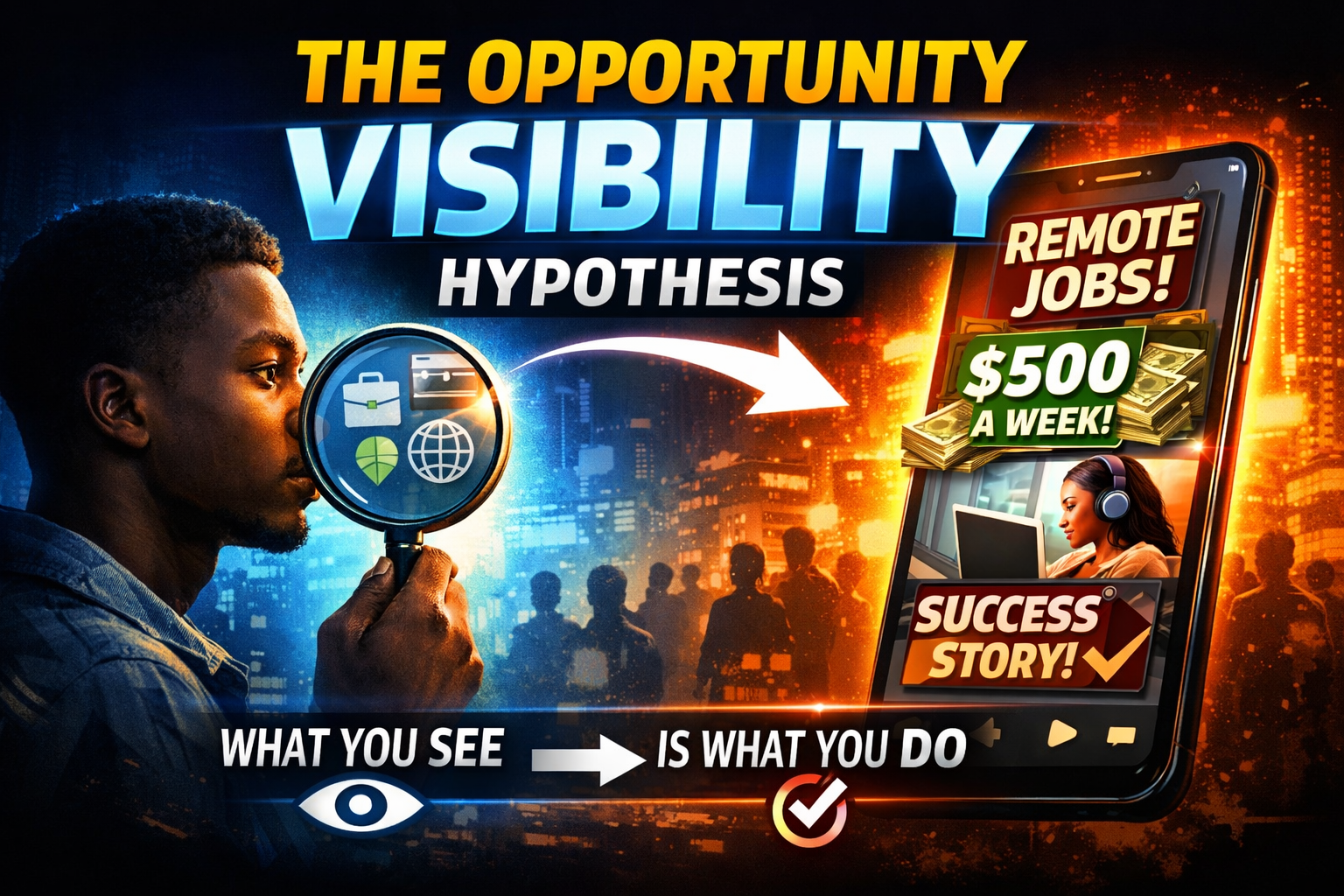
The internet has already broken many of the traditional barriers.
You can:
- Build software used globally
- Create content consumed worldwide
- Access knowledge from anywhere
- Collaborate across borders
The limitation is no longer purely external. It is increasingly internal.
The Courage to Look Ridiculous
Big thinking in a small economy often looks unrealistic.
People may not understand your vision.
They may question your goals.
They may even mock your ambition.
Because your thinking does not match the environment.
But that is precisely the point.
If your vision fits perfectly within your environment, it is probably too small.
Every meaningful leap requires a period where you look out of place.
Where your ideas seem too big.
Where your goals feel distant.
Where your path is unclear.
That discomfort is not a sign that you are wrong.
It is often a sign that you are thinking beyond the default boundaries.
Building New Realities
The truth is, small economies do not stay small forever.
They evolve when individuals begin to think differently.
When someone builds something that scales beyond borders.
When someone introduces a new model.
When someone refuses to accept the limitations as permanent.
Change does not start at the macro level.
It starts with individual minds refusing to shrink.
The companies that redefine economies are not built by people who think locally.
They are built by people who see globally—even when they are physically local.
The Real Constraint
At the end of it all, the biggest constraint is not capital. Not infrastructure. Not policy.
It is perception.
What you believe is possible determines what you attempt.
What you attempt determines what you build.
What you build determines what becomes real.
Small thinking is not just a mindset—it is a self-fulfilling system.
It limits action.
Action limits outcomes.
Outcomes reinforce the belief that limits are real.
Breaking that cycle requires something simple, but not easy:
You have to think beyond what you can currently prove.
Final Thought
A small economy is a context—not a destiny.
It can shape your starting point, but it does not have to define your endpoint.
The real danger is not being in a small market.
It is allowing that market to shrink your imagination.
Because once your thinking becomes small, everything else follows.
And once your thinking expands, the world—regardless of where you start—becomes a lot bigger than it first appeared.